
Agility Opens Fremont Physical-AI Hub to Expand Digit’s Skills
Agility Robotics has opened a 60,000-square-foot facility in Fremont, California, dedicated to software and capabilities development for its Digit humanoid. The hub aims to bridge the gap between manufactured hardware and customer-ready operational skills.
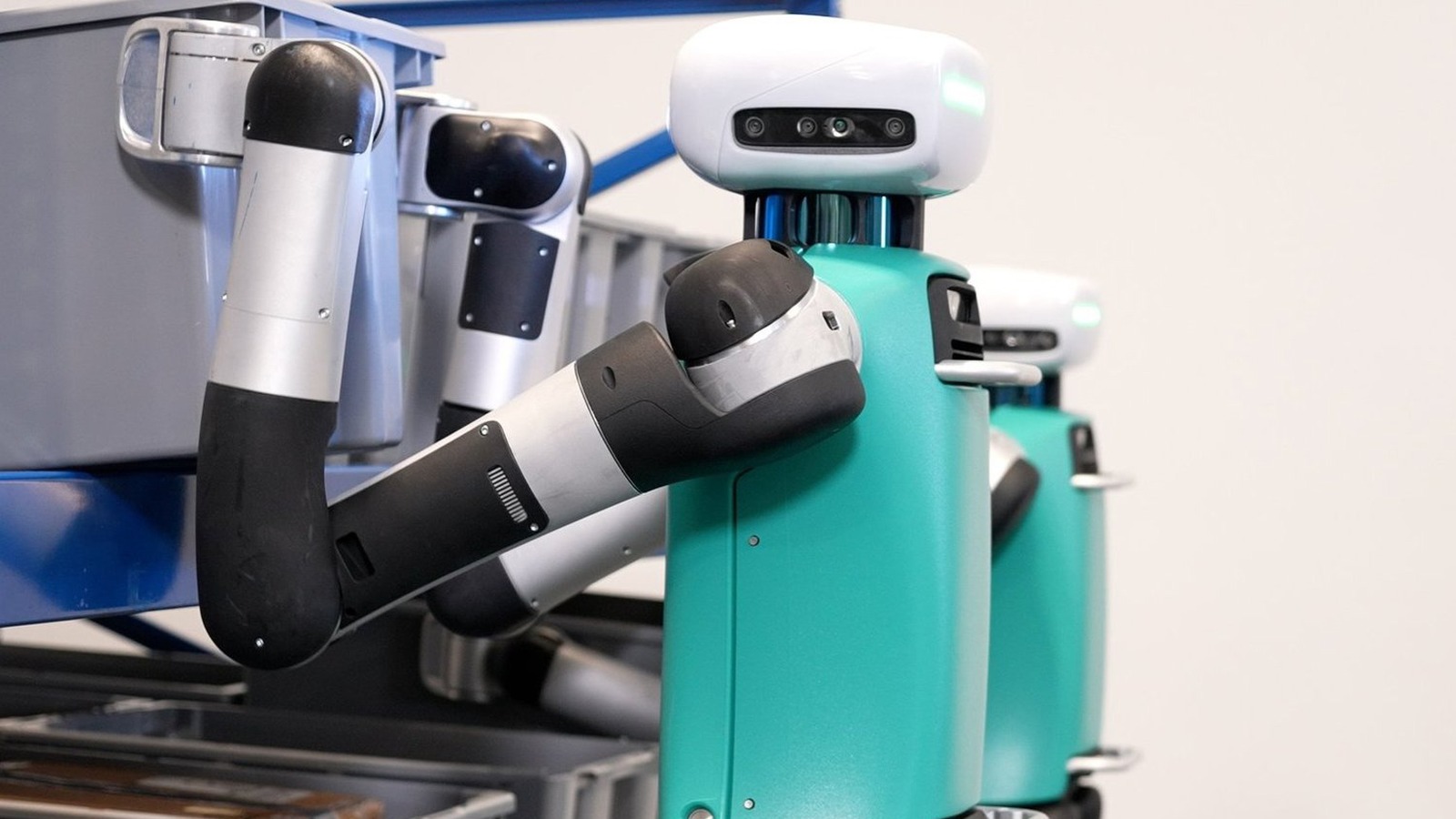
The humanoid robotics sector is confronting a critical bottleneck where manufacturing capacity outpaces the software capabilities required for real world deployment. Agility Robotics, a United States based humanoid robotics and Physical AI company, has opened a 60,000 square foot facility in Fremont, California, to address this exact constraint. The new hub is dedicated entirely to software and capabilities development, focusing on training the Digit humanoid to perform sophisticated tasks in customer environments. While the company has secured more than US$300 million in multi year orders for its Digit v5 model, these orders remain subject to contractual milestones, making the Fremont facility the linchpin for converting a disclosed pipeline into repeatable customer operations.
The Operational Execution Challenge
The fundamental challenge in commercializing humanoid robots is no longer building the hardware, but rather developing the Physical AI required to operate reliably in unstructured environments. Agility Robotics is expanding its physical footprint ahead of a planned public listing via a business combination with Churchill Capital Corp XI, aiming to become the first publicly listed United States pure play humanoid robotics company. The Fremont facility represents a strategic shift toward software execution, acknowledging that the gap between a manufactured robot and a customer ready solution is entirely defined by AI capabilities.
The new hub will serve as the center where engineering teams train, test, and advance the AI technologies that enable Digit to learn new skills. This facility complements the existing RoboFab manufacturing operations in Salem, Oregon. By separating hardware production from software capability development, Agility Robotics is structuring its operations to solve the two distinct problems of scale: building enough robots and making those robots useful. The company plans to hire nearly 200 professionals across AI and machine learning software engineering, as well as field operations, to staff the Fremont location.
The decision to locate this hub in Fremont places Agility Robotics in the center of the San Francisco Bay Area talent pool, which is essential for recruiting the specialized AI engineers required to solve these complex problems. The competition for talent in Physical AI is intense, and establishing a dedicated facility signals a commitment to building the internal capabilities necessary to deliver on customer expectations. This move also reflects a broader industry trend where hardware companies are increasingly recognizing that their long term value lies in the software that controls their machines.
What role will Agility’s Fremont hub play in Digit deployments?
Agility Robotics opened a 60,000 square foot facility in Fremont, California, on July 16, 2026, to serve as a dedicated software and capabilities hub. The facility focuses on advancing Physical AI to train the Digit humanoid for sophisticated tasks, complementing the company's hardware manufacturing operations in Oregon.
Bridging the Gap Between Hardware and Capability
To understand the significance of the Fremont facility, consider the difference between buying a computer and hiring an employee. When a company buys a computer, it expects to install software to make it useful. When a company hires an employee, it expects that person to arrive with the ability to learn and execute specific tasks. Humanoid robots sit between these two paradigms. The hardware is the computer, but the Physical AI is the employee's ability to learn. The Fremont hub is essentially a training academy where Digit learns the specific skills required by logistics and manufacturing customers before being deployed to their facilities.
This training process is not a simple matter of programming a robot to perform a repetitive motion. It requires the development of generalized capabilities that allow the robot to adapt to variations in its environment. For example, a robot tasked with moving boxes must be able to handle boxes of different sizes, weights, and orientations, even if they are not perfectly aligned on a pallet. It must also be able to navigate around obstacles, including human workers, without causing disruption or safety hazards. These are the types of challenges that the engineering teams in Fremont will be working to solve.
The hard truth of the humanoid robotics market is that impressive hardware demonstrations do not equate to operational readiness. Many observers focus on the physical capabilities of robots, such as payload capacity or battery life, assuming that better hardware will naturally lead to wider adoption. However, the true constraint is the software's ability to handle the infinite edge cases of a real world warehouse or factory. A robot that can lift a box in a controlled laboratory may fail when confronted with variable lighting, irregular packaging, or human coworkers. The Fremont facility is designed to solve these software edge cases, which are the actual barriers to scaled deployment.
Customer Deployment and the Order Book Reality
Agility Robotics has established active humanoid deployments with major operators including Schaeffler, GXO, Toyota Motor Manufacturing Canada, and Mercado Libre. These deployments provide the real world data necessary to inform the software development at the Fremont hub. The company reports a growing pipeline of over 30 customers, indicating strong demand for automated solutions in logistics and manufacturing sectors.
These early deployments are critical for understanding the operational friction that occurs when robots are introduced into existing workflows. The data gathered from these sites will be fed back into the training models at the Fremont facility, creating a continuous loop of improvement. This iterative process is essential for developing the robust capabilities required for broader commercialization. The integration of real world data into the training process ensures that the capabilities developed in Fremont are directly applicable to the challenges faced by customers.
However, the commercial reality is nuanced. The company has secured more than US$300 million of multi year orders for the Digit v5 model, but these orders are explicitly subject to the realization of certain contractual milestones. This conditional structure highlights the importance of the Fremont facility. The revenue is not guaranteed by the hardware alone; it is contingent on the robot's ability to perform the required tasks reliably. The software capabilities developed in Fremont are the key to unlocking the value of the order book.
"The facility matters only if it closes the gap between manufactured robots and customer-ready skills, making execution the core lens."
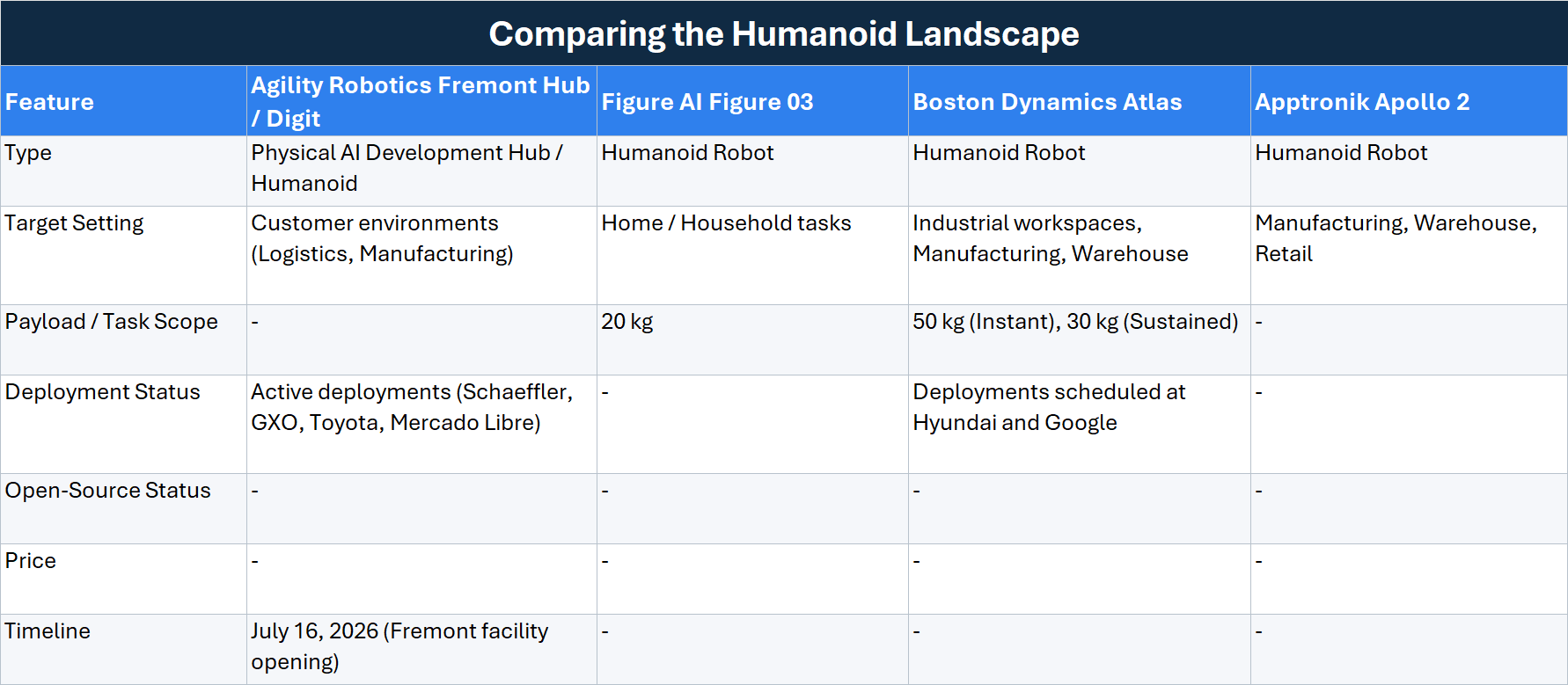
Comparing the Humanoid Landscape
The humanoid robotics market is increasingly defined by the specific environments and tasks each company targets. The following table outlines the current landscape based on available data.
Contract Milestones Put Software Execution Ahead of Fleet Size
For procurement teams and operations leaders, the opening of the Fremont facility signals a maturation in the humanoid robotics market. Vendors are moving beyond hardware specifications and focusing on the software capabilities that drive return on investment. When evaluating humanoid solutions, buyers must assess not only the physical robot but also the vendor's infrastructure for developing and deploying Physical AI.
The conditional nature of Agility Robotics' order book provides a template for how automation buyers should structure their procurement contracts. Tying multi year orders to specific performance milestones ensures that the vendor remains incentivized to solve the operational edge cases that inevitably arise during deployment. The Fremont hub represents Agility Robotics' investment in meeting those milestones, but the burden remains on the vendor to prove that the software can deliver the promised capabilities in unstructured environments.
For buyers, that makes capability acceptance criteria more important than headline fleet commitments. A useful evaluation should connect each contracted milestone to a defined task, operating environment, safety process, exception-handling procedure, and evidence of sustained execution. The facility opening demonstrates added development capacity, but customer acceptance will still depend on performance at the deployment site rather than work completed in Fremont.
Furthermore, the separation of hardware manufacturing and software development highlights the complexity of building a complete humanoid solution. Buyers should be wary of vendors that claim to have solved both problems simultaneously without demonstrating significant investment in both areas. The ability to scale hardware production is distinct from the ability to develop robust AI capabilities, and both are necessary for successful deployment. The establishment of dedicated facilities for each function suggests a more realistic approach to commercialization.
The success of the Fremont facility will be measured not by the sophistication of the AI models developed there, but by the reliable execution of tasks in customer facilities. As the industry transitions from hardware development to software execution, the ability to rapidly train and deploy new skills will become the primary competitive advantage.
This analysis synthesizes company statements and public market information.
Disclaimer: This article is provided for informational purposes only and does not constitute investment, financial, legal, procurement, or other professional advice. Readers should verify specifications, pricing, availability, regulatory requirements, and commercial terms directly with the relevant company or authority before making decisions.














