Embodied AI Startup Noematrix (Qiongche Intelligence) Closes New Round of Hundreds of Millions RMB
Shanghai-based embodied AI company Qiongche Intelligence (穹彻智能, operating internationally as Noematrix) has closed a new funding round of several hundred million RMB — its seventh since founding in late 2023. The round was led by the Shanghai Jiao Tong University AI Future Fund, with participation from Wuxi Data Group and Yicun Capital, bringing the company's cumulative fundraising to over RMB 1 billion.
Noematrix was founded in November 2023 by two co-founders whose credentials span the highest levels of academic research and real-world robotics commercialization. Professor Lu Cewu (卢策吾) is a postdoctoral alumnus of Stanford University's Artificial Intelligence Laboratory, where he studied under Fei-Fei Li and Leo Guibas, 2 of the most cited figures in computer vision and 3D scene understanding globally. He returned to China in 2016 and is currently Deputy Dean and Professor at Shanghai Jiao Tong University's School of Artificial Intelligence. He is the only recipient of the Science Exploration Award in the embodied intelligence field, has been named to MIT Technology Review's TR35 list, and received the Wu Wenjun Natural Science First Prize. His AnyGrasp grasping algorithm, developed prior to founding Noematrix, became one of the most widely adopted open-source robotic grasping systems in the world.
The second co-founder, Dr. Wang Shiquan (王世全), brings a decade of robotics commercialization experience. A graduate of Zhejiang University and Stanford University's Bionics and Dexterous Manipulation Laboratory, Wang founded Flexiv (非夕科技) in 2016, one of China's earliest companies to commercialize adaptive force-control robots. Flexiv's systems are deployed in industrial manufacturing, food processing, and medical services. Noematrix was strategically incubated by Flexiv, giving it direct access to real-world deployment experience, proprietary hardware know-how, and an established commercial customer base from day one. Together, the two founders bring a rare combination: one defines the science, the other has already taken robots to market at scale.
That founding pedigree has translated into a fundraising trajectory that stands out even within China's well-funded embodied AI sector. Since its first close in 2023, Noematrix has completed seven rounds in under three years, a pace that reflects both investor confidence and the company's consistent ability to demonstrate progress. Its backer list spans international venture capital (Prosperity7 Ventures, C Capital), China's leading technology growth funds (Sequoia China, Alibaba), Southeast Asian strategic capital (Sea Limited), and now academic institutional capital through the SJTU AI Future Fund. Cumulative funding has exceeded RMB 1 billion, positioning Noematrix alongside Physical Intelligence and Skild AI as one of the most heavily backed pure-play embodied AI model companies globally.
The company's core product is Noematrix Brain is a general-purpose embodied intelligence engine designed to give any robot body a complete decision-making loop. Unlike traditional robot control systems that rely on pre-programmed trajectories and fixed motion libraries, Noematrix Brain integrates multimodal large models with force feedback data in a closed-loop architecture. The system handles instruction understanding, task planning, environmental perception, object classification, autonomous navigation, and execution feedback within a single unified framework. The current version, Noematrix Brain 2.0, has evolved the system from 'demonstrable in a lab' to 'capable of sustained operation in real-world environments under dynamic and uncertain conditions.
A key technical differentiator is the company's approach to data collection. Training embodied AI models requires large volumes of real physical interaction data, a bottleneck that has slowed the entire field. Noematrix developed the CoMiner 'production-accompanied' data collection system, which captures high-quality operational data without requiring production downtime. Since its release, the system has received nearly one hundred orders within six months. On June 18, the company also announced a city-wide data consortium with Wuxi Data Group, the 'Thousand Enterprises, Million Hours' initiative aimed at building industrial-scale embodied intelligence datasets from real production environments.
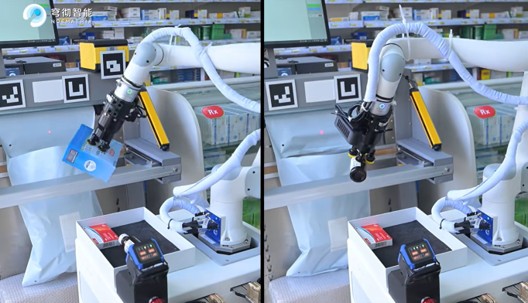
Commercial deployment is already underway. Noematrix robots are operating in batch across pharmacies using what the company calls an 'embedded upgrade' model: no structural changes to existing shelving, 2.5 square meters of floor space required, and direct integration with existing store order management systems. The approach is designed to minimize the friction of adoption for existing retail operators, a deliberate contrast to the heavy infrastructure requirements of traditional automation. The company has also partnered with Haier to develop home service robots for laundry and household organization, and has reached cooperation agreements with major food manufacturers for complex production line automation.
The SJTU AI Future Fund's participation in this round carries institutional significance beyond the capital itself. The fund is initiated by SJTU's AI Institute specifically to support hard-tech ventures with major commercialization potential from within the university ecosystem. Professor Lu Cewu, as Deputy Dean of that institute, is both a founder of Noematrix and a core figure in the institution backing the structure that formalizes the research-to-deployment pipeline and gives Noematrix privileged access to SJTU's research output, talent pipeline, and joint laboratory infrastructure. Wang Yanfeng, Executive Dean of SJTU's AI Institute, noted that the fund's investment represents a continuation of joint laboratory collaboration and a commitment to advancing China's embodied intelligence industry.
With this round, Noematrix plans to continue iterating Noematrix Brain toward stronger generalization and higher autonomous decision-making capability, accelerate deployment in hotel laundry and home organization scenarios, and release a next-generation proprietary embodied intelligence world model. The company's trajectory of seven rounds in under three years, cumulative funding exceeding RMB 1 billion, batch commercial deployments already live positions it as one of the most advanced embodied AI companies in China and a direct Chinese counterpart to U.S.-based Physical Intelligence and Skild AI.
Primary Sources:
3. 36Kr — Founded by Stanford team, continuously funded by Sequoia and P7 (April 2025)
4. TMTPost — Alibaba Backs Noematrix in Embodied Intelligence Push (October 2025)
Disclaimer: All editorial content is independently written based on publicly available Chinese and English-language sources. Quoted material is attributed to its original publisher not been independently verified.