DEEP Robotics Puts Humanoids on Traffic Duty at Hangzhou Marathon
DEEP Robotics fielded its DR02-based humanoid for traffic control and crowd safety at the 2026 Hangzhou Marathon, testing what the company calls a repeatable security model for large public events.

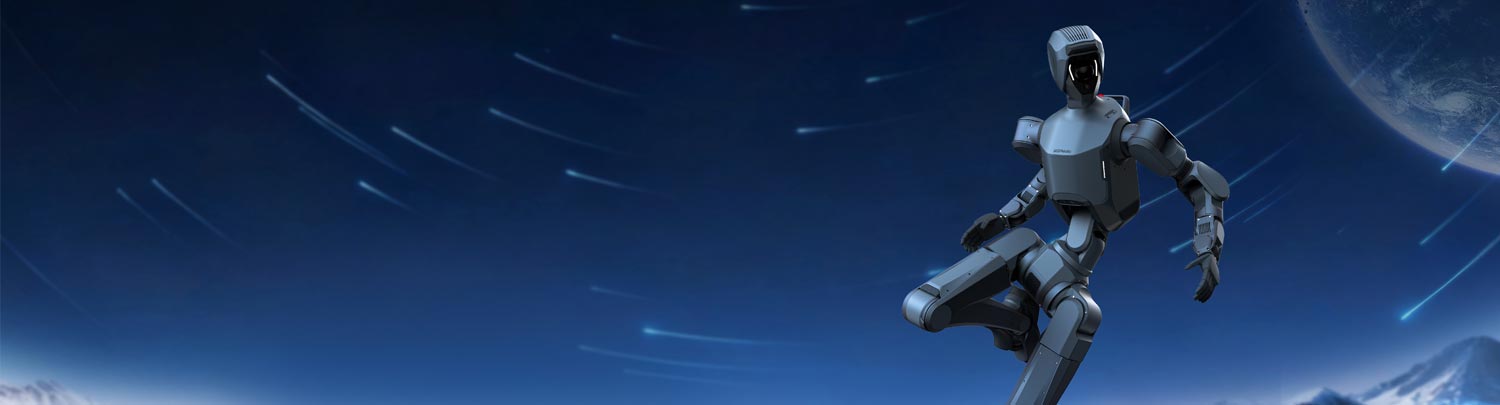
Humanoid robots built by DEEP Robotics worked traffic duty alongside police officers at Sunday's Hangzhou Marathon, patrolling intersections, warning runners and spectators about violations, and fielding public questions across a route that drew 36,000 participants through the city. The deployment, which the Hangzhou-based company calls an early test of a repeatable security model for large public events, is among the first times humanoid robots have handled live crowd-management duty at a race of this scale anywhere in the world, rather than appearing as a demonstration on the sidelines.
DEEP Robotics, headquartered in Hangzhou and known mainly for its quadruped robots used in industrial inspection, fielded a humanoid variant called Hangxing No. 2, built on the company's DR02 platform, for the marathon deployment. The 178-centimeter robot carries an IP66 dust and water rating, operates across a temperature range from negative 20 to positive 55 degrees Celsius, and runs 275 TOPS of onboard compute paired with LiDAR, a depth camera, and a wide-angle camera, specifications built for outdoor industrial sites that translated directly to an outdoor civic event covering a large area in a single morning.
What the Robots Actually Did on Race Day
Across four locations around the Huanglong Sports Center, the humanoids ran preset-route patrols between guard posts, monitored intersections for the kind of violations that typically require a dedicated officer, pedestrians crossing against signals, vehicles cutting into a blocked lane, and issued warnings using standardized traffic-control gestures paired with broadcast safety advisories. The company has not disclosed how many violations the robots flagged, what accuracy rate the detection system achieved, or how much human oversight ran in parallel with the deployment, limitations worth stating plainly before reading too much capability into a single event. Available reporting does not establish that the robots independently issued penalties or citations, only that they issued warnings and advisories alongside the broadcast-and-gesture system built into the DR02 platform.
Meng Yuan, a DEEP Robotics representative, described the appeal of a marathon as a first scenario for humanoid security work in practical terms: "Marathon security is concentrated in time," a framing that captures why a one-day event with a fixed route and a known crowd size is a more tractable testing ground than open-ended street patrol. Meng also called the deployment "an exploration of a standardized application model for humanoid robots" in large-event traffic management, language that signals DEEP Robotics is treating Sunday's marathon less as a one-off public-relations exercise than as the first rep in building a repeatable product around event security.
Why a Marathon Is a Better Proving Ground Than a Factory Floor
The choice of venue is itself a strategic signal about how DEEP Robotics is trying to differentiate its humanoid line from the dozens of other Chinese manufacturers racing to put humanoids into factories and warehouses. A marathon route is outdoors, geographically dispersed, time-boxed, and full of unpredictable human behavior in a way that a controlled factory floor is not, which makes it a meaningfully different stress test for perception and navigation systems than the pick-and-place and material-handling tasks dominating most humanoid deployment announcements this year. A robot that can reliably detect a pedestrian stepping off a curb at the wrong moment across a crowded outdoor route is demonstrating a different capability than one sorting packages on a warehouse floor, and it is a capability that maps more directly onto public-safety and event-security contracts than onto industrial automation budgets.
Wang Peng, a research fellow at the Beijing Academy of Social Sciences who was not speaking on behalf of DEEP Robotics or any government body, offered an independent read on the significance: "Moving from factories to marathon courses marks an important step" for humanoid robots. That framing is worth taking seriously precisely because it comes from outside the company, and because it points at a broader shift already underway in China's humanoid sector, where public-facing deployments in parks, transit hubs, and now sporting events are increasingly treated as a proving ground for capabilities that eventually feed back into more commercially lucrative service and security contracts.
The Procurement Logic Behind Event Security Robots
For buyers evaluating humanoid robots for public-safety or event-security applications rather than industrial use, Sunday's deployment is a more relevant data point than most of the factory-floor demonstrations that dominate humanoid robot coverage, precisely because the operating environment, outdoor, variable lighting, dense and unpredictable crowds, dispersed across multiple fixed posts, maps far more closely onto an actual security contract than a staged warehouse pick-and-place run does. Municipal governments, event organizers, and private security contractors evaluating this category should weight outdoor, crowd-facing deployments like this one more heavily in their technical due diligence than indoor industrial pilots, since the failure modes, a robot losing track of a person in a dense crowd, misreading a gesture across variable lighting, are specific to the outdoor, public-facing use case and do not show up in controlled industrial testing.
The commercial case for event-security humanoids rests on a straightforward labor-economics argument: large one-day events require a temporary surge in security and crowd-management staffing that is expensive to source, train, and deploy for a single day, and a humanoid fleet that can be redeployed across multiple events throughout a season offers a different cost curve than hiring and training temporary staff for each event individually. Whether that economic case holds depends heavily on deployment details DEEP Robotics has not yet disclosed, how many robots were actually fielded, what the per-unit operating cost looked like for a single morning, and how much remote human oversight the system required, all of which matter more to a genuine purchasing decision than the fact that the deployment happened at all.
What Would Turn a Marathon Demo Into a Real Product Line
DEEP Robotics has built its commercial reputation primarily on quadruped robots sold into industrial inspection roles, a market where the company has already demonstrated it can convert demonstrations into repeat enterprise contracts rather than one-off showcases. Whether the humanoid line follows the same path depends on whether Sunday's marathon becomes the first of a disclosed series of event deployments, the standardized application model Meng Yuan described, rather than a single appearance timed for publicity around race weekend. A company that can show up at three or four more large public events over the coming months, with disclosed metrics on patrol coverage and incident response, would have a genuinely different pitch to municipal security buyers than one relying on a single widely shared video clip.
How This Compares With China's Other Public-Facing Humanoid Trials
Sunday's deployment arrives against a backdrop of a dozen or more Chinese humanoid makers racing to find a public-facing use case that photographs well and justifies continued investor enthusiasm, from robots greeting visitors at retail openings to robots patrolling transit stations on fixed routes. Most of those deployments share a common weakness as evidence of real capability: a fixed route in a controlled, low-density environment is a far easier perception problem than an actual security task, which is part of why DEEP Robotics' choice of a live marathon, with a genuinely unpredictable crowd moving at pace along the route, stands out from the pattern. A robot greeting shoppers at a mall entrance has to recognize that a person is approaching. A robot patrolling a marathon route has to continuously track a moving crowd, distinguish a runner stepping briefly off the course from a safety violation, and do so without a human operator correcting its read in real time if the deployment is genuinely autonomous rather than remotely supervised.
That distinction, between a photogenic greeting robot and a robot doing an actual, measurable safety-adjacent task, is the one procurement teams evaluating this category should insist on when a vendor pitches a public deployment as proof of capability. DEEP Robotics has not published the operator-oversight ratio for Sunday's deployment, and until it does, buyers should treat the marathon appearance as a strong signal of ambition and outdoor-hardware readiness rather than confirmed evidence of fully autonomous crowd-safety judgment.
The Quadruped Business This Humanoid Push Is Built On
DEEP Robotics did not arrive at Sunday's marathon as a humanoid-only startup chasing its first public moment. The company built its commercial base on quadruped robots sold into industrial inspection work at power plants, substations, and construction sites, a market where buyers care less about photogenic demonstrations than about measurable uptime, inspection accuracy, and total cost of ownership across a multi-year contract. That existing enterprise sales relationship, and the hardware-reliability track record it depends on, is the asset DEEP Robotics is trying to extend into the humanoid security category, rather than starting the commercial relationship from zero the way many newer, humanoid-only entrants into China's crowded robotics market have to.
Whether that quadruped-to-humanoid transfer actually works commercially is an open question that Sunday's marathon alone cannot answer, since industrial buyers and municipal security agencies evaluate vendors on different criteria, procurement cycles, and liability exposure. A company with an existing enterprise sales channel and a demonstrated reliability record in one robotics category has a real structural advantage over a pure humanoid startup trying to break into public-safety contracts for the first time, but that advantage only converts into revenue if DEEP Robotics can show municipal buyers the same kind of disclosed performance data that has made its quadruped line a repeat purchase for industrial customers.
The next concrete marker worth watching is whether DEEP Robotics discloses a second event deployment, a formal partnership with a municipal security agency or event organizer, or hard numbers from Sunday's run, any of which would move this from a promising demonstration into evidence of a repeatable, commercially viable product.
This article synthesizes company statements and public event coverage related to DEEP Robotics' humanoid deployment at the 2026 Hangzhou Marathon. It is for general information purposes only and does not constitute investment or procurement advice.