Kodiak's Gen7 Autonomous Trucks Enter Service With Atlas
Kodiak AI disclosed that Gen7 autonomous trucks have entered commercial service with Atlas Energy Solutions, growing the companies' driverless fleet to 37 trucks as Kodiak works toward a 100-truck order.

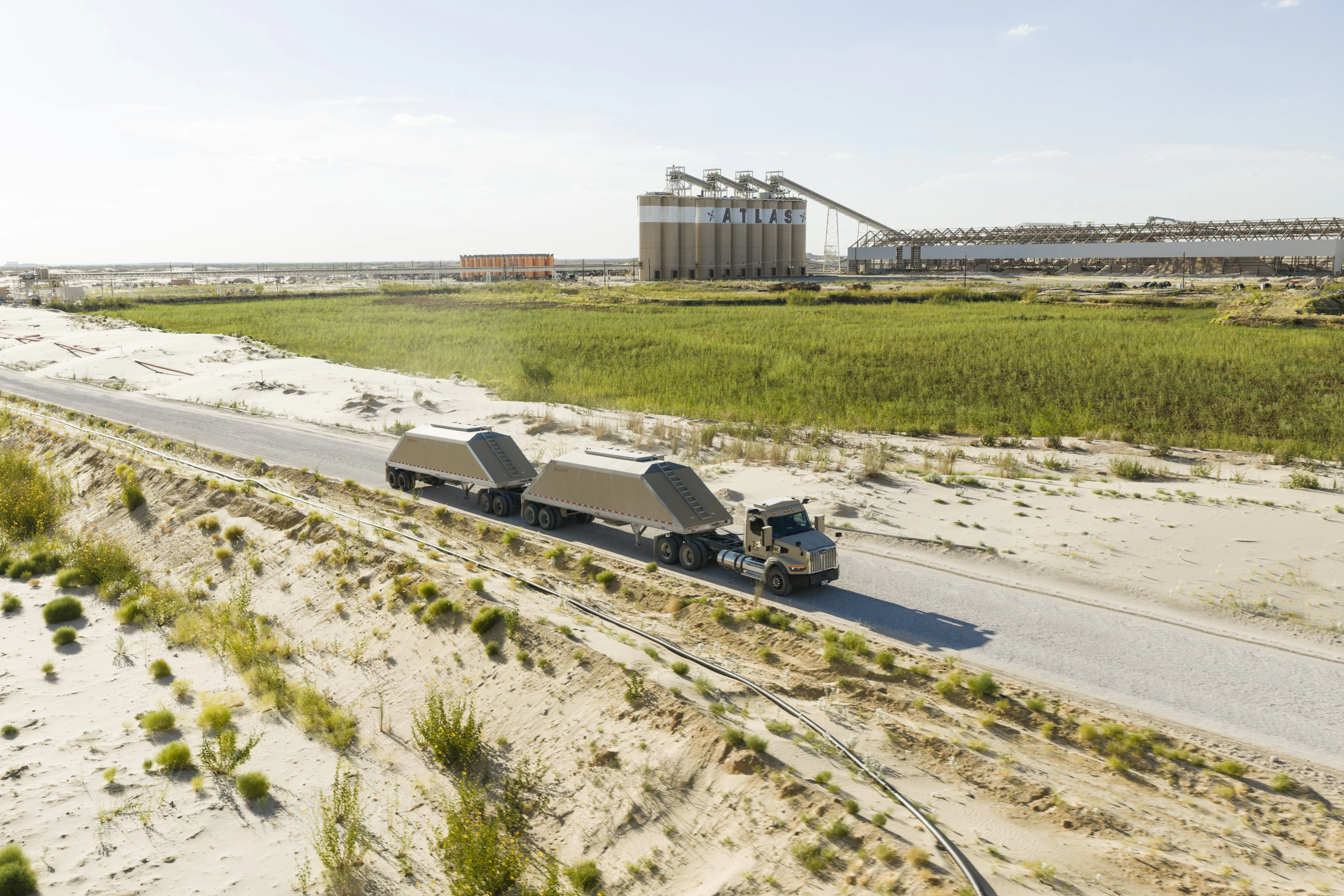
Kodiak AI disclosed this week that the first two Western Star 49X trucks built on its seventh-generation autonomous hardware have entered commercial service hauling frac sand for Atlas Energy Solutions in the Permian Basin, growing Atlas's self-operated driverless fleet to 37 trucks. The trucks themselves reached Atlas in September as Kodiak completed a platform transition it had announced in August, but this week's disclosure is the first confirmation that Gen7 hardware, the compute and sensor package Kodiak is standardizing across its fleet, is now running in paid commercial freight rather than in testing.
That distinction, between when hardware ships and when a company is willing to say it is carrying real freight on it, is where a buyer evaluating autonomous trucking vendors should be looking. Kodiak has spent the past two years building a public track record of uptime and incident-free operation with Atlas specifically, and Gen7's debut inside that same relationship, rather than with a new, less-proven customer, is itself a signal about how much confidence Kodiak has in the new hardware generation.
What Changed Between Gen6 and Gen7
Kodiak says Gen7 is more compact than its predecessor, supports a wider range of vehicle configurations, and carries nearly 50 percent more onboard compute. The company's own stress testing suggests Gen7's SensorPods and compute enclosures will last roughly 50 percent longer in the field than Gen6 hardware did, a claim that matters more to a fleet buyer's maintenance budget than any single performance benchmark. Autonomous trucking sells on uptime, and sensor hardware that survives longer between replacements is a direct line item in the cost of running a driverless fleet at scale, not a marketing footnote.
The Western Star 49X itself, a Daimler Truck North America heavy-duty vocational platform, marks a second milestone buried inside this announcement: these are the first day-cab autonomous trucks Kodiak has put into commercial service, a shorter-wheelbase, no-sleeper configuration built for regional and site-based hauls rather than long-haul line trucking. Oilfield logistics, moving proppant from a transload yard to a well site and back on a short, repeatable loop, is closer to that day-cab use case than it is to the cross-country freight routes that dominate most autonomous trucking demonstrations, which is part of why Atlas has been Kodiak's proving ground of choice since the companies began driverless operations together in December 2024.
Atlas Energy Solutions and the Economics of a Captive Fleet
Atlas Energy Solutions, a Fort Worth-based, NYSE-listed oilfield services company, supplies frac sand, or proppant, to Permian Basin oil and gas producers and separately operates large-scale private power generation for well sites that lack utility grid access. Hauling proppant is a high-volume, short-haul, repetitive logistics task, exactly the kind of narrow, well-defined operating envelope that autonomous trucking vendors have learned to target first rather than chasing the open-road complexity of interstate freight. Atlas owning and operating its own driverless fleet, rather than contracting hauls through a third-party carrier, also gives Kodiak a customer willing to report hard operating numbers publicly: the fleet had logged more than 40,000 cumulative hours of driverless service as of June 30, and a single Gen6 truck ran 64 consecutive days of continuous uptime between June 30 and September 1.
Those figures are the real product Kodiak is selling to the next customer down the pipeline, more than any individual truck delivery. Autonomous trucking has no shortage of pilot programs and demonstration routes; what it has very little of is multi-year, publicly disclosed uptime data from a single customer running driverless trucks as a standard part of daily operations rather than a showcase. Kodiak's relationship with Atlas is now old enough, and public enough, to function as that evidence for the rest of the industry.
Reading the Order Backlog Correctly
The two trucks delivered in September are the leading edge of a larger commitment: Atlas has ordered 100 Kodiak-equipped driverless trucks in total, and Kodiak says it expects to complete that order, delivering the remaining 65 units on top of the 37 already in Atlas's fleet, by the first half of 2027. A hundred-truck order is a meaningful commercial bet for an autonomous trucking company still proving out hardware generations in the field, and the delivery cadence matters as much as the headline number. Shipping two Gen7 trucks now, rather than all 65 remaining units at once, lets Kodiak validate the new hardware generation in revenue service before scaling production and deployment around it, a more conservative rollout than a company chasing a single splashy delivery announcement would choose.
For a fleet operator or logistics buyer comparing autonomous trucking vendors, that staged delivery approach is itself a data point worth weighing against competitors who announce large truck counts without the same visibility into delivery pacing. A vendor willing to show its order backlog broken into tranches, two trucks now, the rest through mid-2027, is giving a buyer more to underwrite a purchase decision on than one that only discloses a total contracted figure. Don Burnette, Kodiak's founder and chief executive, called the Western Star 49X "an outstanding platform" for the deployment, while Atlas chief executive and president John Turner put the commercial stakes in blunter terms: "Uptime is everything in our operation."
What Nearly 50 Percent More Compute Actually Buys
Kodiak's claim that Gen7 carries close to 50 percent more onboard compute than Gen6 is easy to read as a routine hardware refresh, but the practical effect runs further than faster processing. More onboard compute headroom gives Kodiak room to run heavier perception and planning models without a corresponding hardware swap, which matters because the industry's hardest unsolved problems, handling degraded weather, unmapped construction zones, and unpredictable human drivers sharing the road, are usually addressed through software and model improvements rather than new sensors. A fleet that already has the compute margin to absorb those updates can deploy them through the same over-the-air mechanism most autonomous trucking companies now use, rather than waiting on a multi-year hardware replacement cycle across an entire fleet.
That compute margin also underwrites Kodiak's public-road ambitions more directly than the sensor-longevity figures do. Running on private yard roads and short public county stretches inside the Permian Basin is a comparatively forgiving environment: predictable traffic patterns, few pedestrians, and routes the trucks have driven thousands of times. Unrestricted public highway operation, the stated target for mid-2027, demands handling a far wider distribution of edge cases, and the hardware a company commits to today effectively sets a ceiling on how much additional capability it can add later without another fleet-wide swap. Kodiak building that headroom into Gen7 now, well before the public-road expansion it is targeting, suggests the company is pricing in future software growth rather than treating Gen7 as hardware built to just barely clear today's bar.
The Competitive Question Buyers Are Actually Asking
Autonomous trucking has no shortage of companies promising driverless freight at scale, and the field has thinned considerably over the past two years as funding tightened around operators without a credible path to sustained commercial revenue. What distinguishes Kodiak's position in that field is not technical superiority on any single benchmark, but the length and transparency of its operating relationship with one customer willing to disclose real uptime numbers rather than curated demonstration footage. A fleet buyer comparing autonomous trucking vendors for a similar short-haul, high-volume logistics task, agricultural hauling, construction materials, or regional distribution, has very little public operating data to compare across most competitors in the category. Kodiak and Atlas have spent nearly two years building exactly that record together, and Gen7's debut inside the same relationship extends it rather than resetting the clock with a new, unproven customer.
The Public Road Question Still Ahead
Kodiak's trucks are currently running on private and limited county roads inside the Permian Basin, with the company targeting expanded use of public roads for mid-2027, the same rough window in which it expects to finish Atlas's full 100-truck order. That sequencing is deliberate: proving reliability on a closed, repeatable route before taking on the regulatory and safety complexity of unrestricted public highways is the standard playbook for autonomous trucking companies, and Kodiak's choice to disclose its Gen7 debut now, well ahead of that public-road expansion, gives regulators, insurers, and potential customers a longer runway to evaluate the hardware's track record before it is asked to operate in more open, less controlled conditions.
The next marker worth watching is not another delivery count but whether Kodiak's public-road expansion in the Permian Basin actually lands on schedule in mid-2027, alongside the completion of Atlas's order. A driverless trucking company's credibility rests less on how many vehicles it can ship than on whether its own stated timelines, for hardware reliability, fleet scale, and regulatory expansion, hold up once the easy, closed-route proving ground gives way to public infrastructure it does not control.
This article synthesizes Kodiak AI's public announcement and statements from company and customer executives. It is for general information purposes only and does not constitute investment or procurement advice.