Technological Impacts to Watch: Safety Architectures and Logistics Deployments
The upcoming week in the Automation, Robotics, and Physical Intelligence (ARPI) sector is defined by two major technological shifts moving from the lab to the factory floor. First, NVIDIA's announcement of Halos for Robotics introduces the industry's first full-stack safety architecture, addressing the critical bottleneck of safe human-robot collaboration. Second, BMW's deployment of the Figure 03 humanoid robot at its Spartanburg plant marks a transition from simple part-loading to complex logistics sequencing, demonstrating the maturation of Vision-Language-Action (VLA) models in real-world industrial environments.
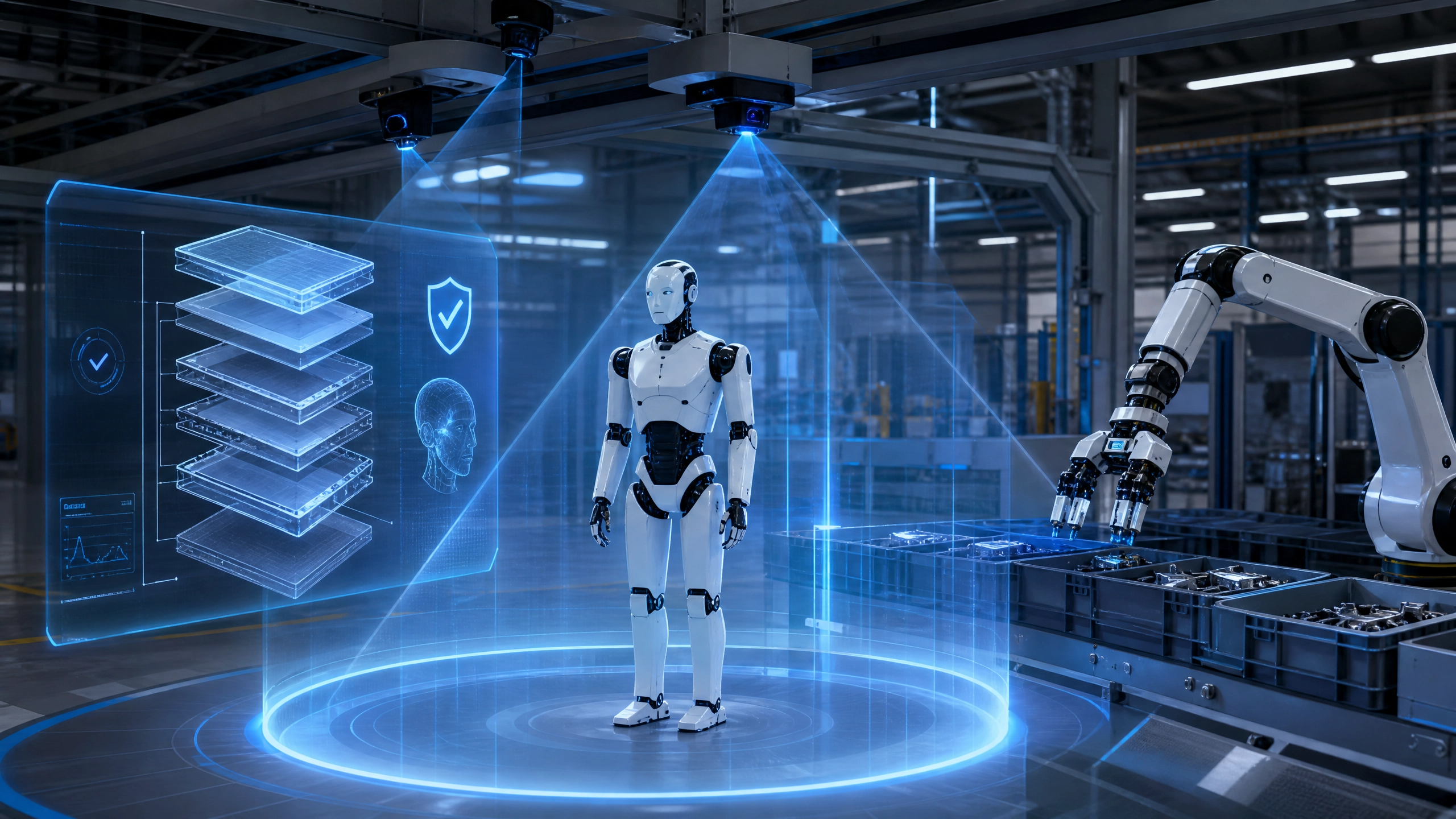
The Safety Bottleneck: NVIDIA Halos for Robotics
As humanoid robots and autonomous mobile robots (AMRs) move out of cages and into unstructured environments alongside human workers, traditional safety mechanisms are no longer sufficient. The primary constraint on scaling physical AI has not been intelligence, but functional safety certification. [1]
To address this, NVIDIA has launched Halos for Robotics, the industry's first full-stack, comprehensive safety system for physical AI. Built upon over 18,000 engineering years of autonomous vehicle (AV) safety development, Halos unifies AI compute and safety into a single platform. [1]
The architecture spans three key layers. The foundation relies on the NVIDIA IGX Thor industrial-grade AI compute module and the NVIDIA Holoscan Sensor Bridge (HSB). The IGX Thor features a dedicated IEC 61508 SIL 3 capable Safety Island, physically isolated from the main compute domain, with over 22,000 safety mechanisms providing diagnostic coverage. [1] Building on that foundation, Halos OS is a safety software stack running on IGX Thor, which includes Halos Core for developing safety applications and blueprints like the Outside-In Safety Blueprint, which uses external worksite cameras to dynamically control robot behavior. [1] The third layer is the NVIDIA Halos AI Systems Inspection Lab, an ANAB-accredited program that helps partners prepare for third-party certification against rigorous standards like IEC 61508 and ISO 13849. [2]
Agility Robotics, maker of the Digit humanoid, is the first to incorporate IGX Thor and Halos Core into its proprietary safe human detection system. Digit is currently deployed commercially with Amazon, GXO, Schaeffler, and Toyota Motor Manufacturing Canada. This partnership signifies a crucial industry shift from ad-hoc, proprietary safety implementations toward a shared, internationally recognized, and standards-aligned foundation. [2]
From Lab Demos to Logistics Sequencing: Figure 03 at BMW
While safety architectures mature, the physical capabilities of humanoid robots are simultaneously advancing into more complex, dynamic tasks. Following an 11-month pilot with the Figure 02 robot in the body shop, BMW Group is now deploying the next-generation Figure 03 at its Plant Spartanburg in South Carolina. [3]
The Figure 02 pilot proved the viability of humanoids in a highly structured task: inserting sheet-metal parts for welding. Over 1,250 hours of runtime, the robot handled more than 90,000 parts, operating in 10-hour shifts, Monday through Friday, with a target cycle time of 84 seconds per load and a target of zero human interventions. [4]
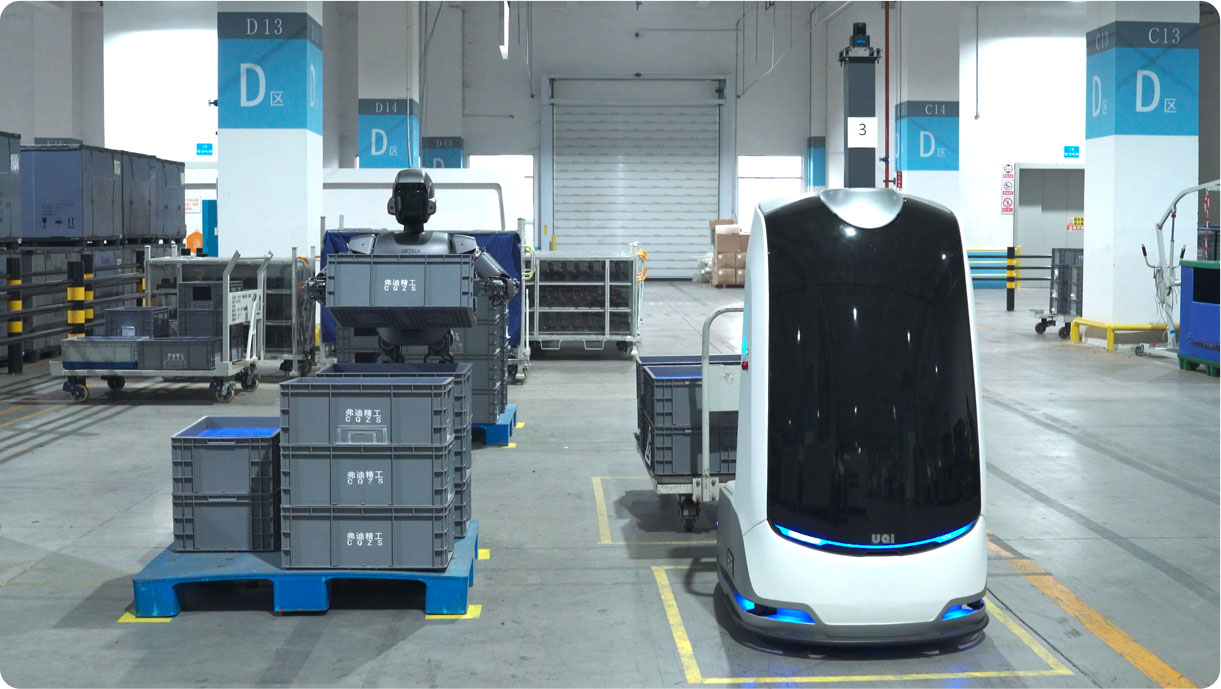
The new deployment of Figure 03 represents a significant leap in complexity. Figure 03 is assigned to logistics sequencing. Delivered components arrive in larger containers, unsorted. The robot must pick these components and sort them into a sequencing trolley in the exact order required for vehicle assembly. This just-in-sequence application requires advanced perception, dexterity, and real-time decision-making, moving beyond simple repetitive motion to dynamic, flow-based material handling. [3]
To achieve this, Figure 03 introduces several critical hardware upgrades. The robot features improved hands equipped with tactile sensors and palm cameras to handle varied, unsorted parts. Its redesigned wrist electronics remove distribution boards and dynamic cabling, allowing each wrist motor controller to communicate directly with the main computer, addressing the primary failure point identified in the Figure 02 pilot. Wireless charging improves availability, and audio functions enable speech-to-speech communication. [3] [4]
The convergence of standardized safety architectures like NVIDIA Halos and the successful deployment of complex sequencing robots like Figure 03 signals the end of the spectacle phase for humanoid robotics. The focus has decisively shifted from proving that humanoids can walk and grasp to proving they can operate safely, reliably, and economically at scale within existing industrial workflows.
Primary Sources
1. Inside NVIDIA Halos for Robotics: A Full-Stack Functional Safety System for Physical AI. NVIDIA Technical Blog. June 22, 2026.
2. NVIDIA Announces Halos for Robotics, the Industry's First Full-Stack Safety System for Physical AI. NVIDIA Newsroom. June 22, 2026.
3. BMW Group advances the use of Physical AI in production with Figure 03 project in Spartanburg. BMW Group PressClub Global. June 25, 2026.
4. BMW deploys Figure 03 humanoid for Spartanburg logistics. Humanoid.guide. June 27, 2026.
The information provided in this article is for informational purposes only and does not constitute financial or investment advice. The robotics and AI sectors are highly volatile, and market conditions can change rapidly. RobotAIGeek is not responsible for any investment decisions made based on this content.