Nobody Is Buying the Humanoid. They're Buying What's Already Deployed.
Sort 2026's physical-AI acquisitions by which side already had hardware deployed, and the humanoid is never the asset being paid up for. NEURA Robotics, Bear Robotics and Mobileye are converging on the same structure from opposite directions: buy the deployed fleet, treat the humanoid as the acquired add-on.

I read corporate filings before breakfast, which in Manila means reading Europe's after-hours announcements while the rest of the household is still asleep. This week's stack included NEURA Robotics buying a German cleaning-robot maker, and it took me longer than it should have to notice what NEURA was not buying: another humanoid.
That absence is the story.
Here is the thesis. Sort 2026's physical-AI acquisitions by which side of the deal already had machines in the field, and the humanoid is never the asset the buyer is paying up for. It is the small, cheap module getting folded into somebody else's distribution. Two companies moving in opposite directions, one starting from a humanoid story and shopping for deployed hardware, the other starting from a deployed fleet and shopping for a humanoid team, have landed on the identical structure. That convergence is more informative than either deal alone.
The company with the humanoid story goes shopping for boring robots
NEURA Robotics is a Metzingen-based company best known for the 4NE-1 cognitive humanoid and the household assistant MiPA, both marketed under the banner of what the company calls Physical AI. In June it closed a Series C of up to €1.2 billion (roughly US$1.4 billion), backed by Nvidia, Amazon, Qualcomm, Bosch, Schaeffler, Tether and the European Investment Bank, at a valuation reported around US$7 billion. That is a humanoid-story valuation if there ever was one.
What NEURA has done with that capital is not build more humanoids. In October 2025 it bought ek robotics, a forklift-automation and warehouse-logistics specialist. On August 13 this year it acquired Bosch Rexroth's ACTIVE Shuttle transport line. On August 24, three weeks later, it took full ownership of ADLATUS Robotics, an Ulm-based maker of autonomous cleaning and sweeping machines with hundreds of units already working shifts in warehouses, hospitals and retail floors.
Three acquisitions in eleven months, and not one of them a humanoid.
NEURA's own founder was direct about why. "We're not buying ADLATUS just to add another cleaning robot to our portfolio," David Reger said in the company's announcement. "We want to give machines like this a new brain." Read plainly, that is an admission that the humanoid is the demonstration project and the recurring revenue lives in forklifts, shuttles and floor scrubbers that a facilities manager signs a maintenance contract for. The 4NE-1 sells the story that raises the round. ADLATUS and ek robotics are what pays the bills while the humanoid is still a research program with a very good stage presence.
The company with deployed robots goes shopping for a humanoid
Now run the tape the other direction. Bear Robotics has shipped more than 16,000 service robots, the hospitality and cleaning machines that glide food carts and mop tiles across thousands of commercial sites in North America, Europe and Asia. That fleet is Bear's actual asset: a constant stream of real-world operating data from paying customers, the kind of deployment scale most humanoid companies would trade their demo reel for.
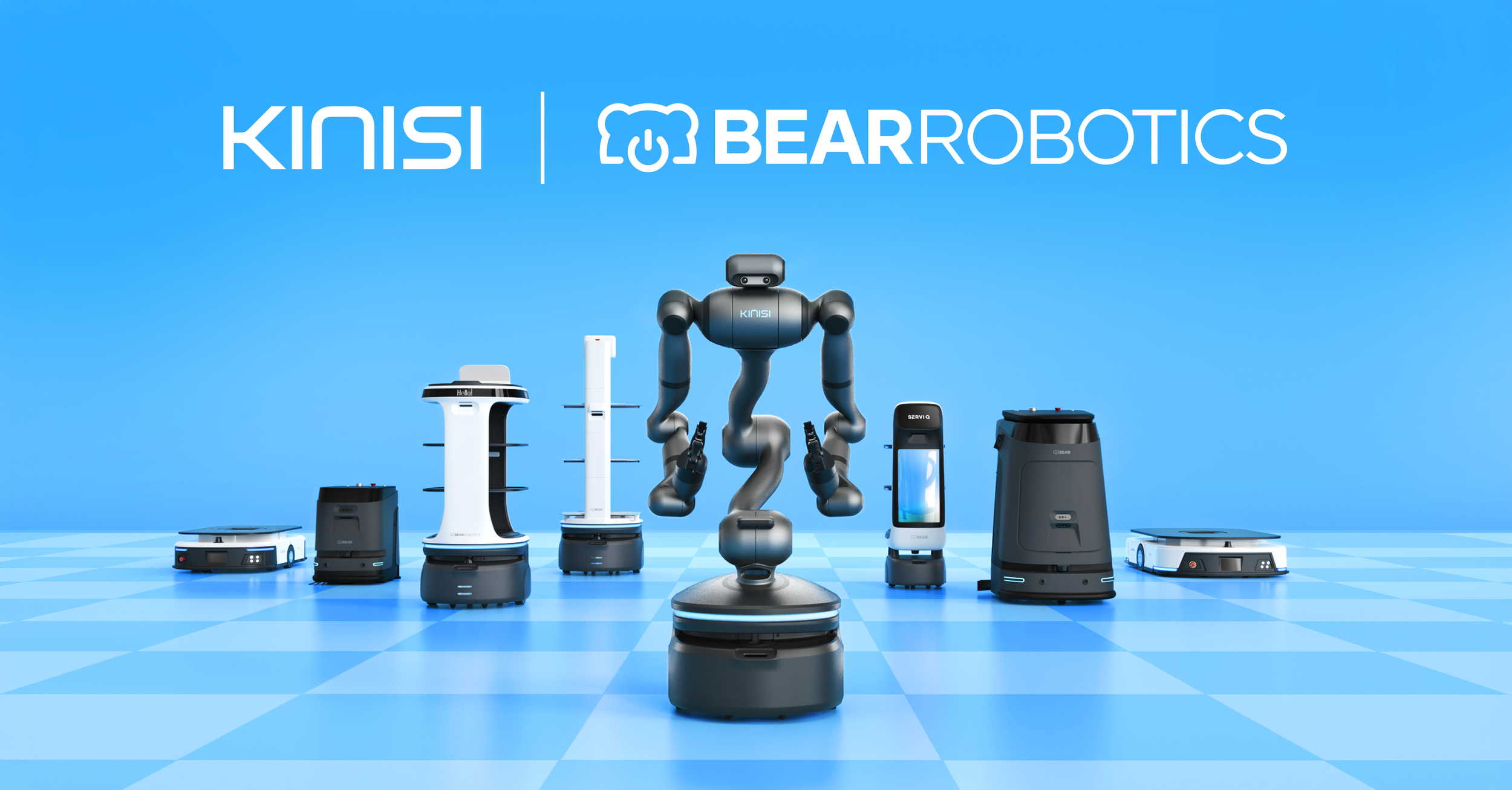
In June, Bear announced it would acquire Kinisi Robotics, a Bristol startup building a wheeled humanoid called the KR1, along with a vision-language-action model and a proprietary low-cost data-capture glove. No financial terms were disclosed, which on its own tells you the deal was priced as a talent-and-IP acquisition, not a platform merger of equals. Bear's own language for the rationale was a "data flywheel": the deployed fleet generates real-world operating data at thousands of sites, Kinisi's capture tools add manipulation examples cheaply, and the two data streams train better models together than either company could produce alone.
Notice what changed hands. Bear did not buy a humanoid company to become a humanoid company. It bought a small manipulation-AI team to extend a business it had already proven works at scale.
A third data point from outside robotics altogether
The same shape shows up in a company that does not think of itself as a robotics company at all. Mobileye, the Intel-controlled autonomous-driving supplier whose EyeQ chips run inside tens of millions of vehicles on the road today, announced in January that it would acquire Mentee Robotics, an Israeli humanoid startup, for US$900 million: roughly US$612 million in cash and about 26.3 million shares of Mobileye stock. The deal closed in early February.
Mobileye is not a company short on distribution. It is a company short on a humanoid team, and it paid for one with a fraction of the capital NEURA raised on its own humanoid story. The pattern holds across three unrelated industries in the same eight months: whichever side already has hardware deployed at scale treats the humanoid as the acquirable piece, not the anchor.
The exception that proves the rule
There is one structure that does not fit this pattern, and it is worth naming because it shows what the alternative actually costs. Hyundai bought Boston Dynamics outright in 2021 and closed on full ownership, buying out SoftBank's remaining stake, this year. It is now targeting 30,000 Atlas units a year by 2028, built inside its own US manufacturing investment rather than assembled through a string of bolt-on deals.
Hyundai can do that because it already owned both ends before anyone else started shopping: mass-manufacturing capacity, an existing customer in its own factories, and, since 2021, the humanoid IP. Most companies chasing this market do not have that luxury and are choosing a side of the trade instead. That is a real tradeoff, not a flaw in the smaller deals. Buying distribution piecemeal is slower and messier than owning it from the start, but it is available to companies that were never going to out-capitalize a car manufacturer.
What I would watch from this seat
Running a robotics data platform out of the Philippines means I mostly see the announcements after the fact, filed alongside procurement questions from operators who have to live with whatever a vendor's cap table decides next. From that seat, the practical read is not that humanoids are worthless. It is that a valuation built on a humanoid demo and a valuation built on a deployed fleet are different instruments, and 2026's dealmaking has started pricing them that way even when the press coverage has not caught up.
A fleet of a thousand unglamorous machines is worth more on a term sheet than one dazzling one.
For an ASEAN buyer evaluating any of these vendors over the next year, the useful question is no longer how good the humanoid demo looks. It is which side of a company's balance sheet is the deployed fleet, and which side is the story that raised the money to buy it. NEURA's cleaning robots and forklifts will keep NEURA in business while the 4NE-1 matures. Bear's 16,000 service robots will keep training Kinisi's models whether or not a wheeled humanoid ever reaches the volumes its glossy renders imply. Watch the fleet counts, not the keynote demos. The fleet is what the acquirers are actually paying for.
Hero image: Kinisi Robotics and Bear Robotics acquisition announcement image, official image from Bear Robotics.
Disclaimer: This article is for general information purposes only and does not constitute investment, legal, or procurement advice. Readers should verify details with primary sources before making business decisions.