Tutor Intelligence Raises US$75 Million Series B
Tutor Intelligence raised a US$75 million Series B led by Andreessen Horowitz, doubling its funding as the robotics company scales a model that deploys robots now and trains them using remote human tutors.

Tutor Intelligence raised a US$75 million Series B led by Andreessen Horowitz, the firm confirmed Monday, roughly doubling the robotics company's known funding since a US$34 million Series A closed less than a year earlier. The round is a bet on an approach that runs counter to how most of the industry is spending its venture capital: rather than wait for a general-purpose robot foundation model to mature in the lab, Tutor deploys hardware into paying customers' warehouses and factories now and uses remote human operators, which it calls tutors, to run the robots through real tasks until enough data accumulates to automate the work.
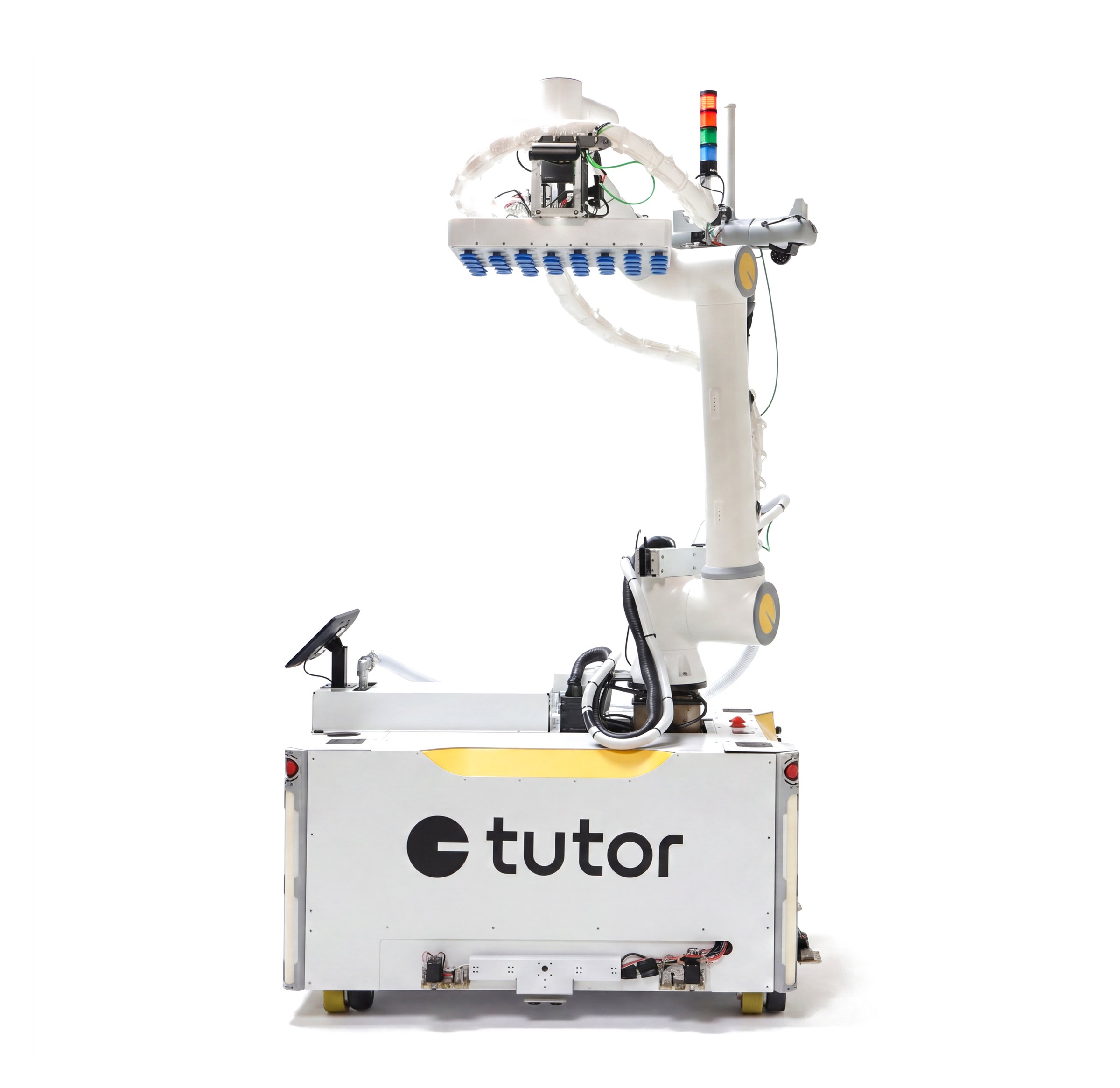
Tutor Intelligence, based in Watertown, Massachusetts, was founded in February 2021 by chief executive Josh Gruenstein and co-founder Alon, both MIT-trained roboticists, and builds two robots: Cassie, a palletizing and depalletizing unit that handles boxes and pallets, and Sonny, a newer semi-humanoid machine built for a wider range of dexterous warehouse and manufacturing tasks. The company's wager is that robotics has spent years treating intelligence as the bottleneck to deployment, when the more immediate constraint was simply a willingness to put imperfect robots to work and let them get better on the job.
The Bet Against Waiting for the Intelligence Breakthrough
Most of the capital flowing into robotics over the past two years has gone to teams trying to solve general robot intelligence before deployment at scale, the belief being that a sufficiently capable foundation model will eventually let robots handle novel tasks with little or no human oversight. Tutor's public argument, laid out by Gruenstein in a blog post timed to the funding announcement, is that this framing gets the constraint backward: with roughly eight billion people already possessing the intelligence robots are trying to replicate, there is no need to wait for an algorithmic breakthrough before putting robots into production. Connect robots to remote human tutors now, the thesis goes, and the resulting stream of real-world task data trains the underlying models faster, and more cheaply, than simulation or lab demonstrations ever could.
That resolution matters commercially because it changes what a customer is actually buying. A warehouse operator evaluating Tutor is not purchasing a fully autonomous system today; it is purchasing a robot that performs reliably from day one because a human is filling in wherever the model cannot yet handle the task on its own, with the expectation that the share of work requiring human intervention declines over time as the model improves. For a procurement team weighing automation vendors, that is a meaningfully different risk profile than betting on a company still iterating toward its first reliable deployment in a lab.
Why the Data Flywheel Is the Actual Product
Tutor frames its own key performance indicator in blunt terms: the company says it currently performs roughly 0.02 basis points of the economically valuable physical labor done in the United States, a figure meant to illustrate both how early the deployment curve still is and how much room exists for the business to scale before it meaningfully dents the broader labor market. The company points to separate figures on US robot adoption: roughly 38,000 units went into American businesses in 2025, a small fraction relative to a national population above 340 million, and nine in ten domestic factories and warehouses still run with zero robots on the floor. Those numbers, if accurate, describe a market still mostly unautomated rather than one nearing saturation, which is the premise Tutor is asking investors, and customers, to underwrite.
Every deployed robot, whether tutored through a task by a remote human or operating with partial autonomy, generates demonstration data that feeds back into Tutor's models. That flywheel, more deployment produces more data, more data improves the models, improved models reduce the human tutoring load and lower the cost per robot, is the actual asset a16z is financing, more than the hardware itself. Gruenstein has said the company expects to manufacture a plurality of all industrial robots built in the United States over the coming year, a claim Tutor has not independently substantiated with shipment or unit figures, and one buyers should treat as a company projection rather than a verified fact.
What a Fortune 50 Customer Base Signals About Reliability
Tutor says its robots are already running in scaled deployment across North America for customers ranging from Fortune 50 manufacturers to family-owned operations, and that the highest compliment the company hears from a customer is that the robots have effectively faded into the background of daily operations, no longer requiring active attention. That kind of customer feedback is a meaningful signal in industrial robotics specifically because reliability, not peak capability, is usually what determines whether a pilot program converts into a long-term contract. A robot that performs an impressive demonstration but requires constant supervision rarely survives past its first year on a customer's floor; one that becomes invisible to the operations team because it simply keeps working is the outcome every automation vendor is chasing and few reliably deliver.
The Series B also arrives roughly three weeks after Tutor introduced Sonny, its second robot platform and a meaningfully more ambitious bet than Cassie's narrower palletizing focus. Sonny's semi-humanoid form factor is built to handle a broader diversity of dexterous manufacturing and logistics work, extending the tutoring model beyond the relatively structured box-and-pallet tasks Cassie was designed around and into less predictable physical work. Whether the tutoring approach scales as cleanly to Sonny's more varied task set as it has to Cassie's narrower one is the open question the new capital is meant to help answer.
How the Tutoring Model Compares to Pure Autonomy Bets
Robotics funding over the past eighteen months has split roughly into two camps. One group of well-capitalized labs is racing toward general-purpose robot foundation models trained primarily on simulation and curated demonstration data, betting that enough compute and the right architecture eventually produces a model that generalizes across tasks without a human in the loop. The other, smaller group, which includes Tutor, is betting that real deployment, even partially human-operated deployment, produces a more useful training signal than simulation can, because it captures the actual failure modes, edge cases, and physical variability a warehouse or factory floor presents that a simulated environment cannot fully replicate.
Neither approach has definitively won the argument, and the honest answer is that the two strategies are not mutually exclusive; several labs pursuing frontier foundation models have also begun standing up their own limited real-world deployments to supplement simulation data, which is implicitly an admission that Tutor's core insight, real-world data beats simulated data for closing the last mile of reliability, has broader support across the industry than Tutor's funding round alone would suggest. Where Tutor differs is in treating that insight as the entire business model from day one rather than as a late-stage supplement to a research program, and in owning the full stack, hardware, tutoring operations, and model training, rather than licensing a foundation model to third-party robot manufacturers.
That full-stack ownership is also what makes the business capital-intensive in a way a pure software or model-licensing company is not. Manufacturing robots, staffing and training remote tutors, and running model infrastructure all scale with the number of deployed units, which means Tutor's cost base grows alongside its revenue rather than staying fixed the way a software subscription business's does. The Series B's size, roughly double the Series A raised less than a year earlier, reflects that capital intensity: scaling a tutored-robot fleet costs meaningfully more per unit of growth than scaling a pure software product, and investors underwriting the model are pricing that difference in rather than ignoring it.
The Capital Discipline Question Every Robotics Investor Is Asking
Robotics has produced enough well-funded, high-profile failures over the past several years that any nine-figure-adjacent raise invites scrutiny of unit economics rather than applause for the headline number alone. Tutor's model has a built-in answer to that scrutiny that pure research-stage competitors lack: because the company is already generating revenue from deployed robots across a real customer base, the Series B is capital to scale an operating business, manufacturing capacity, additional tutor staffing, and model training infrastructure, rather than capital to fund years of pre-revenue research with no committed customers absorbing the output.
That distinction is the core of the bet Andreessen Horowitz is making, and it is the one that should matter most to a procurement team deciding whether to put a Tutor robot on its own floor. A company burning venture capital on open-ended research carries real platform risk if the funding environment tightens before the technology matures. A company burning venture capital to manufacture more units of something customers are already paying to use is making a narrower, more conventional bet, and Tutor's US$75 million round is a wager that narrower bet will keep paying off as it scales from Cassie's warehouses into Sonny's more demanding, more dexterous work.
This article synthesizes Tutor Intelligence's public statements and Andreessen Horowitz's investment announcement. It is for general information purposes only and does not constitute investment or procurement advice.