Jianzhi Raises US$100 Million for Robot Training Hours
Jianzhi Robotics disclosed a US$100 million Series A+ that closed in the third quarter of 2026, aimed at embodied intelligence data hours rather than a finished humanoid.

Jianzhi Robotics disclosed on 2 November 2026 that it closed a US$100 million Series A+ round in the third quarter of 2026. The company sells embodied intelligence data infrastructure, not a finished humanoid. Buyers should treat the round as a capacity claim about training hours, not as proof that a robot can hold a shift.
The disclosure names SAIC Group, Malaysia based EastWorlds, Baidu Group, Shoucheng Holdings, and GALBOT among the investors, with Guanghe Venture Capital, CITIC Goldstone Investment, and CCB International also participating. No post money valuation, revenue, margin, or customer list was released with the round. The useful number in the statement is operational. Jianzhi said quarterly effective data delivery has moved from the 100,000 hour level to the 1,000,000 hour level, and that it plans to deliver 10,000,000 hours in a single quarter in 2027.
That plan is the story. Capital is arriving at the layer that teaches robots, while the machines themselves remain early, uneven, and expensive to keep running. A procurement leader who only tracks humanoid unit prices will miss where the check was written.
## Capital is paying for hours, not for a badge on a torso
Jianzhi describes its work as embodied intelligence data infrastructure. Staff and systems collect how people operate and interact in homes, factories, and logistics sites, then convert those skills into data that can train models. The company says those data products have already completed large scale validation on physical artificial intelligence models at several companies worldwide.
Read that sentence as a vendor claim, not as a factory acceptance test. Large scale validation can mean a model consumed the data in a research loop. It can also mean a paid production workflow with service levels, rejection rates, and a named buyer. The disclosure does not say which. It does not name the customers. It does not define an effective hour. An hour of a person folding a shirt is not an hour of a welder correcting a seam, and neither is an hour of simulated motion that never touched a part.
The round still matters because the investors are not a single theme. SAIC Group is an automaker. Baidu Group is a technology platform with a long autonomy program. GALBOT builds robots. Shoucheng Holdings has been active around robotics assets. EastWorlds adds a Malaysia link that procurement teams in Southeast Asia should notice even if no deployment geography was promised. Guanghe, CITIC Goldstone, and CCB International sit on the financial side of the cap table. A mix of an automaker, a robot builder, a platform company, and financial investors usually means the round is meant to fund a shared input, not a single end product.
The close itself is not a 2 November event. The company said the round closed in the third quarter. What is new on 2 November is the public disclosure, the investor list, and the delivery targets. Older funding should not be folded into this figure. This package does not restate earlier rounds, because those closes are separate events and were not part of today's disclosure.
## An effective hour is a contract term, not a press term
Anyone buying training data, or buying a robot whose price assumes cheap training data, should force a definition before the next meeting. Ask what an effective hour includes. Ask whether the hour is raw video, a cleaned demonstration, a labeled action segment, or a successful task completion. Ask who labels it, in which language, and under what rejection rule. Ask whether the hour is exclusive. Ask whether a customer can delete a site, a face, or a process after delivery. Ask where the recording happened, and whether the worker knew.
Jianzhi's own framing points at homes, factories, and logistics. Those three sites create three different legal and operational problems. A home recording raises consent, minors, and private layouts. A factory recording raises trade secrets, safety rules, and union or contractor status. A logistics recording raises customer cargo, site security, and shift patterns that do not repeat cleanly. A company that claims all three is claiming a data network, not a single studio. That is a harder business than a demo stage, and it is also a harder business to audit.
The jump from the 100,000 hour level to the 1,000,000 hour level is a tenfold move if the words mean what they appear to mean. The 2027 target of 10,000,000 hours in one quarter is another tenfold move. Those are not rounding errors. They imply sites, supervisors, storage, consent operations, and a customer who can absorb the volume. If the customer cannot absorb it, the hours are inventory. Inventory of demonstrations goes stale when the robot hand, the camera, and the task all change.
A plain analogy helps. Buying a million hours of unnamed robot video is closer to buying unmarked steel than to buying a finished press line. The tonnage can be real and still be the wrong alloy for the die you own. The buyer who skips the alloy certificate pays twice, once for the material and again for the scrap.
## Hardware rivals are selling a different promise
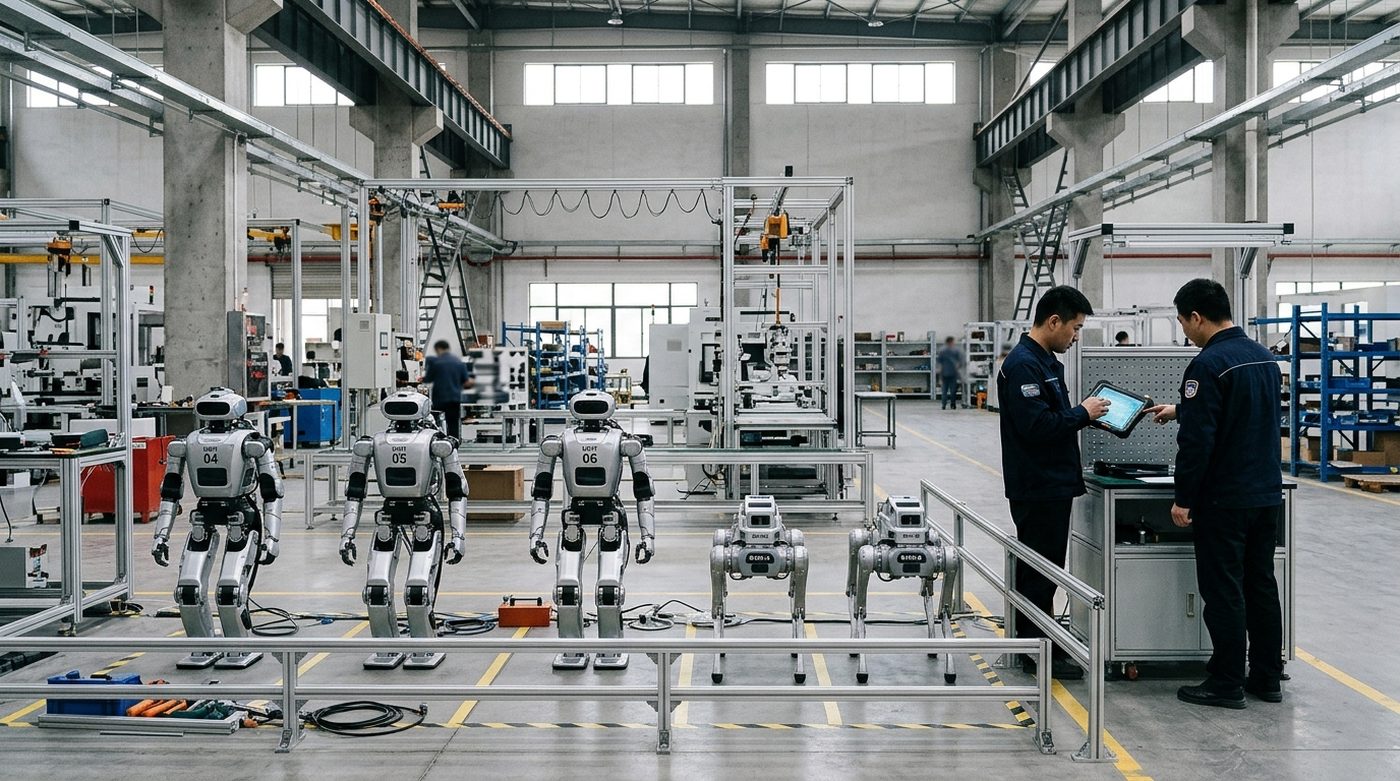
The same week, factory buyers are being offered humanoids, quadrupeds, and programming tools as if the body were the product. Jianzhi is selling the input those bodies consume. That split should change how a sourcing team compares quotes.
A humanoid vendor sells uptime, payload, safety certification, and a service contract. A data vendor sells coverage, freshness, consent, and whether the data matches the buyer's own cell. Putting both numbers in one scorecard without a unit is how pilots get approved on a slide and fail on a line. The table below is a buyer comparison, not a price list. Public prices for these proof paths were not disclosed in the materials used for this package, so price cells stay at N/A.
The skeptical counterpoint is simple. A large round can be a sign that customers will not prepay for the data, so investors are carrying the build. It can also be a sign that customers will pay, and the company needs cash to stand up sites before rivals lock the best factories. The disclosure does not separate those stories. No revenue figure was attached to the hour counts. No gross margin was attached to the data product. No renewal rate was attached to the global validation claim. Until those appear, the round is evidence of investor appetite, not evidence of a repeatable factory budget line.
GALBOT's presence on the cap table deserves a separate look. A robot company investing in a data company can be a customer relationship, a supply hedge, or a strategic option on a scarce input. It is not, by itself, a purchase order. SAIC's presence can mean automotive process data is in scope. It can also mean a corporate venture check with no plant access. Procurement teams should ask whether any investor is also a paying customer, and whether that customer receives exclusivity that later buyers cannot see.
## What a sourcing lead should do this week
Do not add Jianzhi to a humanoid shortlist. Add it to a data and model readiness review. The questions that change a decision are narrow.
First, demand the definition of an effective hour in writing, with a sample of one hour from a factory task and one hour from a logistics task. If the company will not show a sample under a nondisclosure agreement, the hour target is not yet a buying input.
Second, separate collection geography from customer geography. A Malaysia investor does not mean a Malaysia data site. A global validation claim does not mean a site in the buyer's country. Ask for the country of collection, the country of storage, and the country where a dispute would be heard.
Third, ask what happens to the 2027 target if a major customer pauses. Ten million hours in a quarter is a promise about other people's buildings. If those buildings are not contracted, the target is a capacity slogan.
Fourth, keep the round out of any payback model. US$100 million of primary capital does not reduce the price of a robot, and it does not guarantee that data will be cheaper next year. It can just as easily raise the price of scarce factory access as more buyers compete for the same aisles.
Fifth, check whether your own plant data would be more valuable, and more restricted, than anything a third party can sell. Many automotive and logistics operators already record quality, motion, and downtime. The missing piece is often the right to use that recording to train a model, not the existence of a camera. A vendor hour count does not solve an internal legal block.
## The signal underneath the check
The durable point is not the logo list. It is the location of the spend. When a US$100 million round lands on data infrastructure for physical models, the scarce asset is shifting from a novel body to a repeatable record of work. That shift favors operators who can describe their tasks in hours, failures, and consent rules. It punishes operators who approve a pilot because a humanoid stood up in a video.
Jianzhi has not published a price, a valuation, or a customer. It has published a direction and a scale target. Direction is enough to change a sourcing agenda. Scale is not enough to change a purchase order.
A buyer who needs a robot on a line in 2026 should still underwrite the machine, the safety case, and the spare parts. A buyer who needs a model that survives a new part number in 2027 should underwrite the data path with the same seriousness. This round says the second budget line is now large enough to attract an automaker, a robot company, and several financial institutions at once.
The analysis synthesizes the company's 2 November 2026 disclosure and public market context. It does not confirm customer names, revenue, or the internal definition of an effective hour.
This article is for informational purposes only. It is not investment advice, procurement advice, or engineering advice. Figures, investor names, and product claims reflect public disclosures available on 2 November 2026 and may change.