An Indian Robot Maker Takes Its Retail Bet to America's Biggest Retail Show
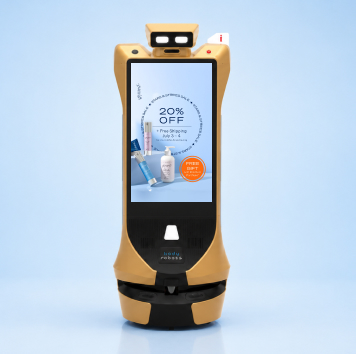
Kody Robots, the robotics arm of India's Kody Technolab, will exhibit its Odigo advertising and wayfinding robot at NRF 2027 in New York, testing whether an Indian service-robot maker with a multi-city domestic mall deployment history can convert that track record into Western retail contracts.

An Indian Robot Maker Takes Its Retail Bet to America's Biggest Retail Show
Kody Robots, the Ahmedabad-based robotics arm of Kody Technolab, confirmed on Wednesday that it will exhibit its Odigo advertising and wayfinding robot at NRF 2027, the National Retail Federation's annual trade show at New York's Javits Center in January, positioning an Indian-built service robot alongside the global retail-technology vendors that typically dominate that stage. The appearance matters less as a trade-show booking than as a data point in a broader question retail technology buyers have been asking for several years: whether India can produce service robots good enough to export, rather than remaining primarily a market that imports them.
Kody Technolab, Odigo's parent company under chairman and managing director Manav Patel, built its robotics business on a specific niche: advertising and wayfinding robots deployed inside shopping malls, where foot traffic and dwell time make an interactive kiosk-on-wheels easier to justify commercially than in most other retail formats. The Odigo robot combines three structured-light depth cameras, a four-microphone array, and a 270-degree, 25-meter-range two-dimensional LiDAR sensor for navigation, running Cartographer-based simultaneous localization and mapping alongside adaptive Monte Carlo localization to move through crowded mall corridors without a fixed guide track.
Where the Robot Is Already Working
Unlike many service-robot export pitches built primarily on specifications and renderings, Kody Robots is bringing a named deployment history to NRF 2027. The company cites installations at Jio World Drive and R City Mall in Mumbai, DLF Mall in Noida, and a fifteen-unit deployment at Pacific Mall in Jaipur, giving it a multi-city, multi-mall-operator track record inside India's domestic market before attempting the harder sell of exporting the product to buyers who have never seen an Indian-built service robot operate commercially. The company also says it shipped seventy-five units internationally within sixty days as of March 2025, with claimed uptime above ninety-seven percent across its installed base.
Those figures are company-reported rather than independently audited, and a retail buyer evaluating Odigo against established competitors from Japan, South Korea, China, or the United States should request the same operational detail any service-robot vendor should be asked for: incident rates, mean time between failures, and what proportion of the quoted uptime figure reflects scheduled maintenance windows rather than unplanned downtime. A ninety-seven percent uptime claim is meaningful only in the context of how it was measured, and Kody has not published that methodology alongside the headline number.
Why NRF Matters More Than a Typical Trade Show
NRF's annual January show functions as the retail industry's primary technology-buying calendar event, drawing procurement decision-makers from chains and mall operators across North America, Europe, and increasingly Asia-Pacific markets evaluating in-store technology for the coming fiscal year. For an Indian robotics exporter, a booth at NRF is less about the three days of the show itself and more about the credibility signal of appearing on the same exhibition floor as the established service-robot vendors that most Western retail buyers already recognize. Being present changes the conversation from "an unfamiliar Indian vendor cold-emailing a pitch" to "a vendor a buyer can walk up to and watch demonstrate its product in person," a meaningfully different sales position for a company still building international brand recognition.
That positioning cuts both ways. Showing up at NRF also means Kody's Odigo will be directly comparable, on the same floor, to competing wayfinding and advertising robots from vendors with longer track records and larger existing customer bases in North America specifically. A buyer who likes what they see on the demo floor will still want to know whether Kody can service and support a robot deployed thousands of miles from its Ahmedabad base, a logistics and after-sales question that matters more for a service robot, which needs regular maintenance and software updates, than for most exported hardware categories.
The "Made in India" Framing and What It Signals
Kody is explicitly marketing this NRF appearance under a "Made in India" framing, positioning Odigo as evidence that Indian robotics manufacturing has matured past components and subassemblies into complete, deployable consumer-facing products. That framing matters for India's broader robotics and automation sector, which has historically been better known as a market for imported industrial automation equipment and foreign-built service robots than as a source of exportable finished robotics products. A credible, independently verifiable export success story from an Indian service-robotics company would be useful evidence for the sector's growth narrative regardless of Kody's specific commercial outcome at NRF, simply by demonstrating the product-development and deployment maturity required to reach that stage.
Whether Kody specifically becomes the company that proves that case, rather than one of several Indian robotics firms attempting it, depends on factors beyond NRF attendance: securing a visible North American customer win, building a credible local service and support presence, and sustaining the uptime and reliability figures it currently reports only from its domestic Indian deployments once operating in a different market with different mall layouts, foot-traffic patterns, and buyer expectations.
What Competing Service-Robot Vendors Should Watch
For established wayfinding and advertising-robot vendors already selling into North American and European retail, Kody's NRF appearance is worth tracking less as an immediate competitive threat and more as an early signal of where the next wave of lower-cost service-robot competition may originate. A vendor with a multi-city domestic deployment history and a claimed uptime record above ninety-seven percent entering a market at a potentially lower price point than established Japanese, Korean, or American competitors changes the competitive calculus for any retail chain currently comparing vendors primarily on brand recognition rather than price and demonstrated reliability.
The more durable question NRF 2027 will actually answer is not whether Kody's booth draws a crowd, trade-show booths reliably do, but whether any Western retail chain signs a pilot deployment in the months following the show. That is the metric that would convert a "Made in India" marketing narrative into a verifiable export success story, and it is the number worth checking back on once the show itself has concluded and the follow-up sales cycle has had time to play out.
What Odigo Is Actually Built to Do
Stripped of the trade-show framing, Odigo is a relatively narrow product category: a mobile kiosk that combines advertising-display functionality with wayfinding assistance, designed to be approached and queried by a shopper rather than to perform a physical task like cleaning, delivery, or security patrol. That narrowness is a deliberate commercial choice rather than a technical limitation. A robot whose job is standing in a high-traffic mall corridor, displaying promotional content, and answering "where is the nearest escalator" has a much lower bar for commercial reliability than a robot attempting autonomous delivery or security work, because the cost of an occasional navigation hiccup is a mildly confused shopper rather than a failed delivery or a missed security alert.
That lower bar is precisely what makes the category a plausible first export product for a robotics company still establishing its international reputation. Kody does not need Odigo to match the capability of a far more sophisticated humanoid or industrial robot to win a mall-operator contract; it needs the robot to reliably show up, move through crowds predictably, and look good doing it, a combination of requirements that favors a company with real deployment experience over one offering only superior specifications on paper. The depth-camera and LiDAR navigation stack Kody has built is arguably over-specified for the task relative to some lower-cost wayfinding kiosks on the market, which may be part of the reliability pitch the company is making to prospective NRF buyers.
The Financing Question Every Export Pitch Eventually Faces
Neither Kody nor any retail buyer evaluating Odigo has addressed, in this announcement, the commercial terms a North American or European mall operator would actually face: purchase price, financing or leasing options, and ongoing service-contract costs once the robot is outside the warranty period Kody can easily support from Ahmedabad. Those terms, more than the technical specifications Kody has published, will determine whether NRF attendance converts into signed contracts. A retail technology buyer comparing Odigo against an established, higher-priced competitor with a known local service network will weigh total cost of ownership over the robot's expected service life, not just the headline hardware price or the uptime percentage printed in a trade-show flyer.
That financing and service-support question is also where Kody's claimed seventy-five-unit, sixty-day export shipment becomes relevant context rather than just a headline statistic. If that export volume went primarily to markets closer to India, where shipping, support, and spare-parts logistics are more straightforward than a transpacific or transatlantic deployment, it tells a buyer less about Kody's readiness for the North American market specifically than the raw unit count suggests. A procurement team should ask directly which markets that prior export volume served before treating it as evidence Kody can support a NRF-originated contract in the United States or Europe.
This analysis is for general information purposes only and does not constitute investment, legal, or professional advice. It synthesizes Kody Robots' own public announcement of its NRF 2027 participation and public market activity as of November 2026.