China's Mobile Robot Makers Are Building More Capacity Than Orders Justify
Nearly 30 Chinese mobile robot manufacturers have disclosed combined annual capacity plans that outpace the industry's own order-volume data, setting up a shakeout among smaller, weaker-capitalized rivals.

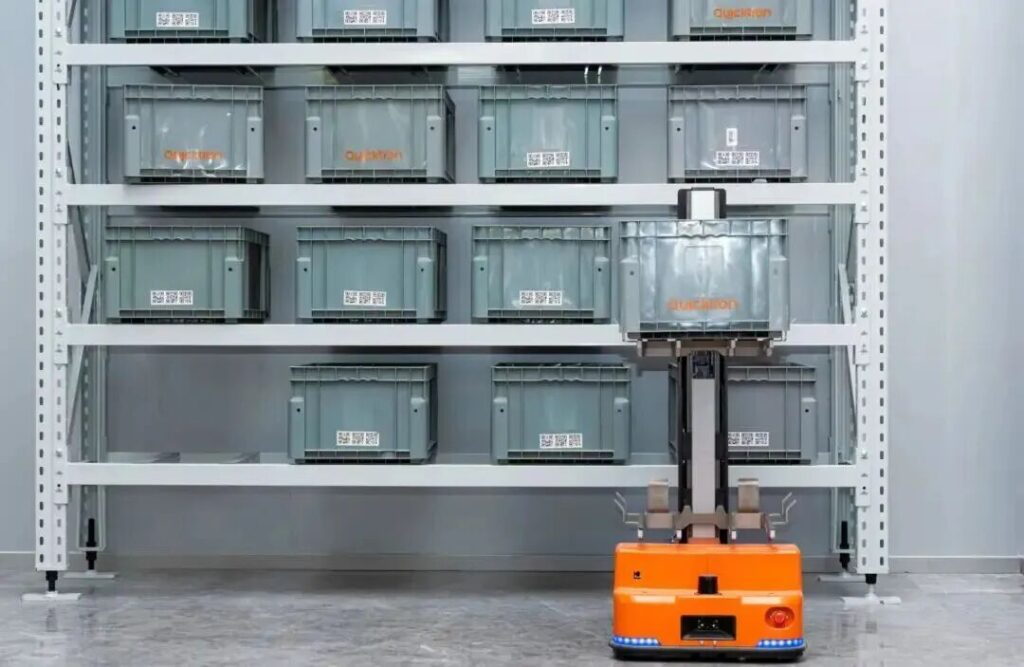
Nearly 30 Chinese mobile robot manufacturers disclosed annual production-capacity plans as of October 27, 2026, with 19 of 27 reporting companies claiming capacity above 10,000 units a year and 14 actively building or expanding factories, committing roughly RMB9.247 billion, about US$1.3 billion, in disclosed investment this year.
That tally, compiled jointly by the CMR Industry Alliance and the New Strategic Mobile Robot Industry Research Institute, reads at first like a routine industrial scorecard. It is not. Capacity announcements of this size, made by this many companies, in the same 12-month window, are a bet that demand for autonomous mobile robots and AGVs will keep growing fast enough to absorb what is about to come off these production lines. The industry's own recent order data suggests that bet is not a safe one for every company making it.
Geek+'s 200,000-Unit Wager
Geek+, already one of the best-known names in Chinese warehouse automation, tops the list by a wide margin. Its Hefei Lujiang base is designed for 200,000 units a year once fully ramped, a figure that alone exceeds the combined disclosed capacity of most of the other companies in the tally. Hikrobot, the robotics arm of surveillance giant Hikvision, follows at 75,000 units a year from its Tonglu base. Hai Robotics, a warehouse robotics maker with bases in Dongguan and Wuxi, has disclosed up to 10,000 units a year at each of those two sites plus a third facility in Jiangsu's Jianhu county rated at 65,000 units, bringing its own disclosed total above 85,000 units.
Those three companies alone account for roughly 360,000 units of planned annual capacity, a number that only means something once it is set against how many robots Chinese buyers are actually ordering in a given year, and that is where the tally starts to look less like a growth story and more like a warning.
The Smaller Names Betting the Same Way
Below the three largest disclosed figures sits a long tail of smaller manufacturers making proportionally similar bets. Huaxiao Precision, a mobile robot maker building out a site in Longquan, has already started production on a 5,000-unit Phase I and is adding 20,000 units in a second phase. Quicktron, a Shanghai-founded AMR and warehouse-automation maker, began production at a new base on April 8, 2026, after investing roughly RMB1 billion, about US$140 million, and expects annual output value above RMB2.3 billion, about US$323 million, once all six of its production lines are running. Blue Ocean Robot, a Guangzhou-based manufacturer, invested roughly RMB300 million, about US$42 million, in a base that passed joint completion acceptance on October 11, 2026, and is targeting RMB1.5 billion, about US$211 million, in annual output.
Standard Robots, based in Wuxi, is taking a more measured path: its new site starts at a design capacity of 800 units and is meant to scale to 8,000 units by 2030, backed by roughly US$131 million in investment, with full operation targeted for the fourth quarter of 2026. Jieluo Intelligent in Suzhou broke ground in August 2026 on a facility rated for 2,000 AMRs and 500 wafer smart-storage units a year, aimed squarely at the semiconductor and electronics supply chain rather than general warehouse logistics. Qingtian Lituo, whose construction began August 18, 2026, is building toward 5,000 smart logistics robots a year. Xinjie Electric has committed RMB2.5 billion, about US$351 million, to the first phase of its own project, and Zhongchuang Zhiling has invested RMB619 million, about US$87 million, in its build-out.
What unites this list is not product category, since it spans general-purpose AMRs, wafer-handling robots, and warehouse shuttle systems, but timing. Nearly all of this investment is landing in the same 12-to-18-month window, which means the industry is about to find out, all at once, whether Chinese and export demand for mobile robots can grow fast enough to use it.
Design Capacity Is Not a Sales Forecast
The tally's own compilers are explicit that a factory's rated capacity and its actual output are different numbers, and the gap between them is where the real risk in this round of announcements sits. Completion, first production, and full ramp-up are three distinct milestones, and a company that just finished construction on a 20,000-unit facility is not shipping 20,000 units this year, or possibly next year either. A 10,000-unit annual target is also not something every company in this market needs to hit. Mobile robot orders are highly customized by vertical, by integration partner, and by the specific warehouse or factory floor a system is built for, so what a manufacturer actually needs is a production system sized to its real order book and product mix, not a round number chosen to look competitive in a press release.
That distinction matters because China's mobile robot order data for 2026 has told a more cautious story than capacity announcements of this scale would suggest. Order volumes have been rising, but average deal sizes have been shrinking, which points to a buyer base that is placing more individual orders at smaller scale rather than a handful of buyers absorbing factory-scale shipments. Capital flowing into the sector has also concentrated into fewer, larger funding rounds this year rather than spreading across the full field of manufacturers now building new plants, which means several of the smaller names on this capacity list are expanding production without the same depth of balance sheet that the largest, best-funded players can draw on if their own sales ramp more slowly than their factories do.
Unused capacity is not a free option. Idle production lines still carry depreciation, lease, staffing, and maintenance costs regardless of how many robots roll off them, and a manufacturer that built for 20,000 units a year but ships 6,000 is absorbing a cost structure sized for a sales volume it has not reached. Planned capacity can be announced in a press release the same week it is approved. Matching demand cannot be manufactured on the same schedule.
What This Means for a Buyer Choosing a Vendor
For a procurement team evaluating Chinese mobile robot suppliers over the next 12 to 18 months, this capacity data is a due-diligence input, not a sales pitch. A vendor with design capacity well beyond its current order book has an incentive to win new contracts on price and lead time that a vendor already running close to capacity does not, which can mean better terms for a buyer in the near term. It can also mean a weaker vendor balance sheet behind that contract, more pressure on that vendor to be acquired or consolidated if its sales ramp lags its factory build-out, and more risk that a long-term service or spare-parts commitment outlives the vendor that made it. A buyer signing a multi-year deployment contract with one of the smaller names on this list should ask directly what share of that company's new capacity is already under contract, not just what the company says its factory can produce.
The companies best positioned to absorb a demand shortfall are the ones whose capacity announcements sit inside a broader, already-profitable product line, where a slower ramp dilutes margin rather than threatening survival. The companies most exposed are newer entrants whose entire balance sheet is now tied to a single new facility built on a capacity number chosen for competitive signaling rather than a confirmed order pipeline. Sorting a long list of Chinese mobile robot vendors into those two categories is now a more useful exercise for a buyer than comparing headline capacity figures against each other.
Vertical specialization is one reasonable way to read some of this build-out as sound capacity planning rather than overreach. Jieluo Intelligent's 2,000-AMR, 500-wafer-unit facility in Suzhou is not chasing the same general-purpose warehouse contracts as Geek+ or Hikrobot; it is sized for the semiconductor and electronics supply chain, a narrower and more predictable customer base where a smaller, purpose-built factory can match demand more precisely than a large general-purpose line ever could. A buyer evaluating a vendor's capacity claims should weigh whether that capacity is aimed at a broad, contested market where a demand shortfall is a real risk, or at a specific vertical where the manufacturer already has visibility into a smaller number of large customers. The two situations carry very different risk profiles even when the headline unit numbers look similar on a spreadsheet.
The next thing worth watching is not another capacity announcement. It is whether any of these manufacturers start disclosing utilization rates, actual units shipped against rated capacity, alongside the capacity figures themselves, since that is the number that would actually tell a buyer which vendors are running close to their stated scale and which are carrying costly excess. If 2027 brings a wave of consolidation among the smaller, less-capitalized names on this list rather than a corresponding wave of new orders, that will be the clearest sign the capacity math in this tally never fully worked out.
This analysis reflects the author's own reading of a capacity tally published October 29, 2026 by the CMR Industry Alliance and the New Strategic Mobile Robot Industry Research Institute, alongside this year's broader order-volume and funding-concentration trends in China's mobile robot sector. It is provided for general information purposes only and does not constitute investment, procurement, or financial advice. Hero image: CMR Industry Alliance, illustrative mobile robot warehouse automation.