Universal Robots and Inbolt Eliminate the Vision-Guidance PC
Universal Robots and Inbolt now run AI-powered 3D vision guidance natively on the Gen 7 cobot controller, cutting part-changeover time and removing the external industrial PC that vision-guided robot cells used to require.

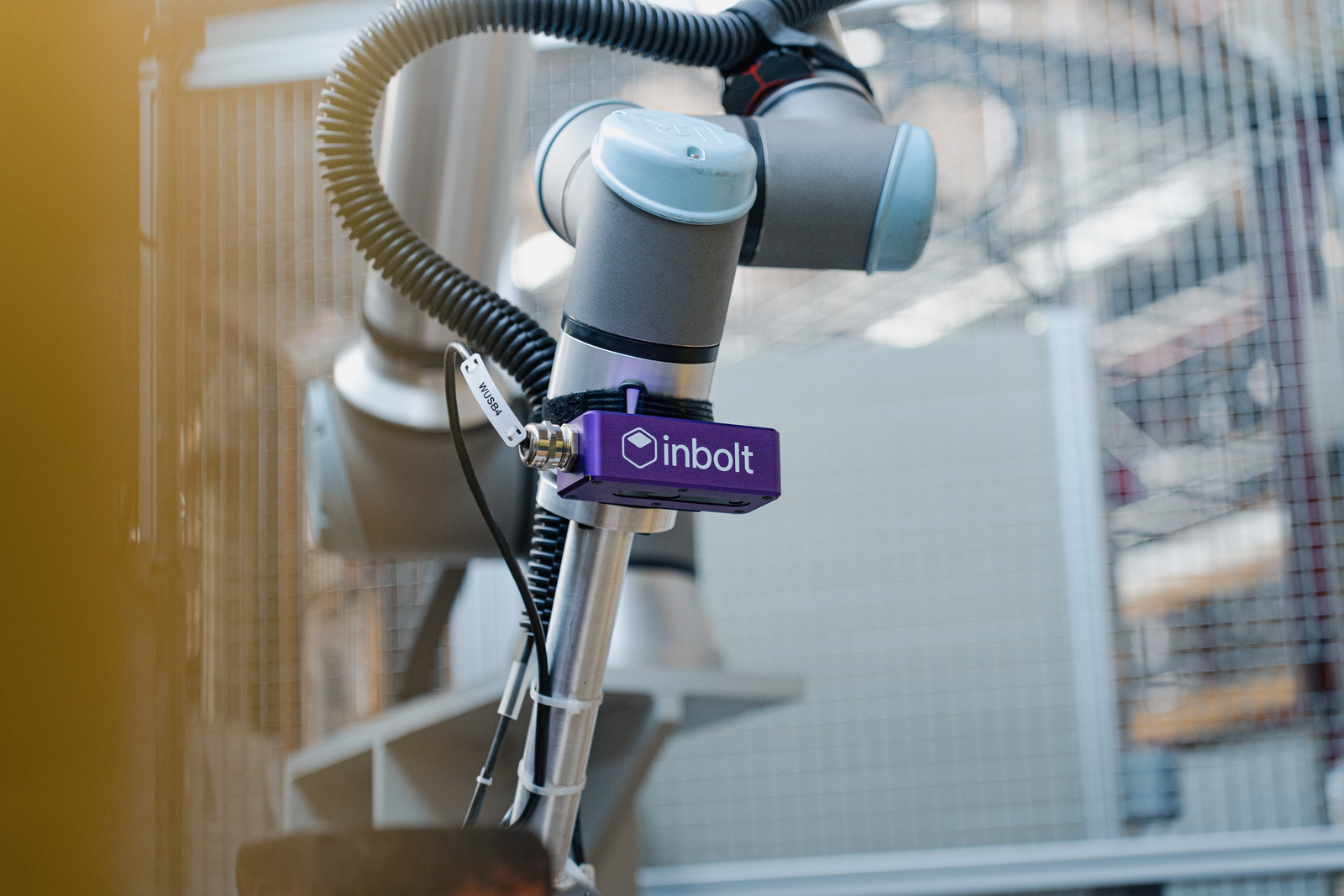
Universal Robots and the Paris-based vision-software company Inbolt announced on November 24, 2026, at the SPS trade show in Nuremberg that Inbolt's AI-guided 3D vision system now runs natively on Universal Robots' Gen 7 cobot controller. The integration removes the external industrial PC that vision-guided pick-and-place work has required until now, folding part recognition directly into the robot's own CB7 Core processor.
Inbolt was founded in 2019 by chief executive Rudy Cohen alongside Albane Dersy and Louis Dumas, and has built its business on a narrower premise than most robotics-AI startups: rather than teaching a robot to handle novel, unstructured objects, its software recognizes a known part from its computer-aided design file and corrects the robot's taught path to match wherever that part actually landed. The Paris company has raised capital from investors including Exor Ventures and expanded into the United States and Japan over the past year, with customers running its guidance software on robots from ABB, Fanuc, and Universal Robots.
The Vision System Moves Inside the Controller
Until this release, deploying Inbolt's software on a production line meant bolting on a separate industrial PC to handle the camera feed and path correction, then wiring a dedicated power and data run to a wrist-mounted sensor. That architecture worked, but it added a line item, a point of failure, and an integration step that a systems integrator had to price into every cell.
The native version collapses that stack. Inbolt Studio, the software used to train a part and set up a job, now runs as a URCap inside PolyScope X, Universal Robots' programming environment, so an operator calls vision commands from the same program tree used for ordinary URScript motion instructions. The 3D camera plugs into the power connector and 1 Gb Ethernet port already built into the g-Series tool flange, eliminating the external cable run along the arm. Part localization itself executes on the CB7 Core controller's processor, the same board that runs the robot's motion control, rather than on a box sitting beside the cell.
Training a new part takes under ten minutes, done locally from a CAD file with no image dataset to collect and no manual labeling pass. Production data stays on the machine rather than leaving the site, a detail that will matter more to contract manufacturers handling customer-owned part geometry than to the robot vendor's marketing copy. Anders Billesø Beck, Universal Robots' vice president of AI robotics products, framed the shift bluntly: with the camera and processing built into the standard hardware, vision guidance stops being an add-on project and becomes, in his words, a standard option for every new cell.
The announcement lands on home turf. Universal Robots, the Odense, Denmark-based company that effectively created the collaborative-robot category and has been owned by the US test-equipment maker Teradyne since 2015, chose SPS, Europe's largest industrial-automation trade show, to put the integration on a live demo floor rather than issue a press release alone. That matters for the audience this news targets: European discrete manufacturers facing the same labor-cost and reshoring pressure that has driven cobot adoption for a decade, now being told that a capability which used to require a systems integrator's quote can be ordered as a software option on hardware they may already own.
Why a Software Changeover Beats a New Fixture
The commercial case for this integration rests on a specific category of pain: high-mix manufacturing lines where a single robot cell has to handle dozens of part variants without a hardware changeover every time the production schedule shifts. Electronics assembly and data-center hardware manufacturing are the two verticals Universal Robots and Inbolt are naming directly, and the logic is straightforward. A fixture-based cell locates a part by constraining it mechanically, which means a new part geometry usually means a new jig, a new qualification cycle, and downtime while it's installed. A vision-guided cell locates the part computationally, so a changeover becomes a matter of loading a different CAD-trained program rather than swapping hardware on the floor.
Universal Robots and Inbolt cite a single program capable of switching among more than 80 part references as the practical ceiling of that flexibility today. Rudy Cohen's framing of the architecture change, that vision guidance now runs on the robot itself rather than beside it, points at the real audience for this announcement: not robotics researchers chasing generalization, but production engineers who need a cobot cell to absorb a schedule change without a weekend of re-tooling.
The companies' reference case is a Stellantis engine-tightening station, where Inbolt's guidance is credited with cutting tightening failures by 91 percent while adding roughly half a second of vision processing per engine to the cycle. That is a specific, auditable claim rather than a lab demo, and it's the kind of number a procurement team evaluating this integration should ask Universal Robots or Inbolt to reproduce against its own failure-rate baseline before signing off on a deployment, since a 91 percent reduction measured on one tightening application will not translate uniformly to, say, a depalletizing cell with far looser part tolerances.
The cost argument is where the native integration is likely to be judged hardest. An external industrial PC for a vision-guided cell typically runs a few thousand dollars in hardware alone, before accounting for the integrator's time to mount it, cable it, and validate the full stack as a single system. Folding that processing into a controller the buyer has already purchased does not just remove a line item; it removes a point of failure and a piece of equipment that has to be rack-mounted, powered, and kept running in a factory environment that an industrial PC was never quite as hardened for as the robot controller next to it. Universal Robots is effectively arguing that vision guidance should be priced and sold the way motion control already is, as a software capability of the robot rather than a bolt-on system integrators assemble project by project.
What the Integration Does Not Yet Cover
The native version is scoped narrowly, and buyers should read the fine print before assuming it replaces every vision-guidance use case on their floor. It targets stationary applications with parts in a repeatable orientation, meaning screwdriving, machine tending, rack loading, and depalletizing, not the kind of unstructured bin-picking where parts arrive jumbled at arbitrary angles. Repeatability is rated at 0.5 to 0.7 millimeters on fixed parts, a tolerance band that suits most electronics and light-industrial assembly but would need separate validation for tighter-tolerance work.
The fully native, no-external-cable configuration is also hardware-specific: it requires Universal Robots' newer g-Series arms, specifically the UR10g-1750, UR17g-1300, and UR18g-950 models, running PolyScope X version 10.13 or later. Operators running Universal Robots' older e-Series or UR Series robots on a CB7 controller can still use Inbolt's software, but the camera connects through an external cable rather than the integrated tool-flange connector, meaning the full simplification is a g-Series-only benefit for now. Pricing for the software itself was not disclosed in the announcement; Universal Robots says the integration will be orderable through its own channel and distribution partners "soon" and is listed on the UR+ Marketplace, its third-party accessory and software catalog.
Inbolt is not the first vision partner Universal Robots has carried on its UR+ Marketplace, which already lists third-party 3D cameras and guidance packages from vendors including Zivid and Roboception, and it competes for the same budget line as the vision systems built directly into rival arms from Fanuc and ABB. What distinguishes this release is not the camera or the algorithm, which Inbolt has sold as a standalone product for several years, but where the computation happens. Running part localization on the robot's own controller, rather than on a vendor-agnostic PC sitting beside the cell, is an architectural bet that the rest of the collaborative-robot industry is also making: push inference to the edge, onto hardware the buyer already owns, rather than treat AI as a separate appliance bolted onto a decades-old motion-control stack. If that bet pays off for Universal Robots and Inbolt, the harder question for competing vision-software vendors is whether they need their own controller-level partnership with every major cobot maker, or whether buyers increasingly expect the robot vendor itself to own the full stack.
The Numbers a Procurement Team Should Verify Next
Three figures carry the weight of this announcement, and each is worth confirming independently before it factors into a purchasing decision: the under-ten-minute training time per part, the 0.5-to-0.7-millimeter repeatability on fixed parts, and the more-than-80-part-reference ceiling for a single program. Universal Robots and Inbolt are demonstrating the integration live at Teradyne Robotics' booth at SPS 2026 in Nuremberg through November 26, which is the nearest opportunity for an integrator to see the training workflow and the repeatability claim tested on hardware rather than taken from a press release. Whether this becomes the default way cobot cells handle vision guidance, or stays a g-Series-specific convenience, will depend less on the demo floor than on how many of those 80-plus part references a real customer line actually needs to run without calling in an integrator.
This analysis synthesizes company statements and public product documentation as of late November 2026.
Disclaimer: This article is for general information purposes only and does not constitute investment, procurement, or professional advice. It synthesizes company statements as of publication.