RoboTechnik Opens a Hong Kong Share Sale
Suzhou automation vendor RoboTechnik opened a Hong Kong H share sale of up to HK$5.18 billion, about US$660 million, for photovoltaic and silicon photonics tools, not humanoids.


RoboTechnik Intelligent Technology, the Suzhou automation equipment maker already listed in Shenzhen as 300757, opened a Hong Kong H share sale on Monday 21 September 2026 that can raise as much as HK$5.18 billion, approximately US$660 million. The company is offering 11.9 million H shares at a maximum HK$436 a share, with the public book scheduled through 24 September and an expected Hong Kong Stock Exchange debut on the morning of 29 September. The deal is not a robotics IPO in the Unitree sense. It is a second listing for a factory equipment vendor that sells photovoltaic cell production lines and silicon photonics assembly and test tools into the same capital cycle that is funding humanoids.
That distinction matters for buyers. A humanoid listing sells a future labor substitution story. A RoboTechnik listing sells the machines that already sit upstream of solar wafers and optical engines. If the Hong Kong book fills near the cap, the company gains an offshore funding channel without waiting for another Shenzhen placement. If it fills poorly, the gap between a roughly US$15.5 billion A share valuation and a thin first half profit will be priced in public, in a market that has just watched Unitree Robotics lose about half its post listing value.
A Dual Listing, Not a New Robot Champion
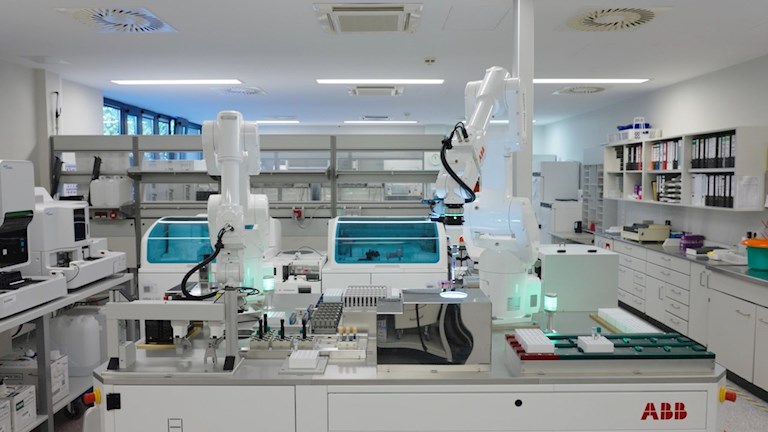
RoboTechnik is headquartered in Suzhou Industrial Park and makes high precision automation equipment for photovoltaic manufacturing and for silicon photonics used in data centers and AI infrastructure. Through its German subsidiary ficonTEC, it has argued for a leading position in ultra high precision photonic assembly and test, with equipment positioning precision cited in the nanometer range. That is a components and process story. It is not a humanoid, quadruped, or autonomous mobile robot story, and it should not be written as one.
Monday's terms are specific. The global offering is about 11.876 million H shares, commonly rounded in market copy to 11.9 million. Hong Kong public subscription is about 10 percent of the deal. International placing is about 90 percent. There is a 15 percent upsize option. The offer price will not exceed HK$436.00 per H share, in board lots of 50. At the cap, and at the Reuters conversion of HK$7.8451 per US$1, the headline proceeds are HK$5.18 billion, or about US$660 million. An earlier 18 September market leak had put the target near US$800 million. The Monday document is smaller and should be treated as the live figure. Pricing talk remains 24 September. Trading remains 29 September, subject to market conditions.
The books are being run by Huatai International together with Citigroup and Orient Securities International. Those names are a distribution statement. They tell overseas funds that the book will be run as a standard Hong Kong secondary listing, not as a private robotics round. Cornerstone language in Chinese market recaps says investors have agreed to buy or procure purchase of shares equal to about US$232.4 million at the offer price. That figure should be treated as disclosed marketing, not as a closed allocation, until the final prospectus names the accounts.
Use of proceeds, as described in the 21 September recap of the offering, is a capital expenditure map rather than a product launch. About 20 percent is earmarked for research and development. About 40 percent is earmarked for capacity expansion and faster delivery. About 10 percent is earmarked for a global sales and service network. About 20 percent is earmarked for potential strategic investment or acquisitions. About 10 percent is working capital. For a factory equipment vendor, the 40 percent capacity line is the operational tell. The company is raising Hong Kong dollars to put more tools on the floor, not to fund a consumer humanoid.
The first half of 2026 is the financial constraint sitting under that map. RoboTechnik reported revenue of about RMB 608.5 million, approximately US$85 million, for the six months ended 30 June 2026, up about 145 percent from RMB 248.5 million a year earlier. Net profit was about RMB 6.6 million, approximately US$0.9 million, a swing from a RMB 33.3 million loss. Earnings per share were about RMB 0.04 against a year earlier loss of RMB 0.21. Those are recovery numbers, not fat margin numbers. A company can grow revenue that fast and still have almost no cash conversion if tools are still being commissioned, if German integration costs are still running, or if customers are stretching acceptance tests.
Shenzhen shares had risen about 166 percent year to date by the 18 September leak, implying a market value near US$15.5 billion. That multiple on RMB 6.6 million of first half profit is the valuation argument Hong Kong will be asked to underwrite. It is also why this listing is a robotics adjacent capital story even though the products are not robots. Physical AI, solar, and optical interconnects have pulled automation equipment into the same multiple neighborhood as embodied AI names. Hong Kong is where that neighborhood gets tested against international books.
What the Money Is Actually Buying
The commercial question for factory buyers is not whether RoboTechnik can print H shares. It is whether a second listing changes delivery risk on photovoltaic and silicon photonics tools.
Photovoltaic cell lines are long cycle capital goods. A delayed tool does not just miss a quarter. It misses a wafer start date. Silicon photonics assembly and test tools are even less forgiving, because optical engines for AI clusters are sold against rack delivery calendars, not against a solar farm's construction window. A company that says 40 percent of proceeds will expand capacity is telling customers that the binding constraint has been slots, not demand. That can be true. It can also be a way to raise money against a backlog that still has to pass site acceptance.
The ficonTEC layer is the part of the story most likely to be oversold. A German precision house inside a Suzhou listed parent is a real asset if the integration is complete and if service engineers can support both photovoltaic and photonic tools from the same global network. It is a liability if the 10 percent sales and service allocation is too small to cover two continents and two process families. Buyers should ask for named service locations, spare parts lead times, and whether Hong Kong proceeds are ring fenced for photonic capacity or can be redirected to solar.
Compare that with the week's other China capital headlines and the difference is obvious. D-Robotics closed a US$400 million Series C last week to scale embodied AI chips. Unitree's Shanghai listing has already given up about half its opening value. Faraday Future put nine robots on sale on 19 September and is already on the public news record. RoboTechnik is none of those stories. It is a listed automation vendor using Hong Kong to buy an overseas balance sheet while its A shares trade at a humanoid era multiple. Mixing it into a humanoid funding roundup would mislead a procurement reader.
There is a second comparison that does belong. Hong Kong has become the overflow valve for mainland industrial names that want dollars, or at least Hong Kong dollars, without a United States listing. A secondary listing does not change the Shenzhen float. It adds a tradable H line, a new investor set, and a prospectus that international funds can underwrite. For a company whose tools sit in solar and AI hardware plants, that channel is more useful than another private round because customers and lenders can see a daily price. The cost is that the daily price will now reflect both photovoltaic capex cycles and silicon photonics order volatility.
Currency math should stay explicit. HK$436 at HK$7.8451 per US$1 is about US$55.58 a share. 11.9 million shares at that cap is about US$660 million. RMB 608.5 million at about RMB 7.2 per US$1 is about US$84.5 million of first half revenue. RMB 6.6 million is about US$0.9 million of first half profit. None of those conversions is a forecast. They are the only way a global reader can hold the dual listing and the A share valuation in the same frame.
The 18 September US$800 million leak should not be laundered back into Monday copy as if it were still live. Books shrink. Caps move. The live offer is the HK$5.18 billion maximum. Anything above that is a prior rumor. Anything below that, after 24 September pricing, is the actual raise.
How Buyers Should Read a Thin Profit Against a Fat Multiple
A factory that buys RoboTechnik tools should treat the listing as a credit and capacity signal, not as a product announcement.
If the book is covered and prices near the cap, the company has a hard currency war chest for the 40 percent capacity plan and the 20 percent acquisition sleeve. That can shorten queues. It can also tempt management into a second German or American bolt on before the first one is digested. The acquisition line is the risk that does not show up in a robot demo. Poorly integrated precision firms destroy delivery more reliably than they create it.
If the book is weak, the A share multiple becomes the story. A US$15.5 billion valuation on a first half profit of RMB 6.6 million is a physical AI era price. Hong Kong investors who just watched Unitree's drawdown do not have to underwrite that price. They can pass. A failed or heavily discounted H share sale would not stop Shenzhen trading. It would tell solar and photonics buyers that international capital is less willing to pay the embodied AI multiple for the equipment layer underneath it.
Either outcome should change diligence questions. Ask whether the Hong Kong proceeds are committed to named plants and named tool families. Ask whether photovoltaic and silicon photonics backlogs are separately disclosed, because a solar boom can hide a photonics slip, and the reverse. Ask whether ficonTEC revenue is consolidated in a way that survives a German service outage. Ask whether the 15 percent upsize, if exercised, funds inventory or another acquisition. Those are procurement questions dressed as equity questions.
Do not wait for a robot to appear in the prospectus. It will not. The robotics relevance is upstream. Humanoid and warehouse robot plants still need power, and AI clusters still need optical interconnects. The companies that sell the tools for those two bottlenecks are being priced as if they were part of the robot boom. Sometimes they are. Sometimes they are solar equipment firms with a photonics subsidiary and a fashionable multiple. Monday's filing is the moment Hong Kong is asked to decide which one RoboTechnik is.
A dual listing is a funding event, not a product event. The only number that will matter on 29 September is whether the H shares open with a buyer who still believes a RMB 6.6 million profit can carry a US$15 billion story. Until then, treat the HK$436 cap as a ceiling, treat the US$660 million as a maximum, and treat the machines, not the listing venue, as the thing a factory can actually purchase.
This analysis synthesizes company statements and public market activity.
This article is for informational purposes only and does not constitute investment, legal, or procurement advice.