OpenBMB Releases MiniCPM-Robot Compact Open Robotics Model Family
OpenBMB has released the MiniCPM-Robot family, featuring compact open-source models for generalist manipulation and embodied target tracking with Apache 2.0 licensing.
How much robotics capability can fit into a compact open model family?
On July 19, 2026, OpenBMB released the MiniCPM-Robot family, demonstrating that significant embodied artificial intelligence capabilities can operate within compact parameter constraints. The release includes a 1.5 billion parameter manipulation model and a 0.9 billion parameter tracking model, both available globally under an Apache 2.0 license.
Two Models Define Separate Deployment Paths
This release introduces an embodied intelligence model family specifically designed for real-world perception, decision-making, and action. The collection features two distinct systems tailored for different robotic tasks. The first system, MiniCPM-RobotManip, is a 1.5 billion parameter generalist vision-language-action (VLA) model focused on robot manipulation. The second system, MiniCPM-RobotTrack, is a 0.9 billion parameter embodied target tracker built upon the MiniCPM4-0.5B architecture.
OpenBMB, an open-source initiative focused on building foundation models and systems, has made these models available under the permissive Apache 2.0 license. The release includes developer-reported compute and latency data, benchmark context, and deployment workflows. By separating manipulation and tracking functions into distinct models, OpenBMB provides developers with targeted solutions that can be deployed based on specific hardware constraints and operational requirements. This modular approach challenges the prevailing assumption that effective embodied artificial intelligence requires massive parameter scales, offering a new pathway for on-device robotic intelligence.
The Technical Reality of Compact Robotics Models
The release of the MiniCPM-Robot family by OpenBMB introduces a significant development in the field of compact open-source robotics models, contributing to the broader discussion on embodied artificial intelligence chips and controller architecture. With parameter counts of 1.5 billion for the manipulation model and 0.9 billion for the tracking model, this release challenges the prevailing assumption that effective embodied artificial intelligence requires massive parameter scales. The models are released under the Apache 2.0 license, providing developers with accessible tools for building and deploying robotic systems. This approach prioritizes efficiency and specific task execution over generalized, resource-intensive architectures.
The MiniCPM-Robot family is divided into two distinct systems. The first is MiniCPM-RobotManip, designed for generalist manipulation tasks. The second is MiniCPM-RobotTrack, focused on embodied target tracking. By separating these functions, OpenBMB allows developers to deploy targeted solutions based on specific hardware constraints and operational requirements. This modularity is a critical factor in the practical deployment of robotics models, where computational resources and latency are often limiting factors.
Generalist Manipulation with MiniCPM-RobotManip
The MiniCPM-RobotManip model represents a focused approach to generalist manipulation. Operating with 1.5 billion parameters, it is designed to handle demanding manipulation tasks while maintaining a manageable computational footprint. The model utilizes streaming inference, capable of processing up to one minute of historical context. This capability is essential for tasks that require an understanding of sequential actions and environmental changes over time.
Deployment of the MiniCPM-RobotManip model is targeted at general hardware setups, with developer-reported compute requirements specifying an H100 graphics processing unit (GPU) using bfloat16 (BF16) precision. The reported model-forward latency is 120 milliseconds per decision step for a single frame. These specifications indicate a system designed for environments where moderate computational resources are available, balancing the need for demanding manipulation capabilities with the realities of hardware constraints. The reliance on H100 GPUs suggests that while the model is compact in parameter count, it still requires significant processing power for optimal performance.
To understand this in human terms, imagine trying to catch a ball while only being allowed to open your eyes once every second. You would struggle to predict where the ball is going. Traditional models often process information in this disjointed way, requiring massive computing power to re-evaluate the entire scene from scratch every time. Streaming inference, however, is like keeping your eyes open continuously. The model remembers the recent past, allowing it to understand motion and context smoothly without having to relearn the environment at every step. This continuous awareness drastically reduces the computing power needed to make decisions.
The integration of streaming inference allows the model to maintain a continuous understanding of its environment. This is particularly important in dynamic settings where objects may move or change state during a manipulation task. By retaining up to one minute of history, the model can make informed decisions based on recent events, improving its ability to execute multi-step sequences of actions.
Quotable insight: Compact parameter counts do not erase hardware constraints. Procurement teams still need to size compute, latency, power, and integration around the exact robotic task.
MiniCPM-RobotManip compresses each frame from 256 to 64 visual tokens. However, the requirement for an H100 GPU highlights a potential bottleneck for widespread deployment in resource-constrained environments.
Embodied Target Tracking with MiniCPM-RobotTrack
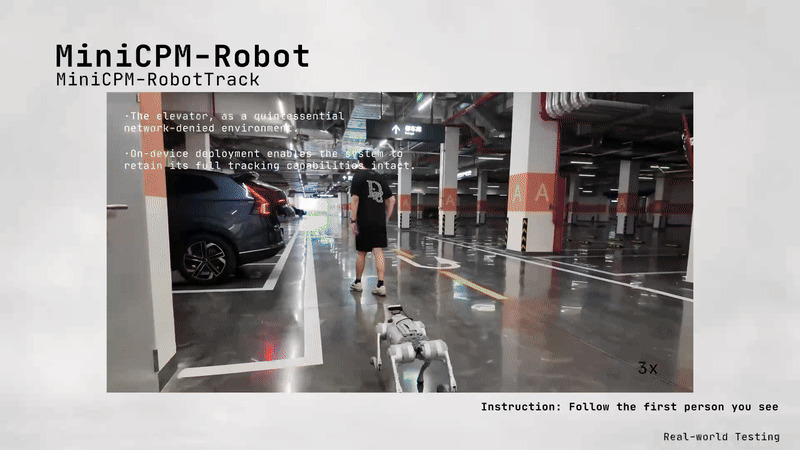
In contrast to the manipulation model, MiniCPM-RobotTrack is optimized for embodied target tracking with a highly constrained parameter count of 0.9 billion. This model is designed for single-frame or short-history context handling, reflecting the immediate, reactive nature of tracking tasks. The deployment target for this model is specifically noted as the Unitree Go2 EDU, indicating a focus on mobile, quadrupedal platforms.
The compute requirements for MiniCPM-RobotTrack are significantly lower than those for the manipulation model, specifying a Jetson Orin NX 16GB. This aligns with the model's focus on edge deployment, where power and computational resources are strictly limited. The developer-reported end-to-end latency is approximately 180 milliseconds. This latency figure is critical for tracking applications, where delays can result in lost targets or unstable movement. The model runs at 5 or more frames per second (FPS) on the Unitree Go2 EDU native onboard compute.
The focus on the Unitree Go2 EDU platform demonstrates a practical approach to hardware-software integration. By targeting a specific, widely available educational and research platform, OpenBMB provides a clear pathway for developers to test and deploy the tracking model. The use of the Jetson Orin NX further emphasizes the model's suitability for edge computing, allowing for real-time processing without the need for continuous cloud connectivity. This is a vital capability for mobile robots operating in varied and potentially disconnected environments. MiniCPM-RobotTrack addresses long-tail cases like target crossings, rapid turns, short occlusions, and multi-person intersections through Dataset Aggregation (DAgger) and self-evolving data pipelines.
Hardware-Software Integration Dependencies
The deployment of the MiniCPM-Robot family highlights several critical hardware-software integration dependencies. For the manipulation model, the reliance on H100 GPUs for optimal performance dictates a specific infrastructure requirement. This dependency limits the model's applicability in scenarios where such high-end compute resources are unavailable or impractical. The 120-millisecond model-forward latency must be considered in the context of the overall system latency, including sensor processing and actuator response times.
Conversely, the tracking model's integration with the Jetson Orin NX and the Unitree Go2 EDU platform presents a different set of dependencies. The system must efficiently manage power consumption and thermal output while maintaining the required processing speed. The approximately 180-millisecond end-to-end latency is a critical metric, as any increase could compromise the robot's ability to track moving targets effectively. Developers must carefully balance these factors to ensure stable and reliable operation in real-world environments.
The separation of manipulation and tracking functions into distinct models allows for more tailored hardware integration. A system requiring only tracking capabilities can be deployed on lighter, less power-intensive hardware, while a system requiring demanding manipulation can be allocated the necessary computational resources. This modular approach provides flexibility but also requires developers to carefully assess their specific needs and hardware capabilities before deployment. PhyAI adds Day-0 support for MiniCPM-Robot, increasing inference throughput on NVIDIA H20 from 10 Hertz (Hz) to 37 Hz.
Specific Failure Modes and Deployment Constraints
Understanding the specific failure modes and deployment constraints of the MiniCPM-Robot family is essential for practical application. For the manipulation model, the reliance on streaming inference with up to one minute of history introduces potential vulnerabilities. If the context window is interrupted or corrupted, the model may lose its understanding of the current task state, leading to incorrect or unsafe actions. Additionally, the 120-millisecond latency, while relatively low, may still be insufficient for highly dynamic tasks requiring immediate reactive responses.
The tracking model faces its own set of constraints. The single-frame or short-history context handling limits the model's ability to predict target movement over longer periods or through occlusions. If a target is temporarily obscured, the model may struggle to reacquire it without additional contextual information. The approximately 180-millisecond end-to-end latency also presents a challenge in high-speed tracking scenarios, where the target may move significantly between frames.
Both models are subject to the limitations of their respective hardware targets. The manipulation model's need for H100 GPUs restricts its use to well-resourced environments, while the tracking model's reliance on edge computing devices like the Jetson Orin NX requires careful management of power and thermal constraints. These hardware dependencies dictate the operational boundaries of the models and must be thoroughly evaluated during the system design phase.
Manipulation and Tracking Demand Different Systems
The following table provides a comparative analysis of the MiniCPM-Robot family, detailing the specific roles, parameter counts, context handling capabilities, deployment targets, compute requirements, latency, and licensing for each model.

Note: Based on OpenBMB reported specifications and measurements.
This comparison illustrates the distinct design philosophies behind the two models. The manipulation model prioritizes historical context and demanding processing, requiring significant computational resources. In contrast, the tracking model focuses on immediate, reactive processing suitable for edge deployment on mobile platforms. Both models share the Apache 2.0 license, promoting open access and modification by the developer community. Competitors for manipulation include π₀ (3B), π₀.₅ (3B), Abot-M0 (4B+), StarVLA-α (4B+), Qwen-VLA (5B+), and LingBot-VA (5B+). Competitors for tracking include TrackVLA (7.8B+), TrackVLA++ (7.8B+), Qwen-RobotNav (4.4B+), and OmTrackVLA (1.0B+). All competitor comparisons are based on developer-reported benchmarks in the official repository.
Evaluating Real-World Viability
The true test of the MiniCPM-Robot family will be its viability in real-world deployment scenarios. The models must demonstrate reliable performance outside of controlled laboratory environments, handling the unpredictability and noise inherent in physical spaces. The tracking model's performance on the Unitree Go2 EDU platform provides a starting point for evaluating mobile deployment, but further testing across diverse hardware and environments is necessary.
The manipulation model's ability to execute demanding tasks using streaming inference must be validated in practical applications, such as industrial automation or assistive robotics, where understanding industrial robot applications is crucial. The 120-millisecond model-forward latency must be evaluated in the context of complete system response times to ensure safe and effective operation. Identifying and mitigating specific failure modes during these real-world tests will be critical for the models' long-term success.
The open-source nature of the release facilitates this real-world evaluation by allowing a broad range of developers to test the models in various applications. This distributed testing approach will generate valuable data on the models' strengths and weaknesses, guiding future updates and improvements. The success of the MiniCPM-Robot family will depend on its ability to deliver consistent, reliable performance across a wide spectrum of deployment scenarios.
Compact Models Still Carry Hardware Costs
The OpenBMB MiniCPM-Robot release provides a tangible example of how targeted, compact models can address specific challenges in embodied artificial intelligence. The separation of manipulation and tracking functions allows for optimized hardware integration, catering to both high-compute and edge-deployment scenarios. While the developer-reported metrics require independent verification, the open-source nature of the models encourages community validation and iterative improvement.
The reliance on specific hardware configurations, such as the H100 GPU for manipulation and the Jetson Orin NX for tracking, dictates the operational boundaries of the models. Developers must carefully evaluate these dependencies and the associated failure modes before integrating the models into their systems. The success of the MiniCPM-Robot family will depend on its ability to perform reliably in real-world environments, handling the unpredictability and noise inherent in physical spaces.
The availability of these models under the Apache 2.0 license lowers the barrier to entry for developers and researchers, fostering innovation and collaboration within the robotics community. As the industry continues to evolve, the development of compact, efficient models like MiniCPM-Robot will play a crucial role in the widespread deployment of intelligent robotic systems. The focus must remain on practical, real-world viability, ensuring that these models can deliver consistent performance across a diverse range of applications and environments.
This analysis synthesizes company statements and public market activity.
Image credit: OpenBMB
Disclaimer: This article is provided for informational purposes only and does not constitute investment, legal, technical, or business advice. It synthesizes verified primary-source materials available on July 19, 2026. Product specifications, event schedules, benchmarks, and performance claims remain subject to independent verification. Readers should conduct their own due diligence before making commercial or technical decisions.