LimX Dynamics pre IPO raises US$200 million 2026
LimX Dynamics closed a US$200 million pre initial public offering round in July 2026, lifting the Chinese embodied artificial intelligence company to a US$2.2 billion valuation. The funding follows an earlier US$200 million raise this year, bringing LimX’s 2026 total to about US$400 million. Capital will scale production for TRON, a multi form robot platform spanning full sized bipedal humanoid Oli and wheeled humanoid Luna. The company showcased both at ChinaJoy 2026 in Shanghai, signaling a push beyond research pilots into paid deployments. The raise underscores a broader Chinese surge in humanoid and embodied platforms, where form factor bets are proliferating and consolidation pressure is building as companies face yield, reliability, and unit cost realities on the road to mass manufacturing.
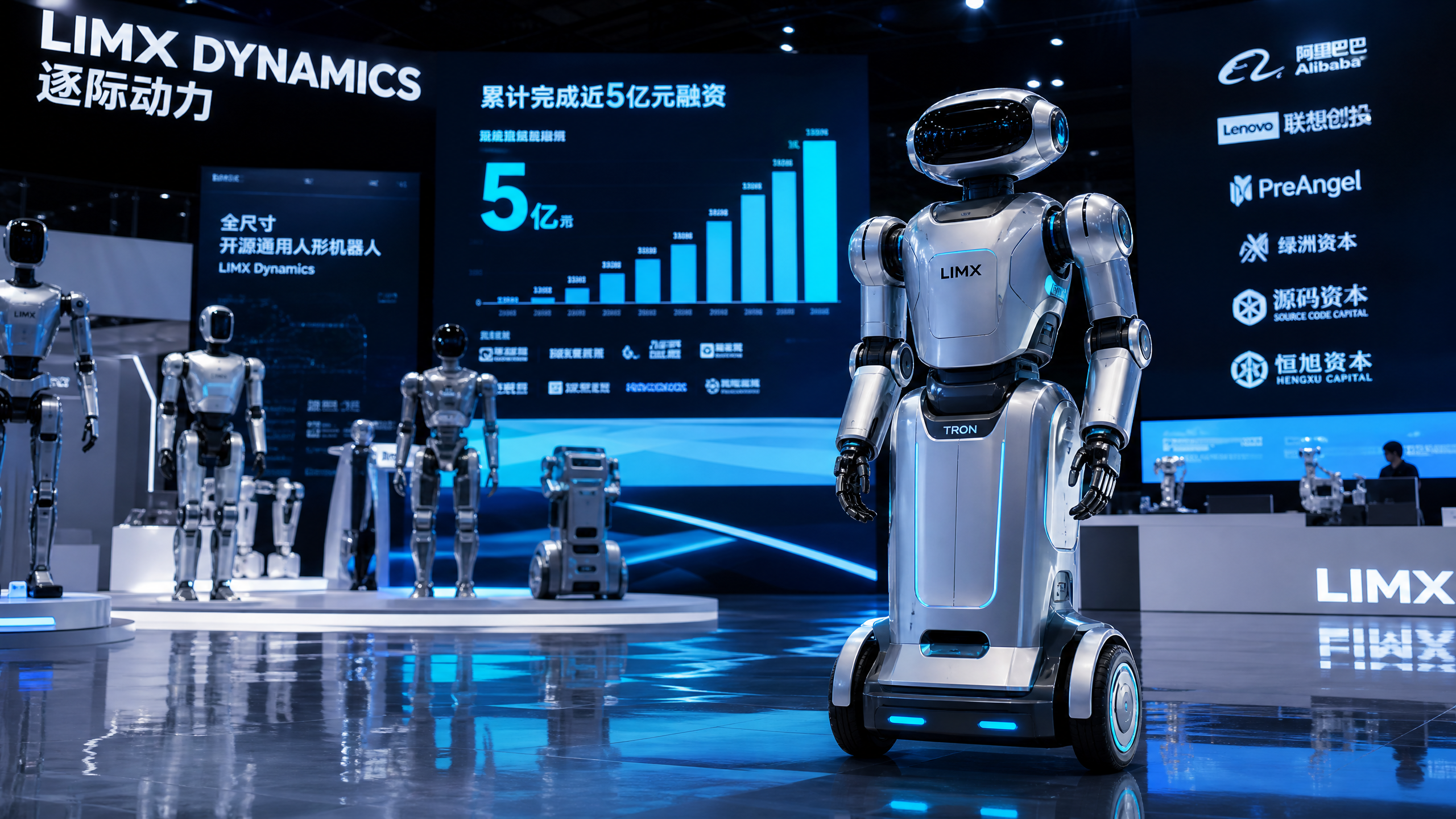
LimX Dynamics closed a US$200 million pre initial public offering round in China to scale production of its TRON platform and its Oli and Luna robots in July 2026, following public demos at ChinaJoy 2026 in Shanghai.
LimX Dynamics is a Shenzhen headquartered robotics firm focused on embodied AI systems. Its core technology stack blends visual and tactile perception with reinforcement and imitation learning policies running on edge compute, wrapped in a modular electromechanical design. The market niche targets industrial service tasks such as inspection, materials handling, and human facing workflows where humanoid and humanoid adjacent form factors can slot into existing environments.
Funding Locks Fuel for Production Scale
LimX Dynamics has raised approximately US$400 million in 2026, including the July pre initial public offering round at a US$2.2 billion valuation. That is rapid capitalization by any standard and places LimX within the top flight of Chinese embodied AI ventures by cash on hand. The use of proceeds is pragmatic. Tooling up for volume, securing long lead actuators and reducers, building motor and gear manufacturing partnerships, expanding end of line testing, and hardening software validation pipelines. The company signaled a move from one off pilots toward hundreds of units shipped over the next 12 months, with a near term focus on controlled environments and paid trials.
The speed of fundraising across Chinese humanoid and embodied platforms in 2026 has been striking. Several peers have reached nine figure rounds, provincial industrial funds have accelerated matching capital, and component makers are adding capacity for torque dense actuators and harmonic reducers. Cheap capital is not the full story. Government linked industrial parks are also offering rent deferrals, production subsidies, and tax offsets that compress payback periods for assembly lines. The combination reduces time to scale by quarters, not months.
TRON Platform bets on Multi-form Adaptability
TRON is LimX Dynamics’ umbrella platform designed to share core modules across distinct morphologies. The premise is simple. One compute core, one actuator family, one sensor suite architecture, multiple robot bodies. That reduces bill of materials diversity, simplifies supplier qualification and lets the software team ship a unified embodied intelligence stack. In practice, multi form means bipedal limbs for Oli and a wheeled base with articulated upper body for Luna. Common joints, drives, harnessing, and software interfaces are intended to keep service costs manageable and enable field swappability.
The platform approach echoes automotive skateboard chassis thinking. Put batteries, motors, and control in a repeatable package, then dress it for the job. The analogy helps frame both opportunity and risk. A skateboard makes sense once you have two or more winning models on top of it. If demand concentrates around one morphology, shared modules can just add compromise. The skeptic will also point out that shared actuators which are optimal for biped dynamic locomotion may be over specified and overpriced for a wheeled base that lives in flat factories. The counter to that is an inventory advantage that keeps lead times short across products during ramp.
Oli Humanoid Targets Heavy Pick and Inspection Pilots
Oli is a full sized humanoid robot designed for manipulation and mobility in brownfield spaces. The company positions Oli for heavier pick assist, machine tending, and visual inspection in plants and warehouses with frequent changeovers. Expect a device in the 35 to 45 kilogram class with high torque joint modules in hips and knees, a four to six hour duty cycle per charge in low to moderate exertion tasks, and embedded redundancy to meet safety standards for human proximity.
The commercial pitch aligns with corporate pilots that have proliferated in 2026. Operators want to see a biped traverse steps, open doors, handle totes, and press buttons without reconfiguring the building. For buyers, the gating items are uptime and field serviceability. A humanoid that requires a bench after two hours is a curiosity, not a tool. LimX is talking about swappable limbs and sealed joint modules with field level diagnostics. If those service designs survive real deployments, they offer a pathway to 90 percent plus availability within shifts. If not, maintenance burden will erase any wage arbitrage.
Luna Wheeled Humanoid Chases Cost and Uptime
Luna positions on the other side of the form factor split. A wheeled base with a humanoid upper body promises simpler locomotion, higher battery efficiency, and less wear on joints. For tasks that do not require stairs, such as cart push, aisle scanning, pick to light assistance, and front of house guidance, wheels are often good enough. Uptime tends to be higher, parts are cheaper, and path planning is less compute hungry.
The tradeoff is capability at the edges. Wheels falter at curbs, ladders, and poorly aligned docks. Yet most factories and large stores have flat floors and ramps. If Luna ships at a hardware bill of materials below US$15,000 at moderate volume and a sale price below US$40,000 with service, it will find buyers for routine work. That is why form factor proliferation is rational. The market will reward both biped and wheeled humanoid designs, as long as each is priced against the job to be done.
ChinaJoy Demo Signals Consumer Grade Polish
Showcasing at ChinaJoy 2026 put LimX in front of a mass audience that expects polish. The event is not an industrial fair, yet it is a stress test for human robot interaction and reliability. Demos that run for hours without handlers propping up robots are not trivial. Strong showings at public expos help de risk user interface, voice, gesture, and safety interlocks. They also supply a pipeline of enterprise leads who attend in force from consumer electronics and entertainment sectors.
Exhibition appearances should not be confused with certification or production readiness. That is the skeptical counterpoint. A stage is not a factory and a choreographed routine is not a line change. Investors should treat trade show footage as a top of funnel indicator, not a proof of capability. On the positive side, the product fit and finish noted at ChinaJoy suggests LimX can traverse the gap from prototype to pilot ready with less rework than some peers.
Capital Flows Flood Chinese Embodied AI in 2026
The 2026 cycle in China has seen embodied AI companies raise at a clip rarely matched elsewhere. Humanoid focused ventures, wheeled humanoid builders, and multi form platforms have all tapped nine figure rounds. Provincial and municipal funds have been active limited partners. Corporate venture units from electronics and automotive groups have also participated to secure early access to software and actuators. This is not just headline money. Tier two suppliers of reducers, bearings, motors, and battery management systems are adding lines in Suzhou, Ningbo, and Dongguan.
One geographic insight sums it up. In the Yangtze River Delta you can still book castings in two weeks if you can pay, said a Suzhou factory manager. That shortens ramp timelines and enables flexible minimum order quantities in early runs. It also pressures startups to move fast, since competitors can access the same supply elasticity. Speed is a feature of the Chinese manufacturing system. It is also a forcing function. Poor designs can reach scale before their flaws are discovered.
Form Factor Divergence Creates Parallel Roadmaps
Buyers now face a menu of options. Full bipeds promise maximal environmental compatibility and human equivalence in physical reach. Wheeled humanoids trade ultimate capability for cost, endurance, and uptime. Multi form platforms, like TRON, propose unified spares and a common intelligence layer. The divergence is healthy at this stage. Specialization reduces waste. The risk is fragmentation in software interfaces, safety standards, and service training. Procurement teams will see a rising cost in integrating workflows across divergent robot types if vendors do not align on interfaces and data models.
A plain language analogy helps. Think of your fleet like a toolbox. A biped is the adjustable wrench. It fits anything in theory but it is heavier and sometimes slips. A wheeled humanoid is the socket set. Faster and more reliable for standard sizes but useless on odd jobs. A multi form platform bets that the wrench and sockets share the same handle. Sensible, as long as the handle does not break under load.
Manufacturing Reality Tests Torque Density and Yields
The most substantial risk for every embodied AI builder in China is not software. It is physical reliability, yield, and unit cost during scale. Bipedal robots need high torque density at human scale joints. That demands precision machining, reliable thermal management, and consistent motor windings. Reducers must survive millions of cycles under shock loads. Cables and harnesses must endure repeated twists without micro fractures. End of line calibration needs to be automated to avoid weeks of technician time per unit.
Yield is the silent killer. If a joint module takes 12 hours of assembly with a 70 percent first pass yield, cost balloons and schedules slip. If that module moves to eight hours at 90 percent first pass yield after six months, margins recover. The ramp hinges on dozens of such micro transitions. Battery pack supply will also be a watch item. Multi shift duty cycles require fast charging or hot swap packs with robust connectors. That adds wear points and safety steps.
Consolidation Window Opens as Unit economics Decide Winners
Chinese embodied AI looks crowded in mid 2026. Well known names have cash, yet the number of credible suppliers still exceeds likely buyer diversity. The transition from research and staged demos to multi site deployments will reduce the field. A handful will show unit economics that justify scale. Many will not. Expect mergers between teams that have strong software but weak actuators and those with reliable hardware but thin autonomy stacks. Expect acqui hires into industrial groups that want humanoid options but do not want to build from scratch.
Capital will get more selective. Late 2026 and 2027 funding will favor companies with repeat orders, 5,000 hour reliability data, and credible cost down roadmaps. The near certain path for others is specialization into subsystems. A standalone actuator vendor with real yields and margins can make a good business. A chassis supplier with a robust wheeled base and certified safety stack can supply multiple humanoid brands. The gravity toward ecosystem roles is familiar from the electric vehicle supply chain.
What Procurement Leaders should ask Vendors Now
Decision makers evaluating LimX and its peers can reduce risk by standardizing a few diligence questions.
- What is the current first pass yield for your top three joint modules and what is the target by Q1 2027
- What is the field replaceable unit strategy for actuators, controllers, and harnesses and what tools are required at my site
- What is the measured mean time between failure across locomotion and manipulation subsystems under my task profiles
- What is the end to end spare parts lead time at 100 units deployed and at 1,000 units deployed
- What safety certifications are completed today and what is the schedule for additional certifications required for my sites
- What is the multi year cost down plan and which components deliver the largest drops in 2027 and 2028
Straight answers will separate prototypes from products. Technology roadmaps should be specific, with named suppliers or in house capacity plans, not just slides with arrows trending down. Service arrangements should specify response time, escalation steps, and replacement pools. Data interfaces should be documented and stable. Without these, buyers will spend more on integration than on robots.
Implications for LimX Dynamics and Peers
LimX’s US$200 million pre initial public offering round buys time and option value. The company can run parallel production lines for Oli and Luna without starving either. It can invest in joint module automation and put buffer stock in place before larger orders land. It can place forward orders for reducers and motors to secure build slots through 2027. It can also sustain a longer learning cycle in the field to refine policies and edge cases, rather than being forced into a risky mass launch.
The flip side is expectation pressure. A US$2.2 billion valuation implies a path to hundreds of millions of US dollars in revenue within a few years. That requires thousands of units at four to five figure margins per unit, or substantial software and service contracts layered on top. The company’s multi form pitch is defensible, but only if both Oli and Luna find strong repeat use cases. If one lags, the shared platform advantage thins. Investors and enterprise customers will watch delivered uptime, service incidents, and cost down velocity more than demo videos.
Software Stack Maturity will Decide Fleet Value
There is a lot of talk about foundation models for robots in 2026. The practical test is whether policy learning, simulation to real transfer, and reinforcement learning in the loop reduce on site training time. If a new task can be learned from a few human demonstrations and then shared across a fleet, the platform gains compounding value. If each site requires weeks of tuning, the economic promise collapses. LimX pitches an embodied intelligence layer that moves across morphologies. Success on this front would justify the TRON thesis even if hardware margins are thin early.
Edge compute and thermal budgets matter as well. Running larger models on board means additional heat and power draw. That shortens duty cycles and stresses joints. Smart scheduling between edge and cloud, plus efficient policy distillation, is no longer research theater. It is a product constraint. Buyers should ask for task learning curves and energy consumption profiles under real workloads.
Geo Industrial Context Shapes the Next 18 Months
The Chinese ecosystem provides unique tailwinds. A dense supplier base within the Yangtze River Delta and the Pearl River Delta makes iteration cycles faster. Contract manufacturers can turn out pilot runs in weeks. Government programs can underwrite capital expenditure for lines and fixtures. Certification bodies are engaging with humanoid and wheeled humanoid safety frameworks at speed. These structural advantages will pull embodied AI to market faster in China than in most regions.
The risks are mirrored. Entrants with thin differentiation can still reach scale because the machine is well tuned. Surprises in the field will surface in parallel across many teams. That creates a higher likelihood of visible failures, followed by abrupt retrenchment. Consolidation will not be polite. Winners will be selected by delivery and yield, not by sentiment.
LimX Dynamics just bought a manufacturing runway and a chance to prove that a multi form platform can translate capital into reliable robots at scale. The money is real, the prototypes look credible and the showcase was timed well. Now the market will adjudicate on uptime, field service, and unit economics. In 2026 the embodied AI story in China moves from promise to production. There will be more raises, more demos and more consolidation. The companies that survive will be the ones that ship and keep shipping.
Disclaimer
This content is for informational purposes only and does not constitute investment, legal, or engineering advice. No warranty is made as to completeness or accuracy. Always perform independent due diligence before making commercial decisions.