Kodiak AI Puts AMD EPYC Server Chips in Driverless Semi Trucks
Kodiak AI is the first autonomous-trucking company to deploy AMD EPYC server processors in production driverless hardware, addressing a sensor-fusion compute bottleneck ahead of its planned public-highway launch later in 2026.

Kodiak Puts AMD Server Chips Inside a Driverless Semi
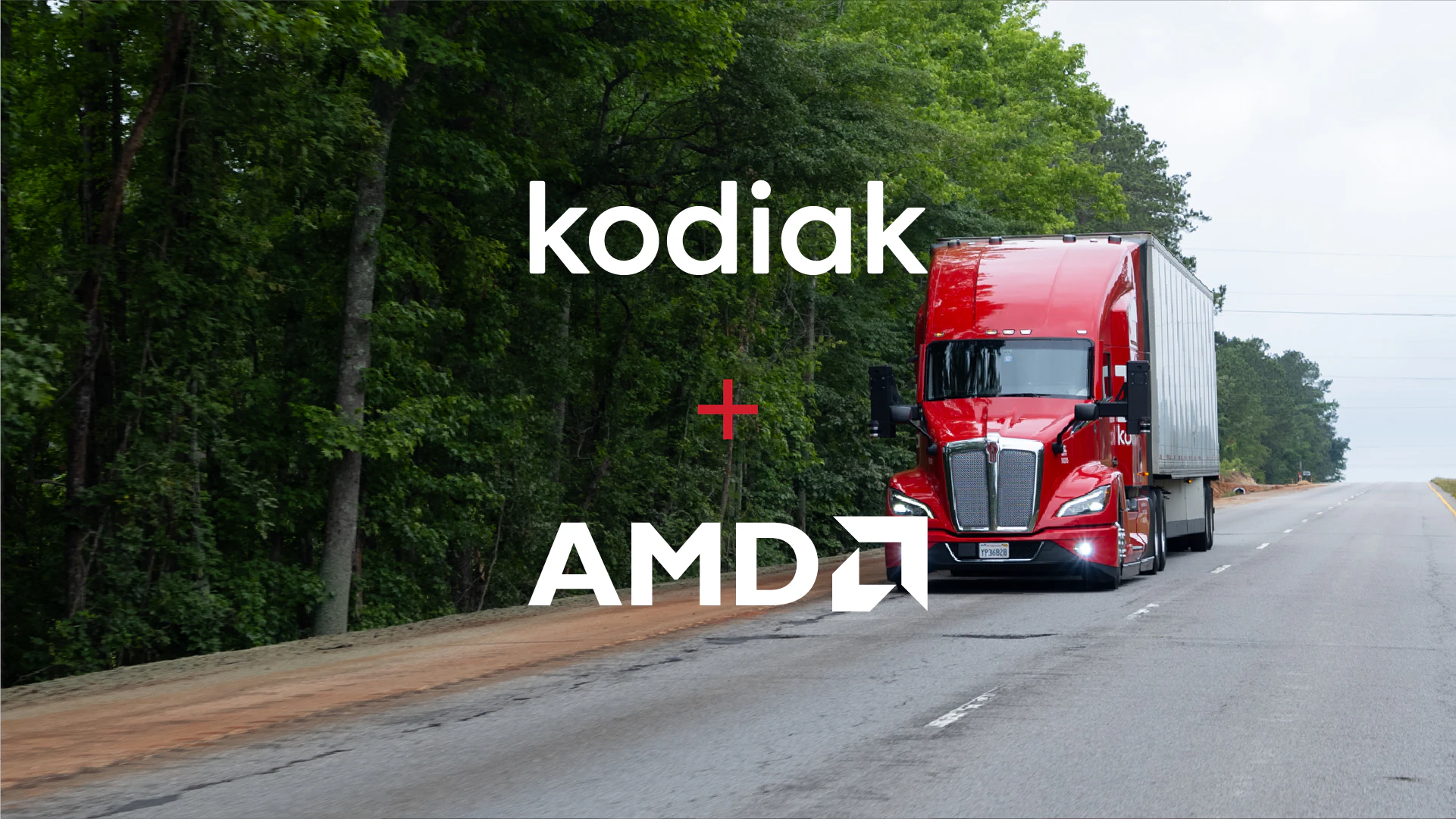
Kodiak AI said Wednesday it has begun deploying AMD EPYC server processors inside the compute stack of its seventh-generation Kodiak Driver platform, making it the first autonomous-trucking company to put that chip family into production driverless hardware. Kodiak AI, formerly Kodiak Robotics, is a Mountain View, California-based autonomous-trucking company founded in 2018 that went public in 2025 through a SPAC merger with Ares Acquisition Corp. II at an implied valuation of roughly US$2.5 billion, and it currently operates fully driverless Class 8 trucks with no human safety operator across the Permian Basin, hauling oilfield proppant under commercial contract while preparing a public-highway driverless launch later this year.
The specific problem the AMD chips solve is not the part of autonomous driving that gets the most public attention. Perception models, the neural networks that identify lanes, vehicles, and obstacles from camera and lidar input, tend to dominate autonomous-vehicle coverage because they map most directly onto the "can it see" question a general audience asks first. But before a truck's autonomy stack can reason about what it is seeing, it has to aggregate and preprocess a continuous, high-bandwidth stream of raw sensor data from multiple lidars, cameras, and radars simultaneously, a workload that is latency-sensitive and difficult to parallelize across many small cores the way a modern AI accelerator handles matrix math. That aggregation and preprocessing layer is where Kodiak is placing the EPYC processors, running alongside the specialized AI accelerators that handle perception and path-planning inference rather than replacing them.
Why General-Purpose Compute Still Matters in an Accelerator-First Industry
The autonomous-vehicle industry's compute narrative over the past several years has centered almost entirely on AI accelerators, the specialized chips built to run neural-network inference as fast and efficiently as possible. That framing is not wrong, accelerators are genuinely the component doing the heaviest perception and planning workloads, but it obscures a structural requirement underneath: an autonomy stack still needs a capable, high-throughput general-purpose processor to manage the sensor-fusion pipeline, coordinate data flow between subsystems, and run the safety-critical, deterministic-timing code that accelerators are not architecturally suited to handle. AMD's pitch to Kodiak, articulated by Wayne Lyons of AMD's data center and embedded systems group, framed the deal in exactly those terms. "Physical AI is pushing computing into some of the most complex and data-intensive environments in the world," Lyons said, a description that positions autonomous trucking as one instance of a broader category, physically deployed AI systems operating outside a controlled data-center environment, that AMD is targeting as a new demand driver for its server silicon beyond its traditional cloud and enterprise customer base.
Kodiak's chief executive, Don Burnette, framed the partnership in more direct commercial terms. "AMD EPYC CPUs give us the compute capabilities we need to advance the Kodiak Driver and continue commercializing autonomous trucking," Burnette said, a statement that ties the chip decision explicitly to Kodiak's near-term commercial roadmap rather than presenting it as a purely technical upgrade. That framing matters because Kodiak is not a research program evaluating hardware in the abstract, it is a publicly traded company with a live commercial deployment in the Permian Basin and a stated near-term goal of adding public highway routes, and its compute decisions are constrained by the same considerations any procurement team faces: power draw, thermal budget, supplier reliability, and total cost per vehicle at fleet scale.
The Off-Road-to-Highway Compute Problem
Kodiak's current commercial deployment sits in an unusually constrained operating environment. Driverless trucks hauling proppant across Permian Basin oilfield routes with no human operator aboard have effectively zero tolerance for a compute failure that causes a missed obstacle detection or a delayed path-planning update, because there is no driver available to intervene if the software falls behind the sensor stream. That constraint is precisely what makes the sensor-fusion and preprocessing layer, the part of the stack AMD's EPYC chips are handling, as operationally critical as the perception model itself. A truck can run a slightly less capable perception model and still operate safely at reduced confidence; a truck that cannot process its incoming sensor data fast enough to keep its world model current is not a safety-degraded system, it is a system that has stopped functioning as intended.
Kodiak's stated plan to extend driverless operation onto public highways later in 2026 raises the stakes on that same compute requirement rather than easing it. Highway environments introduce a wider range of traffic scenarios, higher closing speeds between vehicles, and less predictable behavior from other road users than a controlled oilfield route, all of which increase the volume and complexity of sensor data the compute stack has to process in real time. A hardware decision made now, while the company is still primarily operating in the more forgiving Permian Basin environment, is effectively a bet on what compute headroom the public-highway deployment will require, and Kodiak choosing to add server-grade AMD processors rather than relying solely on its existing accelerator hardware suggests the company judged its current sensor-fusion throughput insufficient for that harder operating environment even before the highway launch begins.
Reading the Deal Against Kodiak's Broader Commercial Position
Kodiak's business extends beyond long-haul freight into industrial logistics and defense-adjacent, off-road autonomy missions, a diversification that distinguishes it from autonomous-trucking peers focused exclusively on highway freight lanes. The company's Kodiak Network already spans more than 18,000 miles of freight-dense commercial lanes through partnerships with logistics operators including Pilot Company and Ryder System, and its oilfield deployment with Atlas Energy Solutions marked the industry's first fully driverless, customer-owned commercial semi-truck service. A compute platform that has to satisfy the reliability requirements of a defense-adjacent off-road mission and the throughput requirements of a public highway freight lane simultaneously is a harder engineering target than either use case alone, and it is a reasonable explanation for why Kodiak reached for server-class general-purpose silicon rather than treating its existing accelerator stack as sufficient.
For a fleet operator or logistics partner evaluating whether to route freight through Kodiak's network, the AMD announcement is a useful, if indirect, diligence signal. It does not by itself prove the seventh-generation Kodiak Driver platform is safer or more capable than a competitor's stack, hardware specifications alone rarely settle that question, but it does show a publicly traded company with disclosure obligations making a specific, named hardware commitment tied explicitly to its next phase of commercial expansion rather than describing compute upgrades in vague terms. AMD, for its part, gains a visible reference deployment for EPYC processors in physical-AI applications outside the data center, a category it has publicly identified as a growth vector, and a successful highway deployment later this year would be the clearest validation of that positioning available to AMD's other prospective embedded and physical-AI customers.
What the Supplier Choice Signals to Rival Fleets
Kodiak's decision to name AMD publicly, rather than describing the upgrade only in general terms, also carries competitive weight in a driverless-trucking field where several well-funded rivals are racing toward the same public-highway milestone on similar timelines. A logistics buyer comparing Kodiak against other autonomous-trucking suppliers has historically had to rely on each company's own safety and readiness claims, which are difficult to verify independently and rarely disclose specific hardware. A named, on-the-record chip partnership gives a procurement team something more concrete to ask competing vendors to match or explain: which general-purpose compute vendor underpins their sensor-fusion pipeline, what redundancy exists if that supplier faces a shortage, and whether the platform has been validated at the same combination of off-road and highway operating conditions Kodiak is now targeting. Vendors unwilling or unable to answer that level of detail should be treated as a weaker diligence position, not necessarily a weaker product, since some competitors may simply be earlier in their own public-disclosure cycle.
The Supply Chain Question Behind Any Single-Vendor Commitment
Naming a specific chip supplier also introduces a concentration risk that a fleet operator evaluating Kodiak as a long-term logistics partner should weigh directly. AMD's EPYC line is a mature, high-volume server product with a broad manufacturing base, which reduces the acute shortage risk that has periodically affected more specialized automotive and robotics silicon, but it does not eliminate the exposure a trucking company takes on by tying its safety-critical compute stack to one processor family from one supplier. A logistics partner with high-value, time-sensitive freight should ask Kodiak directly what its qualified second-source or fallback compute plan looks like if AMD faces an allocation constraint during a period of high data-center demand, since server-grade chips are shared across data-center, enterprise, and now physical-AI customers competing for the same production capacity. That is a standard supply-chain diligence question for any single-sourced safety-critical component, and the specificity of Wednesday's announcement makes it a more answerable one than it would be against a vaguer "advanced compute" description.
Disclaimer: This article is for general information purposes only and does not constitute investment, legal, or procurement advice. Readers should verify details with primary sources before making business decisions.