Google Confirms Gemini Robotics ER 2 as Its Most Capable Embodied Reasoning Model and Yaskawa Deploys It in Industrial Robots
Google's official July 2026 AI recap confirms Gemini Robotics ER 2 as the company's most capable embodied reasoning model, enabling natural conversation, environmental understanding, and complex multi-step task execution. Yaskawa has already deployed the model in its MOTOMAN NEXT AI Robot, marking the first major industrial robot manufacturer to integrate a Google AI model at the product level.
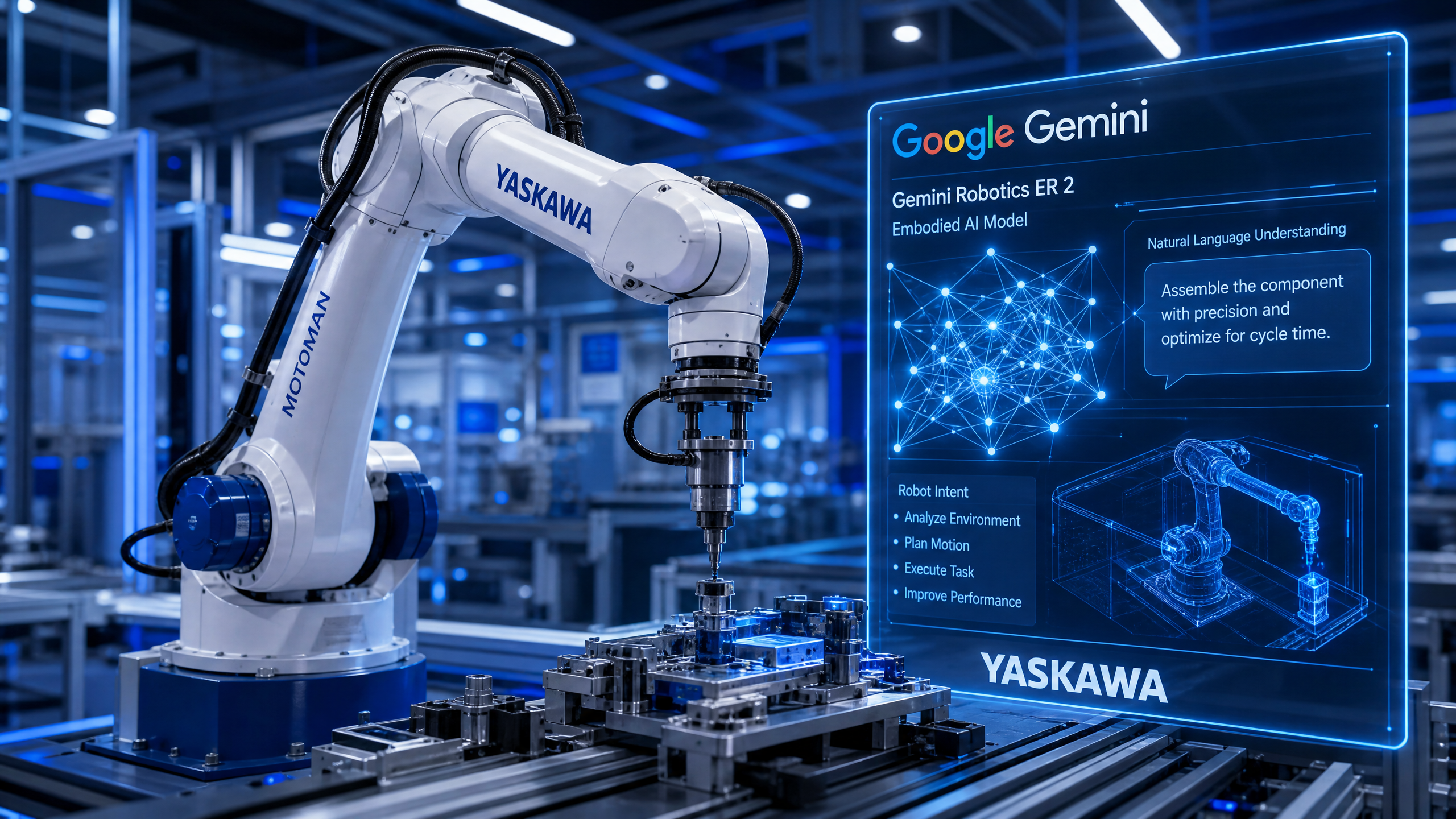
Google has confirmed Gemini Robotics ER 2 as its most capable embodied reasoning model in the company's official July 2026 AI recap, published on August 4. The model, which bridges what Google describes as the gap between digital intelligence and physical world interaction, enables robots to hold natural conversations with people, understand their environment in three dimensions, and execute complex multi-step tasks that require both reasoning and physical manipulation. Yaskawa, the Japanese industrial robot manufacturer, has already integrated the Gemini model into its MOTOMAN NEXT AI Robot, making it the first major industrial robot company to deploy a Google AI model at the product level.
The confirmation matters because it moves Gemini Robotics ER 2 from a research announcement to an officially supported product. The July 30 DeepMind blog post that introduced the model was a technical announcement aimed at researchers and developers. The August 4 official Google AI recap is a product communication aimed at enterprise customers and partners, and it signals that Google is treating embodied AI as a commercial priority rather than a research experiment.
The Technical Capabilities That Set ER 2 Apart
The Gemini Robotics ER 2 model is designed to serve as the high-level reasoning layer for a robot -- the part of the system that understands what a human wants, interprets the environment, and decides what sequence of actions will achieve the goal. This is distinct from the lower-level control systems that manage the physical execution of those actions, such as the motor controllers that determine how fast a joint moves or how much force a gripper applies.
The distinction matters because it defines where Google is competing and where it is not. Google is not trying to replace the mechanical engineering and control systems expertise of companies like Yaskawa, FANUC, or ABB. It is trying to add a reasoning layer on top of those systems that makes them more capable of handling unstructured tasks and natural language instructions. The analogy is a skilled worker who can follow complex verbal instructions and adapt to unexpected situations, versus a machine that can only execute pre-programmed sequences.
The three capabilities that Google highlights -- natural conversation, environmental understanding, and multi-step task execution -- address the three most common failure modes of current industrial robots. Conventional industrial robots cannot understand natural language instructions, which means every new task requires explicit programming. They have limited environmental understanding, which means they struggle with objects that are not in precisely expected positions. And they cannot execute multi-step tasks that require adapting to intermediate results, which limits them to tasks where every step can be pre-specified.
Yaskawa's MOTOMAN NEXT Integration
Yaskawa's decision to integrate Gemini Robotics into the MOTOMAN NEXT AI Robot is a significant commercial validation. Yaskawa is one of the four largest industrial robot manufacturers in the world, with a customer base that spans automotive, electronics, food processing, and logistics. When a company of that scale integrates a specific AI model into a product line, it is making a statement about the model's readiness for industrial deployment, not just research applications.
The MOTOMAN NEXT AI Robot was announced in July 2026 and represents Yaskawa's first product explicitly designed around large AI model integration. The company's decision to use Gemini Robotics rather than building its own AI layer or using a different provider reflects an assessment that Google's model offers capabilities that Yaskawa cannot replicate internally in a reasonable timeframe, and that the partnership terms are commercially viable.
The integration also raises questions about exclusivity and competitive dynamics. If Gemini Robotics ER 2 becomes the standard AI layer for industrial robots, Google gains a platform position in the industrial automation market that could be highly valuable. If multiple AI providers offer comparable embodied reasoning capabilities, the market will be more competitive and the value will accrue to the robot manufacturers rather than the AI providers. The current state of the market -- where Google has a clear lead in embodied reasoning model capabilities -- favors Google's platform position, but that lead is unlikely to be permanent.
The Developer Ecosystem Question
Google's official recap describes Gemini Robotics ER 2 as built for developers crafting genuinely helpful machines. This framing suggests that Google's near-term strategy is to build a developer ecosystem around the model rather than deploying it exclusively through large industrial partners like Yaskawa. A developer ecosystem would allow smaller robotics companies, research institutions, and startups to build applications on top of the model, expanding the range of use cases and generating the diverse training data that improves the model over time.
The developer ecosystem approach has worked well for Google in other domains -- Android, TensorFlow, and the Google Cloud platform all benefited from broad developer adoption that created network effects and made the platforms more valuable over time. The question is whether the embodied AI domain has the same characteristics that make developer ecosystems valuable, or whether the physical complexity of robotics creates barriers that limit the developer pool to a smaller, more specialized community.
The physical complexity argument suggests that embodied AI development requires not just software skills but also access to physical robots, which are expensive and require specialized facilities. This limits the developer pool compared to software-only domains where anyone with a laptop can participate. Google's response to this constraint is likely to involve simulation environments that allow developers to test their applications without physical hardware, but simulation-to-reality transfer remains an unsolved problem in robotics.
The Industrial Automation Market Context
The industrial automation market is at an inflection point. The combination of labor shortages, rising wages, and the availability of capable AI models is creating demand for robots that can handle tasks previously considered too complex or variable for automation. The traditional industrial robot market -- characterized by high-precision, high-speed machines executing pre-programmed tasks in controlled environments -- is mature and growing slowly. The emerging market for AI-enabled robots that can handle unstructured tasks and natural language instructions is growing rapidly but is still small in absolute terms.
Google's entry into this market through Gemini Robotics positions the company to capture a share of the emerging segment before it becomes large enough to attract the full attention of established AI competitors. The Yaskawa partnership provides a distribution channel into the industrial market that Google could not have built independently, and the MOTOMAN NEXT integration provides a reference deployment that other industrial robot manufacturers can evaluate.
The risk for Google is that the embodied AI market develops more slowly than expected, or that the competitive dynamics shift in ways that erode the company's current model capability advantage. The risk for Yaskawa is that integrating a third-party AI model creates a dependency that limits the company's ability to differentiate its products over time. Both companies are making bets on a market that is still in its early stages, and the outcomes will depend as much on execution and market development as on the current state of the technology.
--- Disclaimer: This article is for informational purposes only and does not constitute financial or investment advice.