Galbot Shows the New Question for Embodied AI: Is the Robot Brain Outrunning Shipments?
Galaxy General, better known as Galbot, has become one of China’s most watched embodied-intelligence companies. The next test is whether financing, models and demos can translate into repeatable commercial deployment.

Galbot, also known as Galaxy General Robot, has become one of the clearest examples of how China’s embodied-intelligence race is changing. It is no longer only about who can build a convincing humanoid body. It is increasingly about who can build the robot brain, collect usable data and turn advanced demonstrations into repeatable deployment.
Galbot is a Beijing-based embodied multimodal large-model robotics company founded in May 2023, with R&D centers in Beijing, Shenzhen, Suzhou and Hong Kong and joint research links with institutions including Peking University and the Beijing Academy of Artificial Intelligence. That positioning matters because Galbot is selling itself as a full-stack embodied-AI company, not simply a hardware maker.
The financing story has been unusually large. In December 2025, Galbot said it had raised more than $300 million in a new round, bringing total funding to $800 million and valuing the company at $3 billion. The Robot Report separately summarized that round and linked it to efforts to scale mobile-manipulator deployments, new technologies and global expansion.
Chinese commentary has pushed the scrutiny further. A June 2026 TMTPost / 巨潮 WAVE article described Galbot as one of the most heavily financed companies in the embodied-intelligence sector and argued that investor attention is moving from robot bodies toward “robot brains.” While Galbot’s capital and valuation story is strong, it still has to prove it can match those expectations in shipment and deployment terms.
That tension is not unique to Galbot. Embodied-AI companies are trying to solve a difficult commercial equation. A robot can look impressive in a single demo and still fail as a product if it cannot repeat the task, recover from errors, operate safely around people, and justify its cost in a customer’s workflow. This is why shipment count, uptime, service cost and task success rate matter as much as model capability.
Galbot’s strategic answer appears to be a robot-brain-first approach. TMTPost describes the company’s focus on an end-to-end embodied model, while Galbot’s own site highlights embodied foundation models, generalized manipulation, navigation, and deployment-oriented robotics. The business logic is that if a company controls more of the model, data and hardware stack, it may be better placed to generalize across tasks and environments.
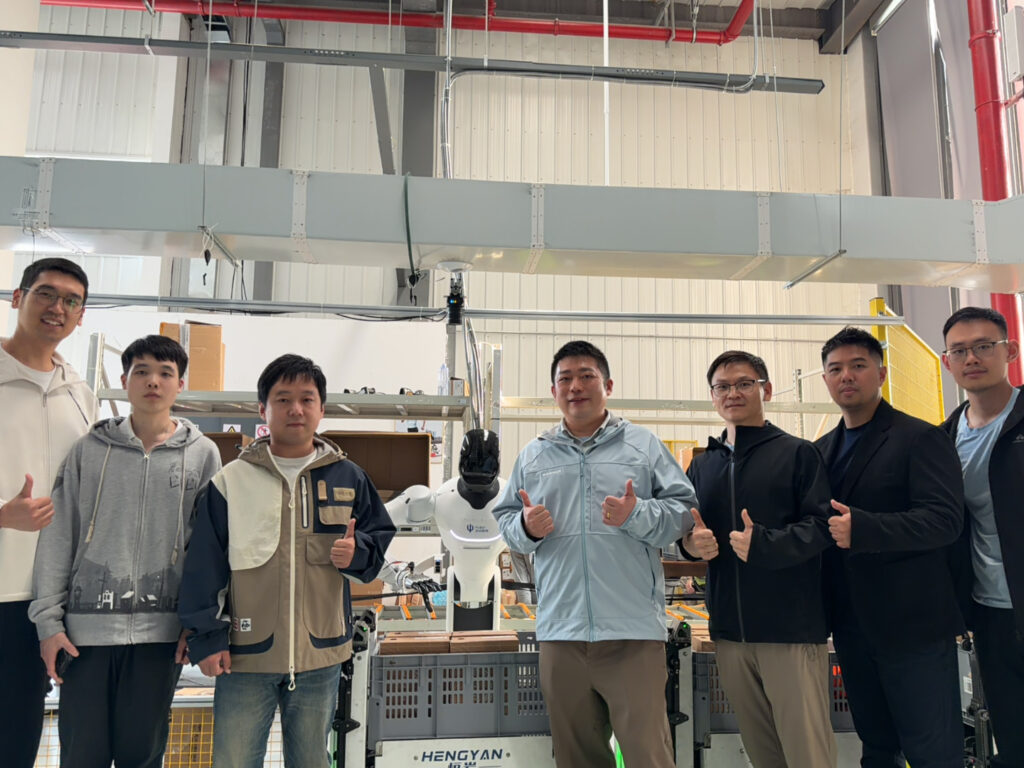
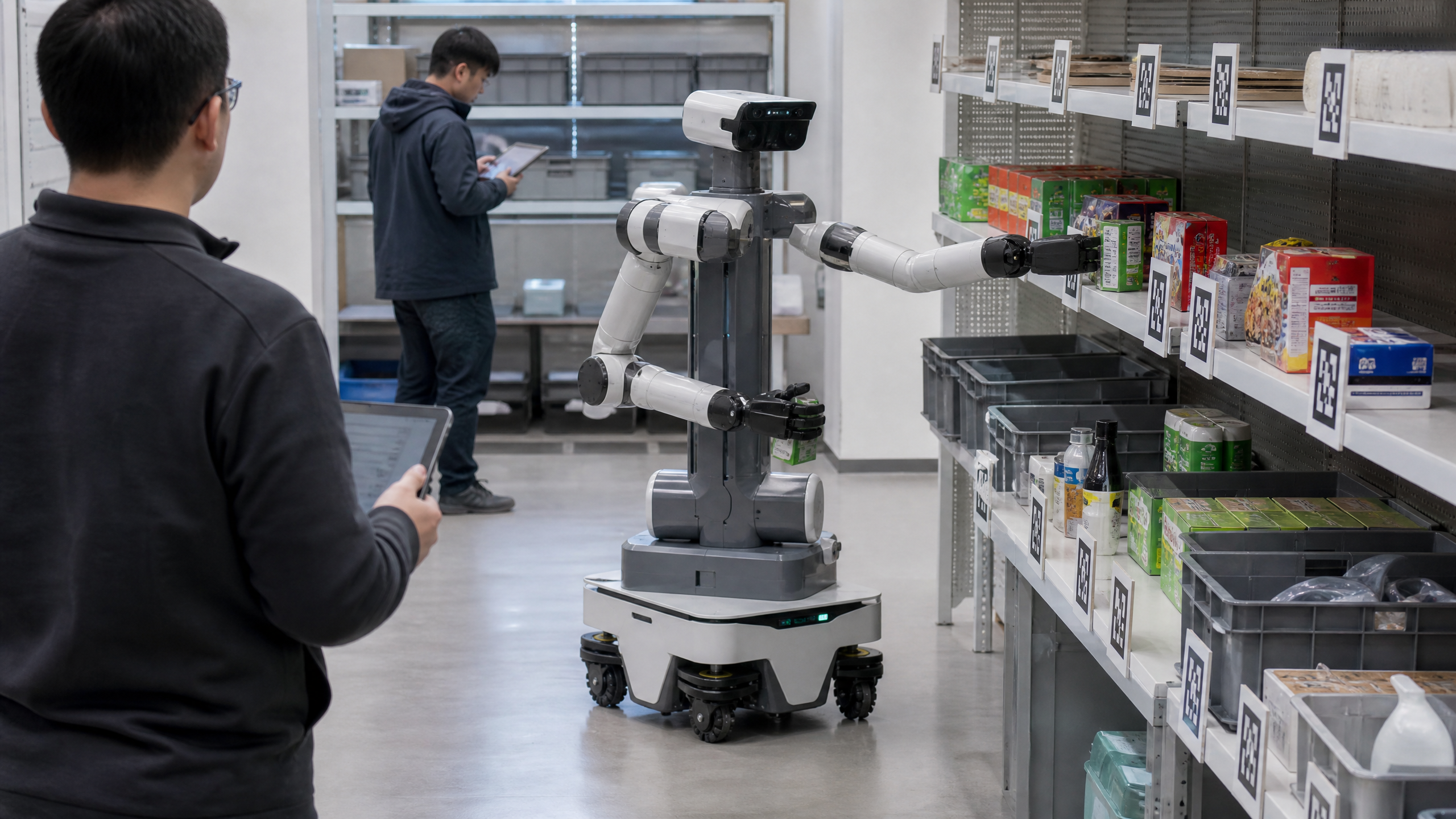
The company also has deployment narratives around mobile manipulators rather than only classic bipedal humanoids. The Robot Report describes Galbot’s G1 as a mobile manipulator with a human-like torso, two arms and a mobile base, designed for inventory, replenishment, delivery and packaging. It also reported Galbot claims of warehouse, healthcare, manufacturing and autonomous retail deployments, including Galbot Store operations in more than 30 Chinese cities.
The important point is that Galbot sits at the center of the next embodied-AI evaluation standard. The market is beginning to ask whether advanced models can produce commercial output, whether synthetic and real-world data loops can improve reliability, and whether mobile manipulation can become a practical bridge before fully general humanoids scale.
Galbot’s importance is therefore larger than one company’s financing story. It marks a practical test for the next phase of embodied AI in China: whether powerful models, synthetic data loops and mobile-manipulator platforms can become reliable services that customers reorder, maintain and measure. If Galbot can convert its robot-brain advantage into dependable everyday work, it will strengthen the case that embodied intelligence is moving from laboratory spectacle to commercial infrastructure. If not, the sector will face a sharper reminder that the hardest robotics milestone is not an impressive demo, but repeatable performance in ordinary operating environments.