Daxiao Robotics Introduces Physical IQ as a Real-Scene Evaluation Layer for Physical Artificial Intelligence
At the World Artificial Intelligence Conference (WAIC) 2026, Daxiao Robotics placed real-scene evaluation at the center of physical artificial intelligence (AI) deployment through its Physical IQ platform.

Why does physical artificial intelligence need real-scene evaluation beyond model benchmarks?
Daxiao Robotics hosted a World Artificial Intelligence Conference (WAIC) forum on July 19, 2026, to release the Physical IQ evaluation platform. The system defines robot capability boundaries through real-scene testing rather than digital simulation, addressing the gap between cognitive understanding and physical execution in environments like retail and hotels.
Daxiao Robotics, a robotics company focused on world models and physical artificial intelligence (AI), used the WAIC 2026 forum to argue that physical AI cannot be judged by digital fluency alone. The official event page says the forum focused on driving physical AI from understanding to execution, and it lists three elements that matter for that transition: environment-style data collection, world model development, and a unified real-scene evaluation platform called Physical IQ. The same page also says the company plans to show a full-stack practice that links data capture, a world model, and industry-level solutions for retail, hotel, and open scenarios. Taken together, those agenda choices make the article more than a launch note. They show how one part of China's embodied AI ecosystem is trying to connect model quality, operating context, and measurable robot performance in the same conversation.
Real Deployment is the Question Sitting Behind the Forum
The most revealing part of Daxiao Robotics' WAIC forum is not simply that a new platform appears on the agenda. It is the way the whole program is arranged around a single operational problem. The official page says the forum theme is driving physical AI from understanding to execution. That framing matters because it treats perception and reasoning as only part of the deployment stack. A robot may interpret a scene correctly and still fail at the moment of action. In physical AI, that gap between knowing and doing is where many deployment programs slow down.
The forum description makes this point indirectly but clearly. It says Daxiao Robotics chairman Wang Xiaogang will present a full-stack practice involving environment-style data collection, the Kairos world model, and industry-level solutions intended for retail, hotel, and open scenarios. The same description says the forum will jointly release Physical IQ, described as a unified embodied physical intelligence evaluation platform that uses real-scene assessment to define the boundaries of robot capability and support industry standard building. The event page does not describe evaluation as a side topic. It places evaluation next to data, models, and applied solutions.
When organizers move evaluation into the center of a world model forum, they are signaling that the hard part is no longer only model rhetoric or demonstration quality. The harder issue is whether a robot can complete useful work in physical settings that introduce timing pressure, object variation, human activity, and recovery demands. A real-scene benchmark is an attempt to make that problem visible instead of leaving it hidden behind curated demos.
Why Physical IQ Matters as an Evaluation Layer
The official page describes Physical IQ as a unified evaluation platform and says it will use real-scene assessment to define robot capability boundaries. That wording is unusually important. A boundary is not a marketing flourish. In deployment terms, a boundary is the line between tasks a system can complete reliably and tasks that still create unacceptable risk, delay, or supervision load.
This is where an evaluation layer becomes strategically significant. Component tests can tell an engineering team whether a sensor still calibrates, whether a gripper closes at the required force, or whether a joint remains within tolerance. A simulation run can report whether a model completes a digital task under the assumptions built into the software environment. A human-guided demo can show that an interaction sequence is possible. None of those on its own gives a buyer or operator a clean view of how an integrated system behaves once perception, planning, actuation, and environmental noise all collide in the same moment.
Physical IQ, at least as described on the official agenda, is trying to sit above those partial tests. Its role is not to replace component verification or simulation work. Its role is to ask a higher-order question. Can the full robot system execute in a real setting, under the conditions that matter to a customer or partner? That is why real-scene evaluation has stronger deployment relevance than a laboratory-only metric. It forces hardware and software to meet each other under conditions that are hard to sanitize.
The significance of that approach becomes clearer when viewed against the rest of the agenda. The forum includes a release segment for Physical IQ, a joint signing ceremony, a world model cloud ecosystem co-building session, and talks on multimodal world models and embodied native world action models. The sequence suggests that evaluation is being positioned as part of a broader ecosystem rather than as a standalone scorecard. Daxiao Robotics and its partners are asking how to build a shared framework that links data generation, model development, deployment targets, and common assessment rules.
The Forum Points to a Chain of Dependencies
One of the most useful ways to read the WAIC agenda is as a map of dependencies. The page mentions environment-style data collection, a world model, edge-side direct drive of the robot body, reflective self-evolution, industry solutions, Physical IQ, cloud ecosystem co-building, and a roundtable on moving from understanding to execution. None of those items stands alone. Each depends on the others.
Data collection is the first dependency. If a robot is expected to function in retail, hotel, or open scenarios, then the inputs used to train and evaluate that system need to reflect those environments. Real shelves, changing aisles, shifting object layouts, crowds, mixed lighting, and variable floor conditions all shape whether a model's internal representation remains useful once the robot starts acting. A data pipeline that captures only clean, repeatable scenes may still produce a system that looks impressive in a staged presentation but stalls when conditions deviate. This aligns with how physical AI moves from models to data factories.
The world model is the second dependency. The official program repeatedly returns to this theme, including a session titled "Cosmos 3: Full-modality world model for physical AI" and another describing the world model as the key foundation for moving from digital intelligence to physical intelligence. That suggests the forum views environment understanding as a precondition for action, but not a sufficient one. A model may recognize objects and spatial relations while still failing to choose or execute the right action sequence under time pressure.
Execution systems form the third dependency. The event description says Daxiao Robotics will present edge-side direct drive of the robot body and reflective self-evolution. Without adding external claims, the safe reading is that the company wants to connect model output to embodied control at the edge, where latency, bandwidth, and power constraints shape behavior. For deployment, that link is decisive. If execution depends too heavily on remote inference, too much can go wrong when a site introduces connectivity bottlenecks or when the operating window demands immediate adjustment. This highlights the importance of embodied AI chips and controller architecture.
Evaluation is the fourth dependency. A real-scene platform is what tells the ecosystem whether the first three layers actually work together. This is why a unified benchmark can matter even before any public scoring details appear. It creates a place where claims about world model quality, embodied control, and practical solution design have to face task completion in the real world.
Where Real-Scene Testing Can Expose Failure Modes
The official page does not claim that Daxiao Robotics or its partners have solved the deployment problem. That restraint is useful. It leaves room for a more realistic reading of where a platform like Physical IQ can add value.
In retail, one recurring failure mode is object and layout variability. A robot can look reliable when products are aligned, shelves are uncluttered, and routes remain fixed. Performance can degrade once packaging changes, reflective surfaces interfere with perception, or a customer temporarily blocks access to the target zone. A real-scene evaluation layer matters because those are ordinary operating conditions.
In hotels, timing and human coordination become more visible constraints. Elevators, doorways, guests, staff traffic, and service handoff points create moments where scene understanding must remain stable while the action plan adapts. A model may classify the environment correctly but still choose a motion path that is too hesitant, too brittle, or too dependent on ideal spacing. Real-scene assessment can reveal whether the robot recovers smoothly or enters repeated hesitation loops that break the service workflow.
Open scenarios are even less forgiving because they collapse many uncertainties into one setting. Lighting shifts, dynamic obstacles, weather exposure, and less predictable human behavior create a much wider envelope of operational variation. That is why the phrase "capability boundaries" on the official page deserves attention. A serious deployment program needs to know not just what a robot can do, but where its failure envelope begins. If a benchmark can map that boundary honestly, it becomes useful for engineering, procurement, and risk management.
Quotable insight: Capability boundaries turn robot evaluation into an operating decision about task reliability, supervision, delay, and risk.
Another likely failure mode sits in the handoff between model reasoning and physical control. A world model may predict a good action sequence while the robot body fails to carry it out within the tolerance required by the scene. Grasp position can drift. Motion can overshoot. Recovery can be too slow. Perception can desynchronize from action when the environment changes during execution. Real-scene testing is where those failures become visible operational liabilities.
The Comparison That Matters is Deployment Relevance
The comparison rows attached to this package are useful because they show that evaluation methods differ not only in technical design but also in operational relevance. The table below presents the comparison exactly as supplied for this article package.
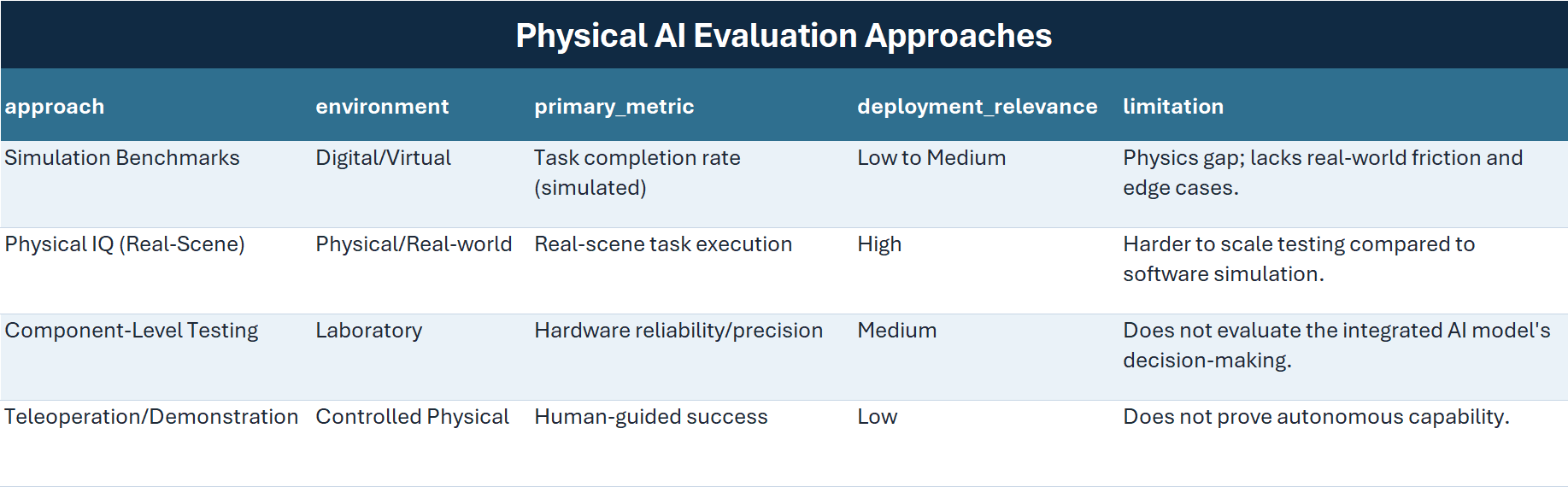
The table compares evaluation approaches at a framework level. No proprietary score, benchmark result, or leadership claim is included.
The practical lesson is not that simulation or component testing should be discarded. Both remain necessary. The lesson is that they answer narrower questions. Simulation can help teams iterate quickly. Laboratory tests can isolate hardware weaknesses. Demonstrations can show possibility. Yet the closer a buyer gets to actual deployment, the more the missing question becomes plain: what happens when the whole system is asked to work in a real setting without theatrical control?
That is where Physical IQ enters the story. The official page places it as a unified platform rather than a one-off demo, which suggests an effort to make real-scene evaluation repeatable and shareable across the ecosystem. If the platform eventually becomes a common language for capability boundaries, it could help reduce one of the persistent problems in embodied AI, namely the distance between impressive narratives and decision-ready operational evidence.
World Model Talk is Becoming Execution Talk
The WAIC program also shows how quickly discussion around world models is moving away from pure representation and toward execution discipline. The page mentions a full-modality world model for physical AI, a talk describing world models as the foundation for physical intelligence, an embodied native world action model, and a roundtable focused on how to drive physical AI from understanding to execution. That set of sessions suggests that the field no longer sees world models as valuable only because they enrich machine perception. Their value increasingly rests on whether they support timely, stable action in the physical world.
This shift has consequences for ecosystem building. If cloud infrastructure, model architecture, edge execution, and unified evaluation all have to line up, then no single module can carry deployment on its own. A stronger model cannot compensate indefinitely for weak scenario data. Better data cannot hide slow or brittle execution. Better hardware cannot create reliability if the evaluation framework fails to surface where autonomy breaks down. The forum agenda reads like an acknowledgment of that systems problem.
That is why the world model cloud ecosystem co-building item matters, even though the official page offers only a concise label for it. In deployment terms, cloud ecosystem work can be read as an attempt to coordinate the upstream and downstream pieces that embodied AI needs in order to mature. The more that vendors, developers, and deployment partners share evaluation logic and operating assumptions, the easier it becomes to compare systems on something more meaningful than stage performance.
What This Forum Says About the Current Stage of Embodied AI
The safest conclusion from the official agenda is also one of the most revealing. Daxiao Robotics is not presenting embodied AI as a finished category. It is presenting it as a systems challenge that still needs better data collection, stronger world model foundations, coordinated ecosystem work, and a real-scene assessment layer. That is a more mature signal than a simple capability claim.
For readers tracking robotics adoption, the significance lies in the article's central tension. Physical AI is advancing fast enough that ecosystem builders now need common ways to discuss execution quality. At the same time, the need for a platform that defines capability boundaries is evidence that those boundaries are still unsettled. Physical IQ therefore represents two things at once. It is a product-level announcement inside a WAIC forum, and it is also a marker of where embodied AI remains unfinished.
If future public materials provide scoring methods, task categories, or operating procedures, the market will be able to judge how far this effort goes beyond framing. For now, the official source already offers a meaningful takeaway. Daxiao Robotics chose to anchor its forum in the journey from understanding to execution and to place Physical IQ inside that journey as a real-scene evaluation layer. In a sector where the hardest problems often emerge only when software meets the world, that is exactly where scrutiny belongs.
This analysis synthesizes company statements and public market activity.
Image credit: World Artificial Intelligence Conference 2026 Physical AI Forum Cover
Disclaimer: This article is provided for informational purposes only and does not constitute investment, legal, technical, or business advice. It synthesizes verified primary-source materials available on July 19, 2026. Product specifications, event schedules, benchmarks, and performance claims remain subject to independent verification. Readers should conduct their own due diligence before making commercial or technical decisions.