Bill Gates Wants a Robot Tax Before "Smart" Robots Take Construction and Hospitality Jobs This Decade
Bill Gates' new essay predicts smart robots will compete with construction and hospitality workers by the end of the decade, credits China with the industry's advanced work, and proposes taxing robots like payroll to slow the shift - a policy idea economists remain split on.

Bill Gates Wants a Robot Tax Before "Smart" Robots Take Construction and Hospitality Jobs This Decade
Bill Gates put a specific timeline and a specific policy fix on the table this week for a problem the robotics industry has mostly discussed in the abstract. In a nearly 6,000-word essay published Wednesday on his GatesNotes site, titled "The turbulent AI era is here. The choices we make now are critical," the Microsoft co-founder wrote that "smart" robots will begin competing with people on physical tasks in construction and hospitality by the end of this decade, and that most Americans underestimate how far along that shift already is because, in his words, "much of the advanced work" in robotics is happening in China.
Gates' essay identifies three risks he says world leaders have no credible plan to manage: job losses from automation, AI expanding the capabilities of bad actors including cybersecurity attackers, and effects on children's development from AI companionship tools. On the second risk, Gates wrote that cybersecurity specialists he has spoken with are alarmed that attackers are gaining ground faster than defenders can patch weaknesses, naming hospitals, banks, water systems and power grids as exposed infrastructure. On the third, he cited research suggesting AI chatbots that never challenge or frustrate a user risk becoming addictive and denying young people the friction needed to build normal social skills. Both are treated as serious problems in the essay, but neither carries a specific proposed fix the way the jobs section does, and neither is robotics-specific, which is why the job-loss section is where robots get the most direct treatment and where Gates moves from diagnosis to a concrete policy proposal that has already drawn pushback from economists.
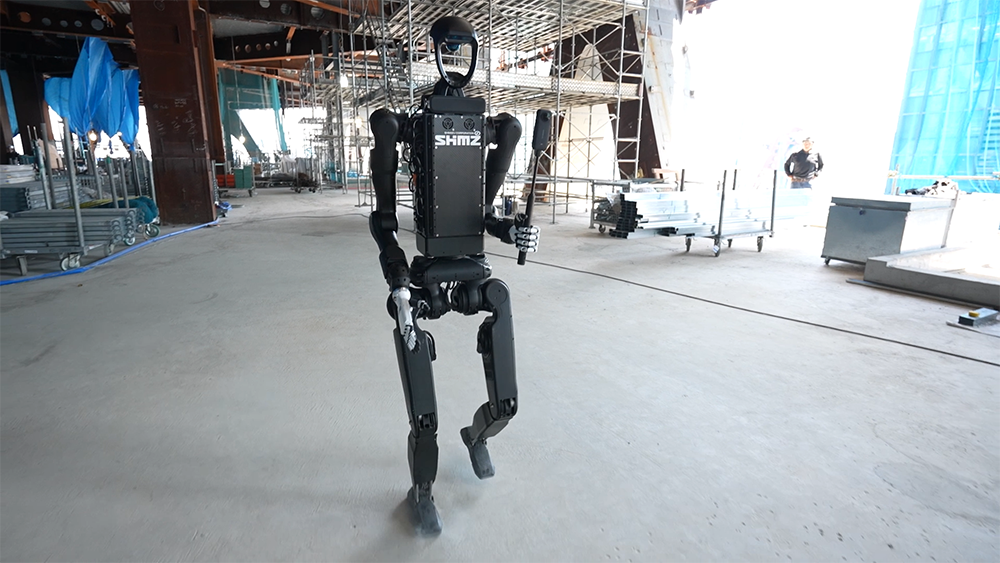
On the jobs risk specifically, Gates named law, medicine, customer service, software development and manufacturing as fields likely to see significant disruption within ten years, manufacturing being the one with the most direct overlap with industrial and collaborative robotics deployment already underway. He framed construction and hospitality separately as the sectors where physical robots, rather than software automation, would be the disruptive force, and put a specific end-of-decade timeline on that shift rather than leaving it open-ended the way the essay treats some of its other predictions.
The Specific Proposal: Tax Robots Like Payroll
Gates' core argument is an asymmetry in how labor and automation are currently taxed. An employer who hires a person pays payroll tax on those wages. An employer who buys a robot to do the same job can typically write off the purchase immediately as a business expense, with no equivalent tax. Gates wants to close that gap with a robot tax, paired with a proposed tax on AI tokens, the usage units AI companies meter and bill customers against for every model query or generation, as a second lever aimed at the same underlying imbalance between taxed human labor and largely untaxed automated labor. He has also proposed "Human Reserved" work: categories of jobs deliberately set aside for people only, even in cases where he acknowledges AI or robots could do the work more cheaply and, in some cases, better.
Gates has anticipated the obvious objection and answered it directly rather than avoiding it. "I don't think that's going to happen," he wrote of a smooth, planned transition, adding that "the geopolitical and economic incentives are pushing too hard to go full speed ahead." To critics who call a robot tax an inefficient drag on productivity, Gates responded that they are "not considering the broader value of work for individuals and society," and argued that accelerated AI-driven productivity gains elsewhere in the economy would leave room to "afford a little inefficiency as the price for keeping people employed."
The Pushback: an Old Argument Revived
Gates has floated a version of this idea before, and it drew a sharp rebuttal at the time. In 2017, when Gates first raised a robot tax publicly, former US Treasury Secretary Larry Summers called the idea "seriously astray," warning that a robot tax risks functioning as "protectionism against progress" by taxing the tool rather than addressing the underlying labor-market transition directly.
The response to this week's essay has been more mixed than uniformly critical. Oren Etzioni, a computer science professor at the University of Washington, said he agreed with much of Gates' diagnosis of the risks but pushed back on parts of the prescription: "I think he has the diagnosis right, but the prescription wrong, at least in some places." That distinction, between agreeing AI-driven job displacement is a real and urgent problem while disputing that a robot tax is the right tool to slow it, is the same fault line that split economists in 2017 and appears to be splitting them again now.
The China Claim Deserves Its Own Scrutiny
Gates' assertion that China is doing "much of the advanced work" in robotics is a characterization from a single, non-technical essay rather than a sourced industry benchmark, and it arrives alongside data points that are independently verifiable: China accounted for the large majority of global humanoid robot shipments in the first half of 2026, and Chinese manufacturers dominate current production volume by any public count available from industry trackers. Where Gates' framing goes further than the shipment data alone supports is in specifically crediting China with the "advanced" end of the work, a qualitative claim about R&D and capability rather than a quantitative one about manufacturing scale, and his essay does not cite a specific technical benchmark, company, or product to substantiate that distinction. Readers should treat the shipment-volume story and the R&D-leadership story as two separate claims requiring two separate kinds of evidence, even though Gates presents them in the same sentence. China's dominance of shipment volume is well documented; whether that scale advantage also translates into an "advanced work" lead in the underlying control systems and models, as opposed to simply an advantage in manufacturing cost and speed of deployment, is the harder claim, and one a single essay from a non-specialist, however influential, is not positioned to settle on its own.
Why This Matters Beyond One Essay
Gates is not a robotics executive, a policymaker with a vote, or an academic publishing peer-reviewed labor-economics research, and his essay carries no formal policy weight. What it does carry is reach: a nearly 6,000-word essay from one of the most widely covered figures in technology, picked up within a day by outlets spanning CNN, CNBC, Fortune, Axios, MIT Technology Review and TechCrunch, puts a robot tax back into mainstream policy conversation at a moment when the US is separately weighing restrictions on Chinese humanoid robot imports on national-security grounds. Those are two different policy tracks, one aimed at slowing domestic automation broadly and one aimed at a specific country's supply chain, but both would shape the economics a robotics company sells into over the next several years, and both are now live in the same news cycle.
For companies selling into construction and hospitality specifically, the two sectors Gates named directly, the practical takeaway is not that a robot tax is imminent; no legislative process is currently underway to enact one. It is that the fastest-growing physical-automation buying decisions in the US are now happening inside a policy conversation that treats a robot purchase as economically equivalent to a hiring decision, an argument buyers evaluating total cost of ownership over a five-to-ten-year horizon should factor in as a live possibility rather than dismiss as a recycled 2017 proposal that never went anywhere. The essay itself did not include a legislative timeline, a specific tax rate, or a mechanism for defining what counts as a taxable robot, questions Summers raised about the original 2017 version that remain unresolved in this one.
The proposal also lands inside a specific gap in US-China cooperation that Gates' own essay gestures at without fully spelling out. The two countries' only current high-level agreement on AI development is a 2024 accord to keep humans, rather than AI systems, in ultimate control of nuclear weapons, a narrow carve-out that leaves the far larger question of commercial AI and robotics development entirely uncoordinated between the two governments. Gates' call for the countries hosting the leading AI developers to establish shared norms before competitive pressure makes cooperation harder is, in that context, a call to widen an agreement that currently covers exactly one scenario. Whether a domestic robot tax in the US would do anything to slow China's own reported pace of robotics development, or would instead simply raise the cost of automation for US buyers while Chinese manufacturers continue selling into markets without an equivalent tax, is a question the essay raises implicitly but does not resolve.
Disclaimer: This article is for general information purposes only and does not constitute investment, legal, or procurement advice. Readers should verify details with primary sources before making business decisions.