AeroVironment Wins NASA Contract to Build Three Autonomous Mars Helicopters
AeroVironment's MacCready Works team will co-design and co-manufacture three autonomous helicopters for NASA's SkyFall mission, moving a 2025 Mars-flight concept into a funded program targeting a November 2028 launch.

AeroVironment Wins NASA Contract to Build Three Autonomous Mars Helicopters
AeroVironment said Thursday it has been awarded a contract by NASA's Jet Propulsion Laboratory to co-design and co-manufacture three autonomous helicopters for the agency's SkyFall mission to Mars, moving the program from a concept unveiled last year into a formally funded science mission with a targeted launch window in November 2028. The award goes to AeroVironment's MacCready Works advanced-solutions team, and it builds directly on the company's earlier partnership with JPL on Ingenuity, the helicopter that completed 72 powered flights at Mars's Jezero Crater and proved rotorcraft flight was possible in the planet's thin atmosphere.
SkyFall is the first mission designed to fly a coordinated team of three instrument-carrying helicopters on Mars at once, rather than a single rotorcraft operating as a rover's scouting companion. Each aircraft will operate independently, using its own ground-penetrating radar to map subsurface ice deposits while separate onboard instruments measure atmospheric conditions and dust transport, then relay high-resolution imagery and radar data back to Earth for analysis. The stated purpose is explicitly tied to human exploration: the three helicopters will survey candidate landing sites under consideration for what NASA has described as America's first crewed Mars mission, giving planners ground-truth data on terrain and subsurface conditions that orbital imagery alone cannot provide.
A Concept Unveiled in 2025 Becomes a Funded Program
AeroVironment and JPL first showed SkyFall publicly as a future-mission concept in mid-2025, an unusual step for a program with no confirmed funding, and the announcement functioned as much as an industry signal as a technical reveal. Converting that concept into an awarded contract roughly a year later is a comparatively fast turnaround for a NASA planetary science program, and it reflects a deliberate strategy on the agency's part to reuse a design lineage it had already validated rather than open a fresh competition for an unproven rotorcraft architecture. For a systems integrator watching how NASA structures its award pipeline, the SkyFall timeline is a data point worth noting: a contractor with a flight-proven heritage system and a public concept reveal can compress the gap between "unfunded idea" and "funded contract" in ways a competitor starting from a clean-sheet design cannot.
The division of labor between AeroVironment and JPL mirrors their Ingenuity partnership and plays to each organization's established strengths. AeroVironment is responsible for the rotor systems, airframes, structures, avionics integration, and accommodation of the multiple science payloads each helicopter will carry, while JPL designs the power systems, electronics, and the flight algorithms and software that will let each aircraft fly and find its own path with minimal real-time control from Earth given the communication delay between the two planets. That split lets AeroVironment apply the high-volume uncrewed-aircraft manufacturing discipline it built for Switchblade and Puma production lines to a domain, planetary exploration, that has historically been built one hand-assembled spacecraft at a time.
The SkyFall Maneuver Removes an Entire Spacecraft Stage
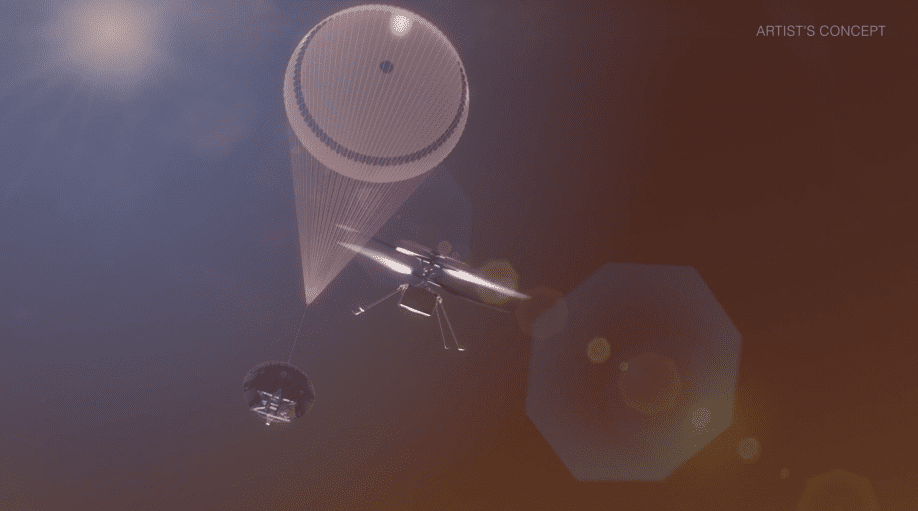
The most consequential engineering detail in the SkyFall design is what AeroVironment and JPL call the SkyFall maneuver: a method for direct atmospheric entry and autonomous powered descent that lets each helicopter fly itself down to the Martian surface without a dedicated lander stage or a host rover to carry and release it. Every previous Mars rotorcraft, including Ingenuity, arrived on the surface strapped to the belly of a rover that had its own separate, extraordinarily expensive entry, descent, and landing system. Eliminating that requirement is not a minor packaging optimization; it removes an entire spacecraft subsystem, along with its mass, cost, and single-point-failure risk, from the mission architecture.
For a procurement or engineering audience evaluating planetary and deep-space hardware suppliers, that architectural choice is the detail worth tracking more closely than the mission's headline goal of scouting landing sites. A rotorcraft that can independently handle its own entry, descent, and landing is a reusable capability that could, in principle, be adapted to deliver science payloads to other bodies with an atmosphere thick enough to support powered flight, decoupling future aerial exploration missions from the cost of a full lander or rover platform. Suppliers of avionics, power systems, and lightweight structures for extreme environments should read the SkyFall maneuver as a signal that NASA is willing to fund an aerial-only delivery architecture once a contractor has demonstrated the underlying flight physics work, which raises the value of flight heritage as a competitive moat in future planetary-exploration procurements.
Three Aircraft Instead of One Changes the Risk Calculus
Flying three helicopters instead of one is itself a deliberate risk-management decision rather than a scientific requirement. A single-aircraft mission has no redundancy: if one rotorcraft is lost to a hard landing, a dust storm, or a mechanical failure, the mission's primary objective is lost with it. A three-aircraft formation can tolerate the loss of one unit and still deliver most of its planned surface coverage, which matters enormously for a mission whose output, candidate landing-site data, will directly inform decisions about where to send human astronauts. That redundancy logic is increasingly common in commercial uncrewed-systems programs on Earth, where fleets of smaller, cheaper platforms have displaced single large, exquisite systems precisely because distributed redundancy tolerates individual unit failure without threatening the overall mission.
The same logic applies to cost and manufacturing strategy. Building three helicopters to a common design, rather than one larger, more capable aircraft, lets AeroVironment apply production-line thinking, shared tooling, common avionics, and a repeatable assembly and test process, to a program that would otherwise require the kind of bespoke, single-unit fabrication that has made planetary spacecraft notoriously expensive and slow to build. AeroVironment's pitch to JPL and NASA rests explicitly on that manufacturing discipline: the company has told JPL it intends to bring the same high-volume uncrewed-systems production mindset it uses for defense hardware into a planetary science program that has traditionally operated on an artisanal build cadence.
Why MacCready Works Is the Right Team for an Unproven Aircraft Category
The SkyFall contract went specifically to MacCready Works, AeroVironment's internal advanced-solutions group named for Paul MacCready, the aeronautical engineer who built the first successful human-powered aircraft and later pioneered ultra-lightweight, high-efficiency flight vehicles decades before AeroVironment became a defense contractor. That heritage is not incidental to the SkyFall award. Building an aircraft light enough to fly in an atmosphere roughly one percent as dense as Earth's, while still carrying scientific instruments and surviving a direct atmospheric entry with no lander stage to cushion the process, is fundamentally a weight and aerodynamic-efficiency problem before it is a robotics or software problem, and it sits closer to MacCready Works' original mandate of extreme-efficiency aircraft design than to AeroVironment's higher-volume Switchblade and Puma production lines. JPL's decision to route the contract through that specific internal team, rather than AeroVironment's broader corporate structure, suggests the agency values that lineage as much as it values the Ingenuity flight-heritage data the two organizations built together.
What the Contract Signals About AeroVironment's Diversification
AeroVironment has built its recent growth primarily on defense hardware, particularly the Switchblade family of loitering munitions and the Puma reconnaissance drone line, both of which depend on defense budgets and geopolitical demand cycles that can shift with little notice. A funded, multi-year NASA science contract sits in a materially different demand category: civil space budgets move on different appropriations timelines than defense procurement, and a planetary-science relationship with JPL gives AeroVironment a foothold in an adjacent government customer base that does not compete for the same budget line as its Army and allied defense contracts. For an investor or supply-chain partner assessing AeroVironment's revenue concentration risk, a second, independent government relationship anchored in civil space is a genuine diversification event rather than an incremental defense order.
It also extends a specific technical relationship, AeroVironment and JPL's rotorcraft partnership, that the company has effectively no domestic competitor for. Ingenuity's 72 flights at Jezero Crater stand as the only powered, controlled flights ever conducted on another planet, and that flight heritage is not a credential a rival contractor can quickly replicate; it requires an actual flown vehicle and years of operational data on how rotorcraft behave in an atmosphere roughly one percent as dense as Earth's. Any competitor hoping to challenge AeroVironment for a future planetary-aviation contract would need to either partner with JPL on a comparable demonstration mission first or accept a materially higher technical and schedule risk profile bidding against a team with a proven track record.
The Mission Timeline Buyers and Competitors Should Watch
SkyFall's helicopters are targeting a launch window in November 2028, with a cruise phase to Mars timed so that arrival coincides with favorable local time, dust conditions, and available solar power for the aircraft once they reach the surface. That multi-year runway gives both AeroVironment's supply chain and any prospective competitors a defined planning horizon: component suppliers building toward the 2028 launch window have a known integration and testing schedule to design against, while a rival contractor evaluating whether to compete for a future planetary-rotorcraft mission has a concrete benchmark, three helicopters, direct atmospheric entry without a lander, common design across the fleet, that the next competing proposal will be measured against. For anyone tracking where NASA is willing to spend on aerial planetary exploration going into the next decade, SkyFall's progression from a 2025 concept reveal to a funded 2026 contract is the more informative signal than the mission's ultimate scientific output, because it shows the agency is now treating flight-proven rotorcraft heritage as fundable in its own right rather than as a one-off technology demonstration.
Disclaimer: This article is for general information purposes only and does not constitute investment, legal, or procurement advice. Readers should verify details with primary sources before making business decisions.