
Wing and Walmart Launch 30-Minute Drone Delivery in Greater Orlando
Alphabet subsidiary Wing has expanded its drone delivery partnership with Walmart, launching 30-minute delivery services in the Greater Orlando, Florida area. The service utilizes Wing's fixed-wing hybrid VTOL aircraft and tether-drop system to deliver packages up to 2.5 pounds for a flat fee of US$3.99. The launch replaces Walmart's previous Orlando drone partnership with DroneUp and extends Wing's US footprint beyond its existing Dallas-Fort Worth operations.
Expansion into Greater Orlando
Commercial drone delivery continues its steady march from isolated pilot programs to standardized logistics networks covering major metropolitan areas. On July 29, 2026, Alphabet subsidiary Wing announced the launch of its drone delivery service in the Greater Orlando, Florida area, in partnership with retail giant Walmart.
The service promises to deliver packages weighing up to 2.5 pounds directly to customers' driveways or front yards in 30 minutes or less from the time of order. Customers can access the service for a flat delivery fee of US$3.99, ordering from a curated selection of thousands of eligible Walmart items, ranging from over-the-counter medications and baby products to grocery staples, household essentials, and personal care items.
The Orlando launch represents a significant geographic expansion for Wing's US operations, which previously centered on the Dallas-Fort Worth metropolitan area. Florida's favorable climate, relatively flat terrain, and large suburban population make it an ideal market for drone delivery, offering consistent flying conditions year-round and a dense concentration of single-family homes with accessible delivery zones.
The Technology and Operational Model
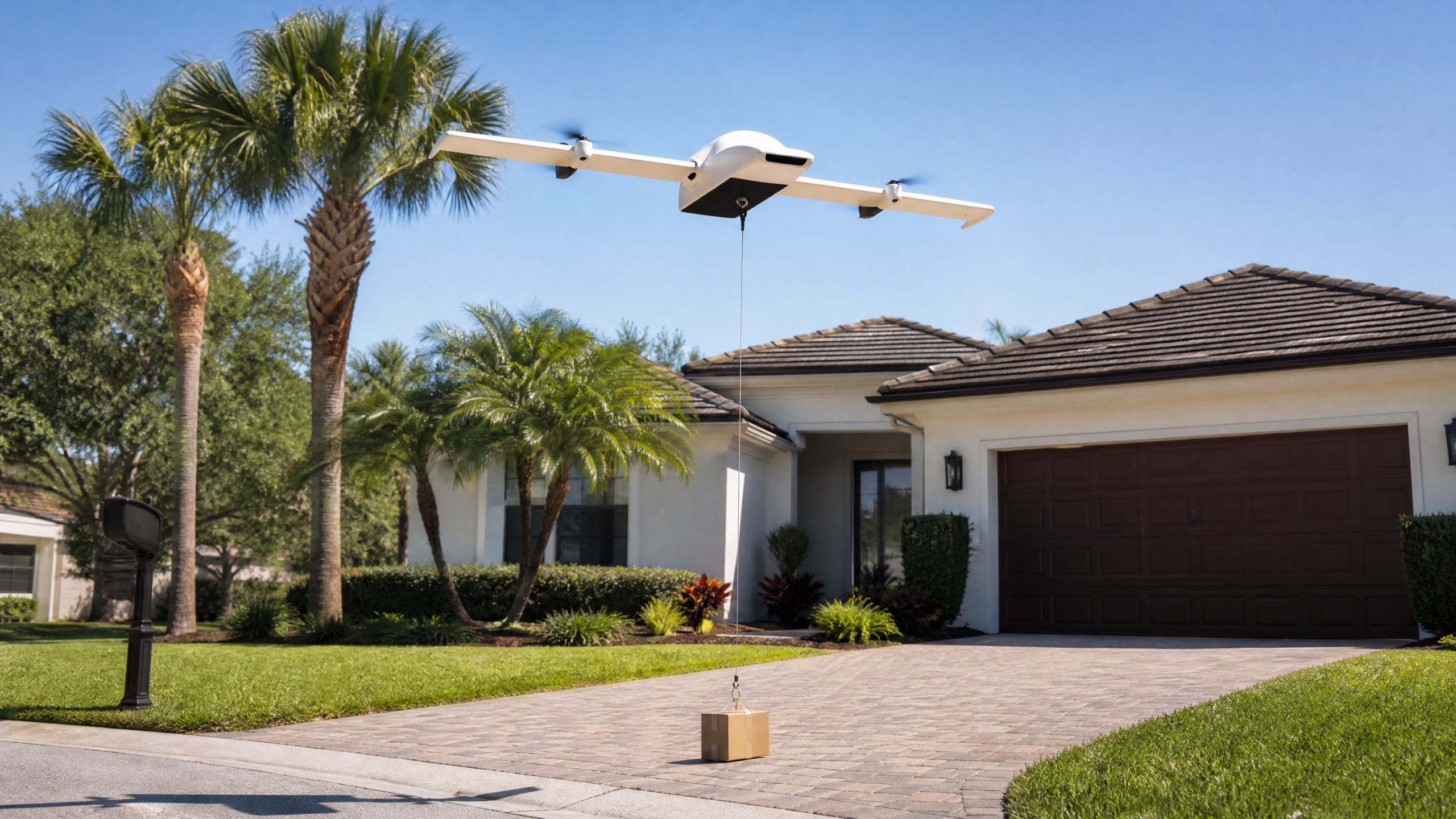
Wing utilizes a highly customized, fixed-wing hybrid Vertical Take-Off and Landing aircraft that represents years of iterative engineering since Alphabet's drone delivery program began in 2012 (originally as Project Wing within Google X). The drone takes off vertically like a helicopter from a staging area at or near the Walmart store, transitions to efficient forward flight on its wings for speed and range, and then hovers over the delivery destination.
Crucially, the drone never lands at the customer's home. Instead, it hovers at a safe altitude of approximately 23 feet (7 meters) and lowers the package using a specialized tether mechanism. Once the package touches the ground and the weight is released from the tether, the line automatically retracts, and the drone returns to the Walmart staging area for its next delivery. This tether-drop method minimizes noise at ground level, significantly reduces the safety risks associated with spinning rotors near consumers and pets, and eliminates the need for a clear landing pad.
The entire delivery process is designed to be autonomous from takeoff to package release, with remote operators monitoring multiple flights simultaneously and able to intervene if necessary. Wing's air traffic management system, called Wing UTM, coordinates multiple simultaneous flights in the same airspace, deconflicting routes and managing altitude separation.
Context: Walmart's Evolving Drone Strategy
This launch is particularly notable given Walmart's history in the Orlando market. In December 2022, Walmart launched a drone delivery pilot in Orlando with a different partner, DroneUp, operating from seven stores. That partnership has since been scaled back, and the transition to Wing suggests Walmart is actively evaluating different hardware platforms and operational models to determine the most economically viable path to scale.
Walmart's willingness to switch drone delivery partners indicates that the retailer views this as a technology-agnostic logistics capability rather than a commitment to any single hardware vendor. This approach mirrors how retailers manage their ground-based delivery networks, working with multiple carriers and gig platforms simultaneously to optimize coverage and cost.
The US$3.99 flat fee positions drone delivery as a premium but accessible option, priced below typical same-day delivery fees charged by ground-based services. For Walmart, the strategic value extends beyond the delivery fee itself; the speed and convenience of 30-minute drone delivery can drive incremental basket sizes and increase customer loyalty in competitive suburban markets.
Competitor Comparison: US Drone Delivery Networks

The US drone delivery market is currently a multi-horse race among well-funded operators, as outlined in the comparison table. Wing's primary competitor is Zipline, which also partners with Walmart (as well as Sweetgreen and healthcare providers) and operates in states like Arkansas, Utah, and Texas. Zipline recently introduced its Platform 2 system, which uses a tethered autonomous 'droid' that can steer itself during the descent, offering precise delivery even in tight spaces between trees or structures.
Amazon Prime Air continues to iterate on its MK30 hexagonal drone, operating in College Station, Texas, and Lockeford, California, though it utilizes a descent-landing model where the drone touches down briefly rather than hovering and lowering a tether. Amazon's approach offers the advantage of no dangling package during descent but requires a clear, flat landing zone. Meanwhile, DoorDash has begun piloting its own in-house drone delivery network under its own FAA Part 135 certification in the Dallas-Fort Worth area.
Each operator is pursuing a slightly different technical approach to the same fundamental challenge: delivering small packages quickly, safely, and economically in suburban environments. The market has not yet converged on a single dominant design, and the next two to three years will likely determine which approach achieves the best balance of safety, speed, cost, and customer experience.
Regulatory Progress and Commercial Outlook
The expansion into Orlando demonstrates that the Federal Aviation Administration is becoming increasingly comfortable with Beyond Visual Line of Sight operations in suburban environments, a critical regulatory milestone that was considered nearly impossible just five years ago. As regulatory friction decreases through established precedents and standardized approval processes, the primary challenge for operators like Wing shifts from technical feasibility and regulatory approval to unit economics and network density.
For retail logistics, the ability to offload small, high-margin, time-sensitive deliveries to an automated aerial network could significantly reduce the cost of last-mile fulfillment, provided the network can achieve sufficient utilization density in target neighborhoods. The key economic question is whether enough customers in a given delivery radius will order frequently enough to keep the drones flying at high utilization rates, spreading the fixed costs of the staging infrastructure and aircraft fleet across a large number of deliveries.
As Wing, Zipline, Amazon, and others continue to expand their geographic footprints, the US is gradually building toward a future where drone delivery is a standard logistics option alongside ground-based same-day delivery, rather than a novelty or experiment. The Orlando launch brings that future one step closer for millions of Florida residents.
Unit Economics and Scalability
The fundamental question facing all drone delivery operators is whether the unit economics can support a sustainable business at scale. At US$3.99 per delivery, Wing must cover the cost of aircraft depreciation, energy, maintenance, remote operator oversight, insurance, and ground infrastructure amortization. Industry estimates suggest that the fully loaded cost per drone delivery currently ranges from US$5 to US$15 depending on utilization rates, suggesting that the US$3.99 consumer price may be subsidized in the near term to drive adoption and generate the volume data needed to optimize operations.
However, the economics improve dramatically with density. As more customers in a given delivery radius adopt the service, the drones spend less time flying empty return legs and more time carrying revenue-generating packages. Wing's partnership with Walmart, which provides access to a massive existing customer base and high-frequency purchase categories like groceries and household essentials, is specifically designed to achieve this density faster than a standalone drone delivery startup could manage on its own.
The Orlando market, with its year-round favorable weather conditions, large suburban population of single-family homes with accessible front yards, and relatively uncongested low-altitude airspace compared to dense urban cores, represents close to ideal operating conditions for drone delivery. If Wing cannot achieve viable unit economics in Orlando, it would be difficult to achieve them anywhere in the continental United States, making this market a critical proving ground for the entire industry's commercial thesis.
The broader significance of the Orlando launch extends beyond any single market. Each successful deployment in a new metropolitan area generates operational data, regulatory precedent, and consumer adoption patterns that reduce the friction for subsequent market launches. Wing's expansion strategy appears designed to build a national network incrementally, with each new market benefiting from the learnings and regulatory relationships established in previous ones. For the drone delivery industry as a whole, every successful commercial deployment strengthens the case for continued regulatory liberalization and infrastructure investment.
Disclaimer: This article is for informational purposes only and does not constitute financial, investment, or technical advice. Readers should conduct their own due diligence before making procurement or investment decisions based on this information.












