
Tesla Just Bought a VR Treadmill for Optimus and It Quietly Explains How Humanoids Learn to Walk
Virtuix disclosed Tesla’s Optimus division bought its first Omni One Enterprise omnidirectional treadmill, positioned for whole-body humanoid teleoperation. Deliberately conservative framing: one unit, seller-disclosed, pilot reading; broker chatter about a Tesla Optimus app excluded. Significance: locomotion training data is becoming a procurement category.
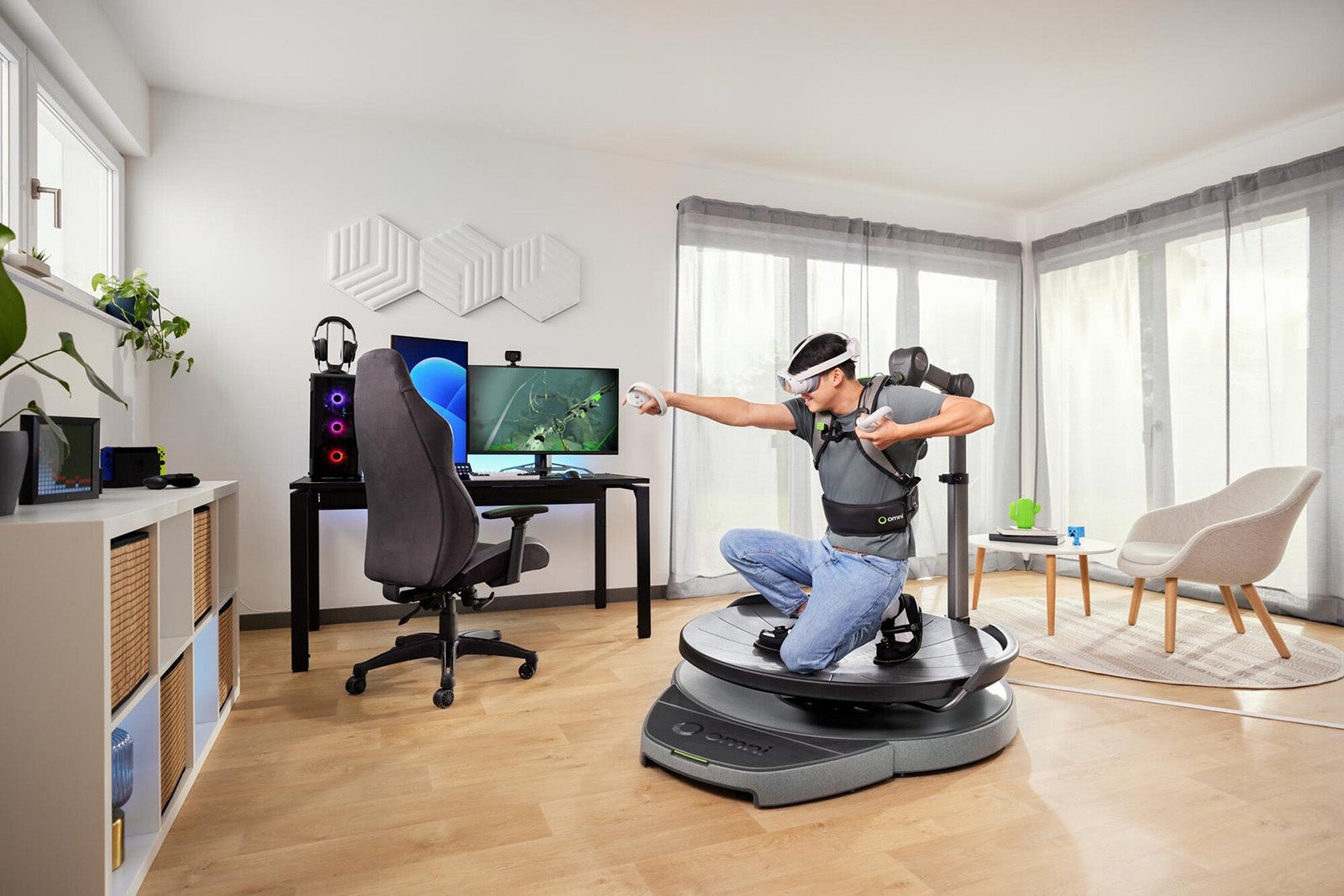
The most revealing robotics purchase order of the week is also one of the smallest. Virtuix, the Austin company known for omnidirectional virtual reality treadmills, announced on July 27 that Tesla has purchased its first Omni One Enterprise system, and that the buyer inside Tesla is the Optimus humanoid robot division. The NASDAQ-listed firm's shares moved on the disclosure, modest in dollar terms, loud in what it implies.
An Omni One Enterprise is a low-friction, omnidirectional treadmill with a support harness: a person wearing a VR headset can walk, run, turn, and strafe naturally in any direction while remaining physically in place within a compact footprint. Virtuix built its business selling these rigs to VR gamers and, increasingly, to institutions; its enterprise résumé already includes collaborations with Meta, NASA, and all four major branches of the US military. The company states the enterprise system is suited to training, simulation, and, in the phrase that matters here, "the teleoperation of humanoid robots, allowing humans to remotely control robots in real time."
Tesla appears to be exploring rigs in which a human operator does not just puppet Optimus's hands from a bench, but walks as the robot walks, turns as it turns, and navigates space with their whole body while the robot mirrors them. "We're pleased to see Omni One continuing to expand into enterprise applications," said Virtuix chief executive Jan Goetgeluk, adding that "as organizations increasingly adopt immersive technologies for training and simulation, we believe our platform is demonstrating its versatility well beyond its original consumer market."
Why a Treadmill Is Training-Data Infrastructure
A single treadmill is not a fleet decision, and honesty requires saying so upfront: this is one unit, a pilot by any reasonable reading, disclosed by the seller rather than the buyer. But the purchase illuminates the least glamorous and most decisive contest in humanoid robotics, the contest over how machines acquire whole-body skills. Manipulation data, hands picking and placing, can be harvested at benches with exoskeleton gloves and paired arms, and companies from Tesla to China's data factories collect it by the tens of thousands of hours. Locomotion-plus-manipulation data, a body that walks to a shelf, braces, reaches, and carries while balancing, is far scarcer, because capturing it requires the human demonstrator to actually move through space.
Tesla knows this problem intimately. Its Optimus program has cycled through motion-capture suits and VR teleoperation setups, and reporting over the past two years has described operators walking warehouse floors wearing capture equipment to generate demonstrations. That approach consumes real estate and constrains repeatability: every demonstration needs cleared floor space matching the task geometry. An omnidirectional treadmill inverts the constraint. The operator walks endlessly in any direction within two square meters; the geometry lives in the simulation or in the remote robot's actual environment. Think of it as the difference between filming a chase scene on location and filming it on a soundstage treadmill with the scenery projected: the soundstage is cheaper, safer, infinitely repeatable, and available around the clock.
The economics compound with distance. A teleoperator on an Omni rig in Austin can, in principle, drive a robot in a factory in Fremont or a customer site in another state, walking naturally rather than nudging a joystick. Whole-body telepresence is precisely the modality the industry's data-hungry end needs: locomotion demonstrations rich in balance shifts, gait transitions, and navigation decisions, the exact behaviours that separate a humanoid that works from one that stands at a bench.
The training-data toolkit for humanoids now spans four distinct modalities, each with a different cost curve.

No single modality wins; production programs blend all four, and the blend is shifting, quarter by quarter and program by program, toward whichever tools yield the most usable, highest-fidelity hours per operator per day at the lowest fully loaded cost. That is the spreadsheet in which a US$60,000-class treadmill earns its place: if it doubles the daily locomotion-demonstration yield of one operator, it pays for itself in weeks against American labour costs.
The Signal Through the Noise
The skeptical frame writes itself, and it should be applied. One unit is one unit; Tesla buys thousands of pieces of equipment, and a US$60,000-class treadmill is a rounding error in a program Elon Musk has called potentially bigger than the car business. Virtuix, a company that went public via crowdfunding-era financing and needs enterprise narratives, has every incentive to press-release its most famous customer, and Tesla has confirmed nothing. The Dongwu Securities chatter the same day about a Tesla app preparing for Optimus's consumer debut is broker speculation, not disclosure, and this publication treats it accordingly, which is to say, not at all.
What survives the skepticism is the direction of the experiment, because it converges with everything else the industry did this month. Enigma raised US$71 million on the thesis that human-robot interfaces are the bottleneck; China's data factories keep scaling teleoperation floors; τ0-VLA's builders bragged about 20,000 hours of real-robot interaction data as a moat. Everyone with a humanoid program is discovering the same constraint: the scarcest input is high-quality human demonstration, and the tooling that captures it, gloves, rigs, suits, and now omnidirectional treadmills, is becoming a procurement category of its own. When the training-data supply chain becomes visible in vendor press releases, it is because the demand side has become real.
Virtuix's own trajectory adds texture to the moment. The company spent a decade selling the Omni to VR arcades and home gamers, survived the metaverse winter that killed most of its peers, and pivoted its enterprise pitch toward training and simulation as institutional demand materialised. Its collaborations with Meta, NASA, and all four major US military branches were the bridge; humanoid teleoperation is the destination the company could not have predicted when it crowdfunded its first treadmill. That a Kickstarter-era gaming peripheral maker now counts Tesla's robot division as a customer says as much about how far the humanoid buildout's supply-chain pull extends as any billion-dollar headline from the same week.
There is also a quietly American subplot here. The humanoid training stack has been bifurcating: Chinese firms industrialised teleoperation with hundreds of human operators on warehouse floors, an approach that scales with labour cost advantages; American firms, facing different wage math, need capital equipment that multiplies each operator's output. A rig that lets one Austin operator generate continuous locomotion data without walking miles of floor, or drive remote robots across time zones, is exactly the kind of productivity-per-teleoperator tooling the US model requires. Virtuix's military and NASA lineage fits the same pattern; whole-body simulation was defence tech before it was robot tech.
What to Watch
Three follow-ons would convert this from signal to trend. The first is repeat orders: a second and third unit to Tesla, or units to Figure, Apptronik, or Boston Dynamics, would confirm that omnidirectional teleoperation is entering the standard humanoid toolchain rather than one team's experiment. Watch Virtuix's disclosures; as a small listed company it will announce every one. The second is integration evidence, any glimpse in Tesla's Optimus updates of operators on treadmill rigs, which would show the pilot graduated to the data pipeline. The third is the emergence of purpose-built competitors; if whole-body teleoperation proves out, the gaming-treadmill form factor will be reengineered for robotics specifically, with force feedback and lower latency, and the category will attract the same capital that flooded exoskeleton data gloves this year.
The wider lesson costs nothing to state and is easy to miss amid billion-dollar AI-factory announcements the same week: the humanoid economy is being assembled out of adjacent industries' parts. A VR gaming peripheral becomes robot training infrastructure; a fintech-backed research lab becomes an interface company; a real estate developer becomes a physical AI landlord. The robot revolution keeps arriving not as a single invention but as a supply chain quietly convening around a new customer, and this week that customer's name, once again, was the training data pipeline. One treadmill in Austin will not teach Optimus to walk. The procurement pattern it represents very well might, and for a market that has learned to discount humanoid promises measured in launch dates, purchase orders, however small, remain the most honest data points available.
This article is for informational purposes only and does not constitute investment advice. Readers should conduct their own research before making investment decisions.












