Ai2's ToyBlocks Benchmark Exposes How Little Robot Policies Actually Generalize
Ai2's own numbers show its generalist, reasoning robot policy solving half of real-world block tasks versus 81% for a narrow specialist model, a benchmark procurement teams should weigh against vendor claims of general-purpose robot intelligence.

The Allen Institute for AI released ToyBlocks on November 6, 2026, an open simulation benchmark built around a robot arm manipulating blocks on a tabletop, and the numbers inside its own technical report are an inconvenient companion to a year of "general-purpose robot" marketing. Ai2's own best generalist policy, a hierarchical model combining its Molmo 2 vision-language model with the ManiFlow motion controller, solved 55.5 percent of simulated tasks and 50.0 percent of tasks on a real robot arm. A narrower model trained only on individual atomic skills, with no broader reasoning layer attached, solved 80.0 percent in simulation and 81.1 percent in the real world.
That 30-point gap, published by the lab that built both models, is the most useful data point procurement teams will see this month about what "embodied AI" currently means in practice. Ai2, the Seattle-based nonprofit research institute founded by the late Paul Allen and best known historically for open language models, has spent the past year pivoting serious resources into what it calls Physical AI, including the MolmoBot and MolmoSpaces projects that preceded this release. ToyBlocks is its attempt to give that work a controlled, repeatable test environment, built as what the lab calls a "FoundationWorld": a simulated world with realistic physics and appearance, automated generation of tasks and demonstrations at scale, and challenges that force a policy to combine reasoning with dexterity rather than one or the other.
A Generalist That Reasons Loses to a Specialist That Doesn't
The headline comparison in Ai2's own release is not flattering to the generalist approach the industry has been racing toward. The hierarchical Molmo 2 plus ManiFlow system is designed to read a scene, reason about it, and decide what to do next before executing a motion. The narrower ManiFlow-only model skips the reasoning step entirely and simply executes a trained skill, such as a stack or a flip, without deciding anything about the broader task. On raw task-completion rate, the model that thinks less wins by a wide margin.
Ai2 is careful to flag that the real-robot comparison rests on a small sample, 30 trials for the hierarchical model, and says more trials are needed before drawing firm statistical conclusions. That caveat matters, and buyers should not treat either percentage as a certified reliability figure. But the simulated comparison runs on a much larger base, and it tells the same story: a system built to generalize across tasks currently pays for that flexibility in completion rate, and a system built to do one thing well does that one thing far more reliably. A procurement team evaluating a vendor's "our robot understands any task" pitch now has a published benchmark, from a credible independent lab with no product to sell, showing that reasoning-heavy generalists and narrow specialists are not yet the same class of system wearing different marketing.
ToyBlocks does not test only the headline skills. Researchers built a long-horizon "spelling" task, in which a robot arranges blocks to spell short words such as "Ai2," and an agentic "search-and-spell" variant where roughly half the configurations are deliberately impossible and the system has to recognize that and say so rather than attempt it. The combined system solved or correctly flagged infeasibility on 63 percent of those tasks. Most of its failures were not planning failures. They were perception failures: mistaking visually similar letter blocks for each other accounted for 13 percent of errors, and placing a correctly identified letter in the wrong orientation accounted for another 15 percent. For a buyer, that distinction is the whole point of running a benchmark like this rather than trusting a demo reel: a robot that fails because it misread a label is a different commercial problem than one that fails because it cannot plan, and it points a procurement conversation toward different questions about sensor quality, lighting conditions, and object variety in the robot's actual deployment environment.
An Agent That Talks to Tools Still Beats Every Learned Policy
The most lopsided result in the release is not learned policy versus learned policy. It is an LLM agent against both of them. Ai2 built a planner around Claude Opus 5.5 that calls the benchmark's pick, flip, and rotate skills as tools rather than learning a policy end to end, and that agent solved every one of 30 block-stacking tasks using nothing but a written description of the scene, then matched that perfect score again in a second run where it instead watched a live camera feed and picked its next move step by step as the scene changed. Neither the hierarchical Molmo 2 plus ManiFlow system nor the specialist ManiFlow policy came close to that completion rate on their own benchmarks. The agent is not doing anything mysterious: it is reasoning in language about a scene it can see, then issuing the same kind of scripted or motion-planned commands an engineer would hand-code, rather than relying on a neural network to map pixels directly to motor commands. That architecture will not generalize to every task a learned policy might eventually handle, and Ai2's tasks here are not identical to the spelling benchmark the two learned systems were scored against, so the numbers are not a like-for-like leaderboard entry. But for a buyer being pitched a single end-to-end learned model as the only path to generalist robot behavior, the result is a useful reality check: on these tasks, routing a capable language model through hand-built or lightly trained skills beat every purely learned alternative Ai2 tested.
A second finding cuts in the opposite direction, favoring the newer tools. Ai2 tested whether the way a task is described to a model changes how well the model executes it, comparing generic default instructions, instructions written by human experts, and instructions generated by another AI model. The model-generated descriptions produced a 63 percent success rate, ahead of both the 36 percent rate from expert-written instructions and the 24 percent rate from default descriptions. That is a counterintuitive result: an AI system describing a task to another AI system outperformed a human expert describing the same task. For an integrator writing deployment instructions or task prompts for a vendor's robot, it is a concrete reason to test machine-generated task framing against a human engineer's intuition rather than assuming the human version is automatically clearer to the system that has to execute it.
Synthetic Practice Closes Part of the Generalization Gap
The release's most commercially relevant result may be its world-model experiment. Ai2 tested several video-generation world models for how accurately they predicted what would happen to a stack of blocks under a given action, and found Wan 2.2 the most accurate of those tested. When the team added 100 rollouts generated by that world model, synthetic practice attempts rather than real demonstrations, into training for a task configuration the policy had never seen, success in that unseen region rose from 19 percent to 78 percent.
That is the kind of number that should reframe a buyer's question about any vendor claiming rapid generalization to new tasks or new facilities. If a meaningful share of a robot's claimed adaptability comes from synthetic rollouts generated by a world model rather than from real demonstrations collected on real hardware, the relevant commercial question changes from "how much real data has this vendor collected" to "how good is this vendor's world model, and has it been validated against real outcomes rather than only against itself." Ai2's own framing treats this as an open research direction, not a solved problem, and the lab is transparent that the underlying dataset released alongside ToyBlocks, 85,336 long-horizon demonstrations covering roughly six to twelve skills each, nearly 1,600 hours of robot execution and 144 million frames, was itself generated at up to 24 times real-time speed on a single GPU running hundreds of simulated plans in parallel. The scale is real. Whether scale of this kind, generated this quickly, transfers cleanly to a customer's actual warehouse or factory floor is exactly the question ToyBlocks is designed to keep testing, not one it claims to have already answered.
What a Research Benchmark Does Not Tell a Buyer
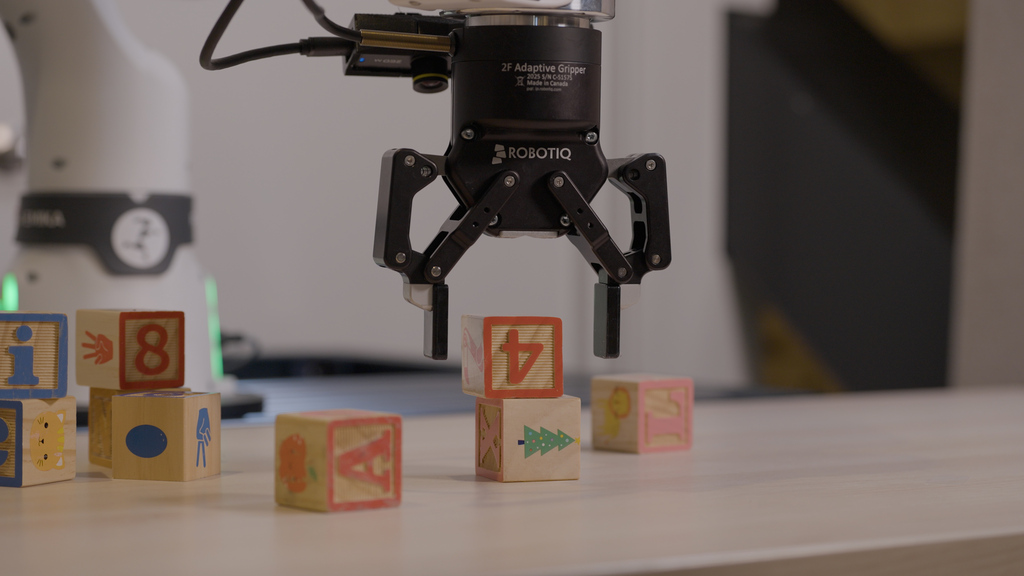
ToyBlocks is a research release, not a product, and it carries a research release's limits. The tabletop block-manipulation domain is deliberately narrow and controlled, chosen for repeatability rather than resemblance to a working warehouse or hospital floor. Ai2's own sim-to-real test used a zero-shot transfer to a Franka FR3 research arm fitted with a Robotiq gripper, a common lab configuration rather than any commercial deployment hardware a procurement team is likely to be evaluating. Nothing in this release names a customer, a price, or a shipping timeline, and none of its numbers should be read across to a specific vendor's humanoid or mobile-manipulation product without that vendor publishing comparable, independently reproducible results of its own.
What the release does provide, which is rarer than any individual number in it, is a shared, open, third-party yardstick that any lab or vendor can be measured against going forward. Ai2 has published the code on GitHub, the dataset and trained models on Hugging Face, and documentation for running the benchmark independently, and says a second release with a larger dataset, more skills and integrated reinforcement-learning training is coming within weeks. Future versions are planned to add bimanual manipulation and dexterous hands with force and touch sensing, both of which sit closer to the humanoid-hand problem vendors have been selling against for the past two years without an open benchmark to check their claims against.
For now, the clearest lesson in the numbers Ai2 chose to publish is the gap between its own generalist and specialist models on the exact same tasks. A vendor's sales pitch about a robot that reasons its way through novel situations is describing the harder, lower-success-rate category. A narrower claim about a robot that reliably executes a defined set of trained skills is describing the category that, on this benchmark at least, is still winning on completion rate by roughly thirty points. Buyers comparing the two should ask which category a specific vendor's product actually falls into, because the marketing language rarely makes that distinction and the benchmark results suggest it should.
Hero image: The Franka FR3 arm and Robotiq gripper used in ToyBlocks' real-robot evaluation, positioned over physical alphabet blocks. Credit: Allen Institute for AI.
This analysis synthesizes the research lab's own published technical release, benchmark results and open-source documentation, without independent reproduction of the benchmark results.
This article is for general information purposes only and does not constitute investment, financial, legal or professional advice.