
DiDi's Next Robotaxi Drops the Safety Driver in Beijing and Guangzhou
DiDi Autonomous Driving's R2 robotaxi, built with GAC Aion, now runs fully driverless in Beijing and Guangzhou, announced from Dubai ahead of a planned UAE expansion - DiDi's first market test outside China.

DiDi's Next Robotaxi Drops the Safety Driver in Beijing and Guangzhou
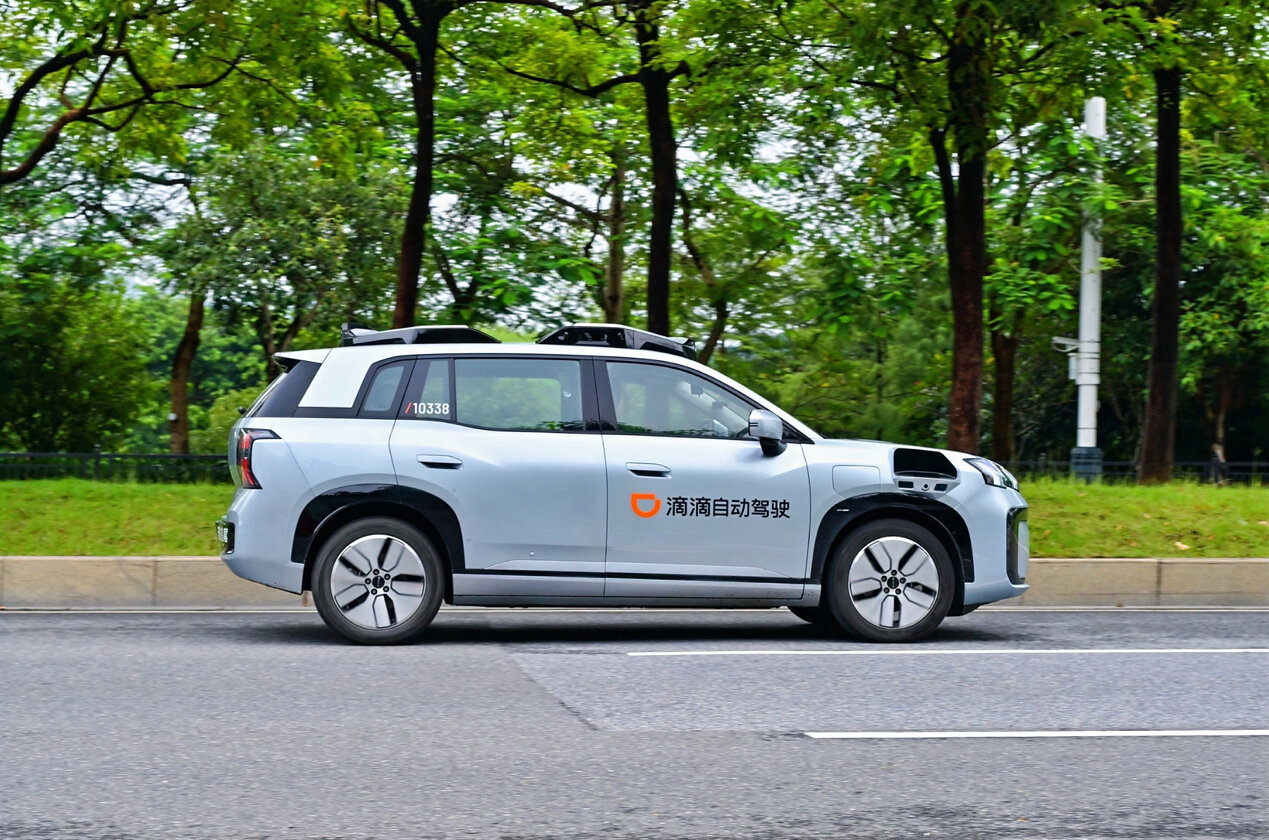
DiDi Autonomous Driving began fully driverless passenger trials of its next-generation Robotaxi R2 on August 31, jointly developed with GAC Aion, the electric-vehicle brand under Guangzhou Automobile Group. The vehicle is now bookable through the DiDi app in designated demonstration zones in Beijing and Guangzhou, with no safety driver behind the wheel, a step up from the supervised testing the platform had been running since deliveries began in January.
DiDi Autonomous Driving is the self-driving unit of DiDi Global, China's largest ride-hailing platform, and the company announced the milestone from Dubai, where it is preparing the United Arab Emirates as its first market outside China; the company has said UAE testing and pilot work are planned within 2026 and will be conducted with local partners on robotaxi applications.
The Dubai dateline is itself a signal worth reading. DiDi's core ride-hailing business, the app most riders in China actually use, has spent years fending off domestic and international competition on price and coverage; the autonomous-driving unit choosing to announce a domestic Chinese safety-driver milestone from a Gulf city underscores that the R2 launch is aimed as much at establishing DiDi's credibility with international regulators and partners as at Chinese riders who can already book the vehicle. A robotaxi story with a UAE dateline reads differently to an audience evaluating whether Chinese autonomous-driving technology is ready to operate under a different country's rules, roads, and liability framework, than the same announcement would if it had simply come out of Beijing.
What's Actually New in the R2
The R2 runs on DiDi's Level 4 full-stack software and hardware, meaning the vehicle is designed to operate without human intervention across its approved operating domain, backed by 33 sensors feeding a triple-domain fusion central computing platform the company says improves perception accuracy and handling of complex driving scenarios, the kind of intersections, double-parked vehicles, and unpredictable pedestrian behavior that remain the hardest cases for any autonomous system. The vehicle carries five-star ratings under both China's C-NCAP and the European Euro NCAP crash-safety standards, and DiDi describes a multi-layer redundancy system, meaning backup systems for critical functions like braking and steering rather than a single point of failure, a baseline expectation for any vehicle carrying passengers with no human driver as a fallback.
Inside, the R2's cabin has been redesigned around the fact that nobody is sitting in the driver's seat: high-angle adjustable rear seats maximize passenger space, a 17.3-inch ceiling-mounted screen handles entertainment, and an AI voice system manages PIN-code entry verification, climate control, window operation, and ambient lighting. The cabin ventilates itself before a passenger arrives. DiDi says planned additions include an exterior interaction screen, likely intended to signal the vehicle's status or the assigned passenger to people waiting curbside, along with preset temperature and lighting profiles and improved vehicle-locating features, the kind of small operational details that matter more once there's no driver to ask.
These cabin details are easy to read as incremental comfort features, but they map directly onto problems every robotaxi operator has to solve before removing the driver: PIN verification exists because there is no human in the vehicle to confirm the correct passenger got in, exterior interaction displays exist because there is no driver a passenger can flag down or make eye contact with at a crowded curb, and vehicle-locating features exist because a driverless car cannot roll down a window and wave. None of these are exotic capabilities on their own, but a service that gets all of them wrong at once produces exactly the kind of confused-passenger, wrong-pickup incidents that have generated negative press for robotaxi operators elsewhere, so their inclusion here reads as DiDi treating the passenger-experience layer as seriously as the driving-technology layer.
What "Fully Driverless" Actually Requires to Get Approved
Moving from a supervised safety-driver trial to a bookable, fully driverless service in China is a regulatory milestone, not just a technical one. Chinese municipalities issue driverless-operation permits separately by city and typically require a demonstrated track record under safety-driver supervision before authorizing removal of that driver for passenger-carrying service, alongside vehicle-specific certification covering exactly the kind of redundancy and crash-safety criteria DiDi cites for the R2: independent backup braking and steering paths, defined fallback behavior if the primary compute stack fails mid-route, and crash-safety ratings from a recognized standard. That the R2 already carries both C-NCAP and Euro NCAP five-star ratings suggests the vehicle was engineered against both a Chinese and a European safety benchmark from the outset, which matters directly for the UAE expansion DiDi is simultaneously announcing: Gulf-region vehicle approval processes generally reference European or American safety standards rather than China's alone, so a vehicle certified only to the domestic Chinese standard would have faced a separate certification process abroad regardless of how mature its software was.
The Track Record Behind the Announcement
DiDi Autonomous Driving frames this rollout against what it describes as more than 2,200 consecutive days of safe operations, a figure the company presents as evidence of operational maturity going into fully driverless service rather than a company rushing an unproven system into commercial passenger trials. The R2 itself has been in regular public-road testing since its January 2026 delivery and is currently operational, in some capacity, across Guangzhou, Beijing, Shenzhen, and other Chinese cities; fully driverless passenger booking is live specifically in Beijing and Guangzhou for now. DiDi also operates what it calls Huiju Port, described as a full-process Robotaxi operations center, the kind of centralized dispatch, charging, cleaning, and maintenance infrastructure that autonomous ride-hailing fleets need at scale and that is easy to overlook next to the vehicle technology itself.
Why GAC Aion Matters as a Partner
The R2 is a joint development between DiDi's autonomous-driving software stack and GAC Aion's vehicle platform, and that division of labor reflects a pattern increasingly common in China's robotaxi sector: the company running the autonomy software rarely also manufactures the vehicle. GAC Aion, backed by one of China's largest state-linked automakers, supplies the electric platform, safety architecture, and manufacturing scale, while DiDi supplies the sensing, compute, and driving-policy software layered on top. That division lets DiDi scale a fleet without building automotive manufacturing capacity from scratch, and gives GAC Aion a route into the robotaxi market without developing Level 4 autonomy software independently, a trade each side is better positioned to make than to go it alone.
The R2 designation implies an earlier generation vehicle in DiDi's robotaxi program, consistent with the iterative hardware-refresh pattern every autonomous-vehicle operator follows as sensors, compute, and safety systems mature between deployments. The company is also not alone in the race to convert Chinese public-road testing into fully driverless passenger service: Baidu's Apollo Go, Pony.ai, and WeRide have all run comparable safety-driver-free trials in Chinese cities over the past two years, each pursuing a similar software-and-hardware-partner model rather than building vehicles in-house. What differentiates DiDi's approach in this announcement specifically is less the technology stack, which reads as broadly comparable to competitors' public claims, and more the direct pairing of a ride-hailing network that already has rider demand and app-based dispatch infrastructure with a purpose-built autonomous vehicle, a vertical integration advantage Baidu and the pure-play autonomy companies have to build through partnerships rather than owning outright.
What a Buyer or Market Watcher Should Track Next
Fully driverless booking availability in two demonstration zones is a meaningfully smaller claim than a citywide commercial robotaxi service, and DiDi has not disclosed fleet size, ride volume, or pricing for the driverless R2 service specifically, figures that would indicate whether this is a limited public demonstration or the beginning of a genuine commercial ramp. The absence of pricing detail matters in particular: robotaxi economics only work at scale once a fleet operator can run enough vehicles per human remote-monitoring staffer to undercut a driven ride on cost, and a demonstration-zone launch reveals nothing about whether DiDi has reached that ratio yet or is still subsidizing rides to build ridership data.
The more consequential test is the one DiDi itself has pointed toward: the planned UAE expansion, DiDi Autonomous Driving's first attempt to operate outside a Chinese regulatory and road environment its systems were trained against. A Level 4 stack tuned on Chinese traffic patterns, road markings, and pedestrian behavior does not automatically transfer to Gulf-region roads, driving norms, and regulatory approval processes, and how quickly DiDi can validate the R2 for UAE conditions will say more about the platform's real generalization capability than another domestic city added to the Chinese fleet. A buyer or partner evaluating DiDi's technology for a market outside China should treat the Beijing and Guangzhou milestone as evidence the underlying stack works under the conditions it was built for, and treat the UAE rollout, whenever it actually begins carrying paying passengers, as the real test of whether that capability travels.
Disclaimer: This article is for general information purposes only and does not constitute investment, legal, or procurement advice. Readers should verify details with primary sources before making business decisions.











