Brain Corp tops 50,000 robots as H1 2026 deployments jump 68 percent
Brain Corp surpassed 50,000 BrainOS powered robots worldwide as first half 2026 deployments rose 68 percent year over year. New alliances with ShelfOptix and Tennant, along with SOC 2 Type II compliance, position the San Diego firm for broader enterprise adoption.
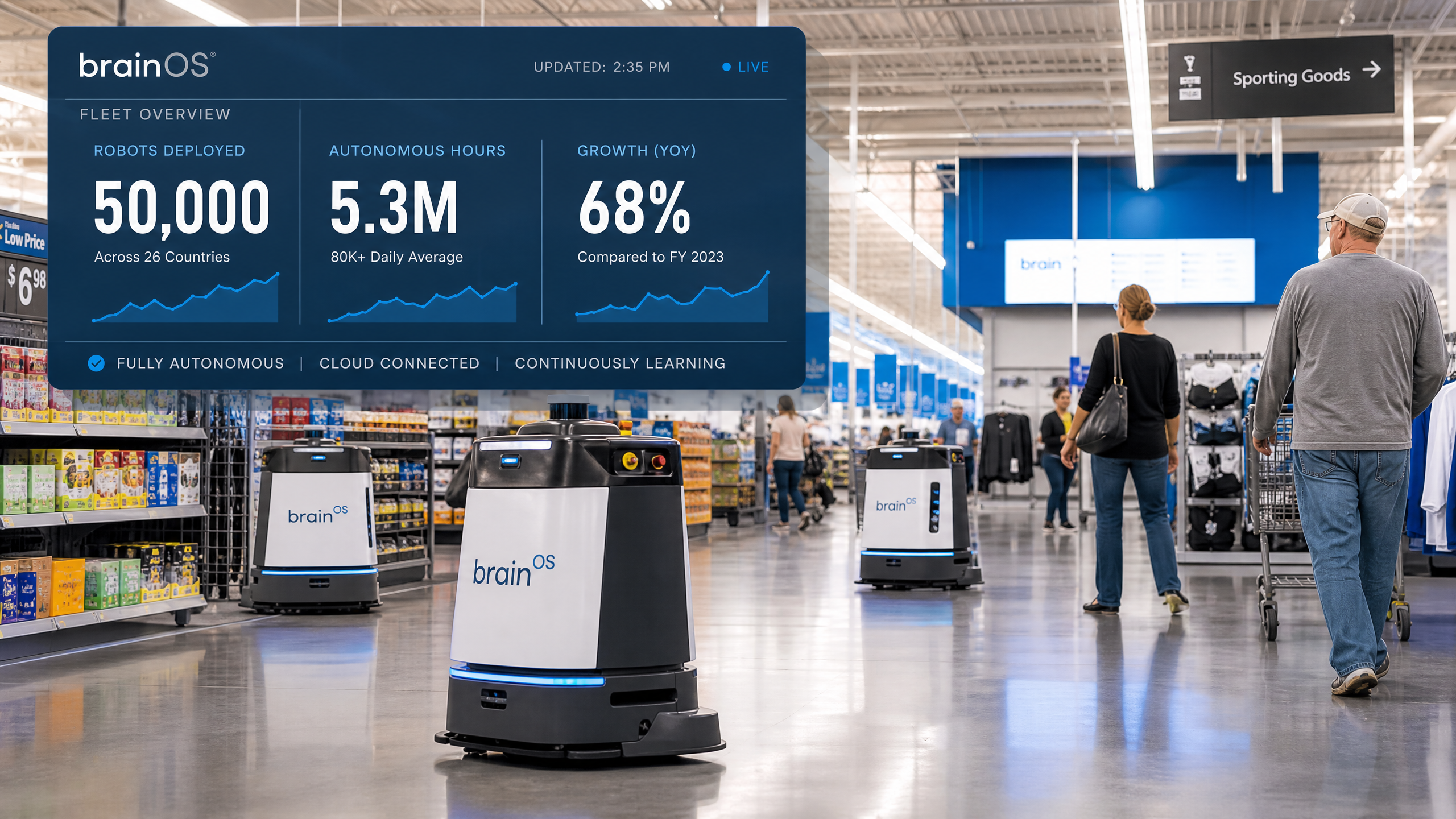
Brain Corp said it surpassed 50,000 BrainOS powered robots deployed worldwide, with global deployments up 68 percent year over year in the first half of 2026. The fleet logged over 5.3 million autonomous operating hours and covered 3.7 billion square feet, roughly the size of Las Vegas, during the period.
The San Diego company announced a new partnership with ShelfOptix and an expanded strategic partnership with Tennant Company, while securing SOC 2 Type II compliance. Chief executive David Pinn said enterprises want scalable autonomous systems, underscoring Brain Corp’s focus on a contextual grounding layer that lets robots interpret spaces rather than just navigate.
Brain Corp anchors enterprise autonomy with software at retail and facilities scale
Brain Corp is based in San Diego and is best known for BrainOS, a software platform that turns commercial cleaning machines and other service equipment into autonomous mobile robots. The software runs on partner hardware from manufacturers such as Tennant and gives retailers, airports, malls, and warehouses a way to automate repetitive floor care and inspection tasks while retaining familiar form factors and service networks.
The firm’s market niche is autonomy for high traffic, mission critical indoor environments. Unlike factories where traffic is structured and predictable, public spaces present dynamic obstacles and complex layouts. BrainOS combines simultaneous localization and mapping with computer vision and fleet orchestration to keep robots productive in shifting conditions. The approach allows large customers to adopt automation without ripping out existing workflows or vendor relationships, which remains a pivotal adoption barrier in facilities management.
Scale moves the autonomy conversation from pilot to utility
Surpassing 50,000 active robots matters because it signals a shift from one off trials to fleet normalcy. A single robot may be a novelty or a pilot. Tens of thousands build a dataset, a maintenance playbook, and an operator training base that compounds over time. Five point three million autonomous hours in half a year translate into millions of encounters with tight aisles, end caps, and spill scenarios that make the models better. The 24 percent jump in operating hours shows not just more units but more workload absorbed from human teams.
In practical terms, scale reduces the total cost of ownership through learned routing, shared maps, and faster remote support. It also attracts partners who want certainty that their integrations will be used. The ShelfOptix deal fits that logic. If robots can already traverse every aisle nightly, then turning their journeys into consistent shelf intelligence is a cross sell with nearly no extra footprint. That is the playbook that powered the rise of cloud software in the enterprise. Nail a beachhead application, prove reliability, then layer monetizable data and workflow modules.
Semantic mapping sets the stage for multi-task robots
Brain Corp’s investment in semantic mapping, described internally as a contextual grounding layer, is the most strategic technical thread in the announcement. Most commercial robots still treat the world as geometry and obstacles. Semantic mapping lets a machine understand that one zone is a produce department with wet floors and constant restocking, another is a cosmetics aisle with fragile packaging and end cap displays, and a third is a back room staging area with mixed traffic.
Think of the difference between a dash mounted satnav and a concierge who knows the neighborhood. The satnav gets you from point A to point B. The concierge gets you to the right door at the right time with an appreciation for street closures, delivery windows, and security protocols. The same concept applies in a store or terminal. Context allows robots to adjust speed, choose alternate paths, select cleaning modes, and trigger camera captures based on department level policies, not just obstacle avoidance.
If Brain Corp lands this shift, it can move beyond single purpose cleaning to blended tasks. A robot could sweep a concourse, verify planogram compliance, flag out of stocks, and capture risk observations such as spills or blocked exits in one pass. ShelfOptix creates a pathway for that blending by attaching shelf analytics and image processing to a routing asset that already covers the footprint nightly.
Enterprise readiness hinges on security and service assurances
SOC 2 Type II compliance is not glamorous, but it removes a frequent procurement hurdle. Enterprise security teams require evidence that data handling, change management, and incident response meet documented controls. For a robot that captures imagery in public spaces and syncs maps across fleets, this assurance can mean the difference between a small pilot and a multi region deployment. Customers in regulated sectors such as airports and healthcare facilities will insist on it.
The expanded partnership with Tennant is equally consequential. In facilities automation, uptime is everything. Tennant’s service network, parts availability, and operator training programs help translate autonomy into reliable outcomes on the floor. Brain Corp’s software might win the demo, but the service truck wins the renewal. Pooling roadmaps and ensuring that new BrainOS revisions map cleanly onto Tennant’s hardware line-up mitigates integration pain that often stalls adoption after the press release fades.
Supply chain dynamics favor software driven autonomy platforms
Hardware supply chains for mobile robots have matured since the worst of the chip and sensor shortages. Solid state lidar volumes have improved, and depth cameras with better low light performance are now standard. That lowers bill of materials pressure for partners and allows more consistent lead times for deployments. Battery chemistry improvements and better battery management systems reduce downtime, which directly improves reported operating hours and strengthens the ROI narrative to facilities directors.
Brain Corp’s partner model lets it sidestep the capital intensity of in house manufacturing while leveraging the distribution channels and sale cycles of established equipment makers. The trade off is shared margin, but the upside is faster geographic coverage, smoother certification paths, and a steady parts pipeline. With 50,000 units as a base, Brain Corp gains purchasing influence on components such as compute modules and sensors even when those are technically bought by partners. That influence can be steered toward configurations that best serve BrainOS, smoothing the range of edge cases that can bog down field support.
One risk remains visibility into upstream disruptions. Export controls and shifting trade policies can affect availability of edge AI compute modules used in autonomous systems. Many robots rely on systems built around GPUs and specialized accelerators that face regulatory scrutiny in certain cross border shipments. Multisourcing and modular designs help, but the firm and its partners will need contingency plans for regional deployments that could be delayed by component holds.
Competitive positioning sharpens as use cases converge
The autonomous cleaning segment features both vertically integrated vendors and platform players. Avidbots builds its own robots and software, while Brain Corp provides autonomy layers for machines already popular with janitorial teams. In retail inventory intelligence, Simbe has carved out a presence with dedicated shelf scanning robots. Locus Robotics and other warehouse specialists dominate goods movement rather than public aisle cleaning. The edges of these categories are blurring as cross functional robots and multipurpose routes become practical.
Brain Corp’s advantage is a blend of scale, distribution reach, and the familiarity of partner hardware. A facilities manager who already fields Tennant machines can upgrade to autonomous modes rather than retrain crews on entirely new devices. That cuts change management friction, which often kills automation pilots. The ShelfOptix partnership suggests that Brain Corp aims to extend the use case footprint without adding fleet types, which could undercut both dedicated shelf scanning and separate loss prevention patrols by making a single robot do more with proven routes.
A skeptical view is that category leaders in inventory analytics or store operations software might be better positioned to own data centric value, relegating cleaning robots to a commodity role. If shelf level insights and planogram enforcement are where budgets grow, software integrators could bolt their modules onto any robot with a camera and a path. Brain Corp’s counter is to make the robot more context aware and to harden the data pipeline with security assurances. By reducing the friction between autonomy, data capture, and workflow integration, the company can keep value chained to its platform.
Labor and operations pressures push adoption beyond experiment
The most durable driver in facilities automation remains labor availability and predictability. Retailers, airports, and property managers report difficulty staffing nighttime cleaning shifts, and sick leave spikes can throw maintenance schedules off course. Autonomous routes, even if they require periodic human intervention, de risk this bottleneck. The reported gains in operating hours indicate that customers are trusting robots with sustained coverage, not just showcase loops during store hours.
That said, unions and worker councils in parts of Europe have pressed for guardrails on automated equipment. Robots that record imagery create concerns about surveillance in the workplace. Brain Corp will need continued engagement with labor stakeholders, clear policies on data retention, and transparency around what is analyzed and what is discarded. SOC 2 compliance is a meaningful step, but the company should anticipate regional differences in acceptable practice, especially as new AI regulations take hold.
Geopolitical and regulatory currents shape the growth path
Global expansion will depend on navigating divergent regulatory regimes. The European Union is building out AI rules that demand transparency and risk management for automated systems, even outside safety critical domains. Privacy laws such as GDPR impose strict consent rules for imaging in public areas, and retailers have become cautious after headline fines. BrainOS must include configurable data minimization and localization features to satisfy those requirements.
In Asia, local content preferences and government backed smart city programs can work in Brain Corp’s favor if it aligns with domestic partners. However, concerns about foreign cloud services and data residency mean the company may have to support more on device processing and region specific data sinks. These technical accommodations can be turned into product features if marketed as enterprise controls rather than regulatory compliance chores.
Trade tensions can also affect spare parts and component pricing. Even if Brain Corp itself is not importing compute modules directly, its partners are exposed. A diversified supplier base and compatibility with multiple edge compute vendors would cushion the impact of a sudden restriction. The company’s software centric model allows it to abstract some of this risk, but firmware dependencies and driver support still require work when platforms shift.
Disclaimer: This article is for informational purposes only and does not constitute financial or investment advice.