Agibot and Maniformer Frame the Next Embodied Artificial Intelligence Bottleneck as a Physical Scaling Problem
At the World Artificial Intelligence Conference (WAIC) 2026, Agibot and Maniformer outlined a physical scaling bottleneck for embodied artificial intelligence (AI), model-data flywheels, and dexterous manipulation.

Why is physical data scaling becoming the limiting factor for embodied artificial intelligence?
On July 19, 2026, Agibot and Maniformer jointly hosted the Embodied Intelligence Forum at the World Artificial Intelligence Conference (WAIC) in Shanghai. The event focused on the physical limits of scaling laws, identifying the acquisition of physical interaction data as the primary bottleneck for deploying generalized embodied artificial intelligence systems.
The Physical Wall of Scaling Laws
The prevailing paradigm in artificial intelligence has relied heavily on the scaling laws of large language models (LLMs), where increasing computational power and dataset size reliably yields improved performance. However, applying this paradigm to embodied artificial intelligence encounters a severe bottleneck often referred to as the physical wall. Unlike digital text or images, physical interaction data is inherently constrained by the laws of physics, hardware limitations, and the sheer time required to collect meaningful real-world experiences. The transition from digital intelligence to physical capability represents the most significant hurdle in contemporary robotics.
Agibot (智元) and Maniformer (觅蜂科技), two organizations participating in the embodied artificial intelligence and robotics sector, emphasized that breaking this physical wall requires a fundamental shift in how data is acquired and utilized. The proposed approach centers on driving physical artificial intelligence emergence through iterative data collection. This model-data flywheel concept suggests that initial models, even if imperfect, must be deployed in physical environments to gather interaction data. This data is then used to refine the models, which in turn enables more advanced physical interactions, creating a continuous loop of improvement.
The challenge lies in the initial stages of this flywheel. Without sufficient capability, robots cannot perform tasks well enough to generate high-quality data. Conversely, without high-quality data, the models cannot improve their capabilities. Overcoming this initialization hurdle requires sophisticated strategies, including the use of teleoperation and human demonstration to prime the system with foundational interaction patterns. The physical wall is not merely a theoretical limit but a practical barrier that dictates the pace of progress in the field.
Moving from Passive Observation to Physical Action
A critical component of the physical scaling problem is the transition from passive observation to active physical action. Traditional computer vision systems excel at identifying objects and understanding scenes, but translating that understanding into precise, context-aware physical movements remains a profound challenge. This gap between perception and action is where many embodied artificial intelligence systems falter during real-world deployment. The scheduled session on "From Observation to Action: Foundation Models and Feedback Learning for Embodied Intelligence" directly addressed this transition.
The forum highlighted feedback learning as a primary mechanism for bridging this gap. By utilizing foundation models for active feedback loops, robots can move beyond pre-programmed trajectories and adapt to dynamic environments in real time. This approach requires hardware and software architectures capable of processing sensory input, updating internal models, and adjusting motor commands with minimal latency. The shift from passive to active learning is essential for robots to operate autonomously in unstructured environments.
The integration dependencies here are substantial. High-fidelity sensors, low-latency communication buses, and powerful edge computing units must work in perfect synchronization. Any delay or inaccuracy in the feedback loop can lead to catastrophic failures in physical tasks, particularly those requiring delicate manipulation or interaction with fragile objects. The focus must therefore be on co-designing hardware and software to minimize these integration frictions. The physical wall is as much an engineering challenge as it is a data acquisition problem.
Transitioning from Narrow Experience to Broad Capability
Generalization remains the holy grail of embodied artificial intelligence. While it is relatively straightforward to train a robot to perform a specific task in a controlled environment, ensuring that the robot can perform the same task in a novel environment, or adapt its skills to a slightly different task, is exceptionally difficult. This transition from narrow experience to broad capability is essential for the commercial viability of general-purpose robots. The scheduled session on "Towards Physical Intelligence: Robots from Experience to Generalization" explored the pathways to achieving this broad capability.
Scaling robot learning in real-world environments is the proposed approach to achieving this generalization. This involves deploying robots across diverse settings, exposing them to a wide variety of objects, lighting conditions, and physical interactions. The data collected from these diverse deployments is crucial for training models that can abstract underlying principles rather than merely memorizing specific trajectories. The scheduled session on "Scaling Robot Learning in the Real World" underscored the importance of this diverse data collection.
However, real-world deployment introduces significant operational constraints. Robots must be robust enough to handle unexpected physical impacts, power systems must support extended operation without tethering, and safety protocols must ensure that the robots do not pose a risk to humans or property. These hardware constraints directly impact the rate at which diverse real-world data can be collected, adding difficulty to the physical scaling problem. The physical wall dictates that generalization cannot be achieved through simulation alone; it requires extensive, varied, and safe real-world deployment.
Acquiring Sufficient High-Quality Interaction Data
Dexterous manipulation, particularly the ability to handle novel objects with varying shapes, weights, and textures, is perhaps the most demanding application of embodied artificial intelligence. The primary challenge in this area is acquiring sufficient high-quality interaction data. Unlike visual data, which can be scraped from the internet in massive quantities, physical interaction data must be generated through actual physical contact. The scheduled session on "Human Data and Simulation Scaling for General Dexterous Manipulation" focused on this specific challenge.
To address this data scarcity, the forum discussed combining human demonstration data with simulation scaling. Human teleoperation provides high-quality, goal-directed interaction data that can serve as a baseline for model training. However, teleoperation is slow, expensive, and difficult to scale. Therefore, this human data must be augmented with massive amounts of simulated data. The scheduled session on "Robots Learning from Human Experience: Science and Scaling" highlighted the role of human data in this process.
Simulation allows for the rapid generation of diverse interaction scenarios, enabling models to experience millions of variations of a task in a fraction of the time it would take in the real world. The challenge, however, is the sim-to-real gap. Physics engines, no matter how advanced, cannot perfectly replicate the intricacies of real-world friction, material deformation, and sensor noise. Models trained exclusively in simulation often fail when deployed on physical hardware.
The solution lies in a hybrid approach. Human demonstration data is used to ground the models in reality, while simulation is used to scale the diversity of experiences. The models are then fine-tuned using real-world feedback learning, creating a robust system capable of dexterous manipulation in unpredictable environments. This hybrid approach is essential for overcoming the physical wall and achieving true dexterity.
Hardware-Software Integration Dependencies
The physical scaling problem is not solely a software challenge; it is deeply intertwined with hardware capabilities. The performance of embodied artificial intelligence models is fundamentally limited by the physical characteristics of the robot, including actuator strength, sensor resolution, and compute capacity. The physical wall is defined by these hardware limitations as much as by the availability of data. The ongoing debate around embodied AI chips and controller architecture highlights the importance of dedicated silicon for processing these models efficiently.
For instance, the model-data flywheel relies on the ability of the robot to execute intricate movements and gather high-fidelity sensory feedback. If the actuators lack the necessary precision or the sensors are too noisy, the resulting data will be of poor quality, hindering the learning process. Similarly, if the edge computing unit cannot process the foundation models quickly enough, the feedback loop will be too slow for dynamic tasks. The physical wall is a barrier that must be overcome through meticulous engineering.
Therefore, successful deployment requires a holistic approach to hardware-software co-design. The software models must be optimized for the specific hardware constraints of the robot, and the hardware must be designed to support the computational and sensory requirements of the models. This tight integration is essential for overcoming the physical wall and achieving true embodied intelligence. The physical wall is a reminder that intelligence cannot exist in a vacuum; it must be embodied in capable hardware.
Specific Failure Modes in Real-World Deployment
Understanding the specific failure modes of embodied artificial intelligence systems is crucial for guiding future development. The forum discussions, while focusing on the path forward, implicitly acknowledged the common pitfalls encountered during real-world deployment. The physical wall is often encountered in the form of these specific failure modes.
One primary failure mode is the inability to handle edge cases. Models trained on limited datasets often fail catastrophically when presented with novel objects or environments. This highlights the critical need for generalization and the importance of diverse real-world data collection. The physical wall is a barrier that prevents models from generalizing beyond their training data.
Another common failure mode is related to hardware limitations. Actuator overheating, sensor degradation, and power failures can all disrupt the model-data flywheel and prevent the robot from completing its tasks. These hardware failures underscore the importance of robust engineering and the need for models that can gracefully degrade in the presence of hardware faults. The physical wall is a reminder that hardware is not infallible.
Finally, integration failures, where the software and hardware fail to communicate effectively, are a significant source of unreliability. High latency in the feedback loop, synchronization issues between sensors, and communication bottlenecks can all lead to unpredictable and potentially dangerous behavior. Addressing these integration dependencies is a prerequisite for safe and reliable real-world deployment. The physical wall is a barrier that must be overcome through meticulous integration.
Procurement and Commercial Implications
The physical wall has significant implications for the procurement and commercialization of embodied artificial intelligence systems. Buyers must recognize that the capabilities demonstrated in controlled environments or simulations may not translate directly to real-world performance. The physical wall is a reality check for the industry, highlighting the gap between potential and actual capability.
Procurement decisions should prioritize systems that demonstrate robust hardware-software integration and a clear pathway for continuous learning in the target environment. The ability of a system to participate in a model-data flywheel and adapt to novel situations is more critical than its performance on a static benchmark. The physical wall dictates that adaptability is more valuable than raw capability.
In addition, the cost of acquiring high-quality physical interaction data must be factored into the total cost of ownership. Systems that rely heavily on human teleoperation or extensive real-world deployment for training will incur significant ongoing costs. The physical wall is a financial barrier as much as a technical one. Buyers must carefully evaluate the data acquisition strategies of potential vendors to ensure long-term viability. Understanding the China humanoid robotics capital cycle provides context for how these companies are funding these expensive data acquisition efforts.
Comparison of Focus Areas and Approaches
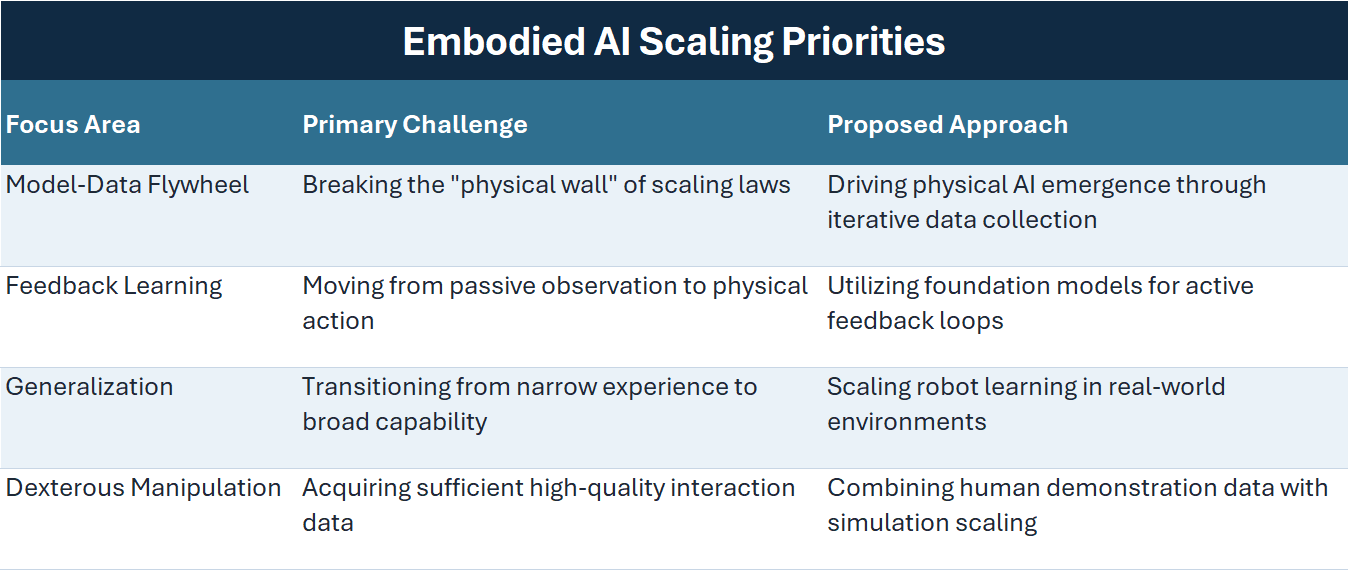
The following table summarizes the primary focus areas, challenges, and proposed approaches discussed during the forum, highlighting the intricate nature of the physical scaling problem.
The Path Forward for Embodied Intelligence
The WAIC 2026 Embodied Intelligence Forum, hosted by Agibot and Maniformer, clearly articulated that the next major bottleneck in robotics is a physical scaling problem. Overcoming this bottleneck requires a fundamental shift in how data is acquired, utilized, and integrated with physical hardware. By focusing on model-data flywheels, feedback learning, and the combination of human demonstration with simulation scaling, the industry can begin to break through the physical wall and achieve generalized dexterous manipulation in real-world environments.
However, this progress will depend heavily on addressing the hardware-software integration dependencies and mitigating the specific failure modes that currently plague real-world deployments. The physical wall is a formidable barrier, but it is not insurmountable. Through meticulous engineering, innovative data acquisition strategies, and a commitment to real-world deployment, the industry can continue to push the boundaries of what is possible with embodied artificial intelligence.
The transition from digital intelligence to physical capability is a journey that will require sustained effort and collaboration across the industry. The physical wall is a challenge that must be met with ingenuity and perseverance. As the industry continues to grapple with this challenge, the insights shared at the WAIC 2026 Embodied Intelligence Forum will serve as a valuable roadmap for the future of embodied artificial intelligence.
Quotable insight: Moving from digital intelligence to physical capability changes the scaling problem because every useful interaction depends on hardware, time, environment, and data collection.
The physical wall is a reminder that the path to true embodied intelligence is paved with physical interaction data. The industry must embrace this reality and develop the tools and techniques necessary to acquire, process, and utilize this data effectively. Only then can the promise of generalized embodied artificial intelligence be fully realized.
This analysis synthesizes company statements and public market activity.
Image credit: WAIC 2026 Official Asset
Disclaimer: This article is provided for informational purposes only and does not constitute investment, legal, technical, or business advice. It synthesizes verified primary-source materials available on July 19, 2026. Product specifications, event schedules, benchmarks, and performance claims remain subject to independent verification. Readers should conduct their own due diligence before making commercial or technical decisions.