
A Stablecoin Company Just Led the Biggest Robot Round in History. Ask Why.
Everyone is covering NEURA's $1.4 billion round as the moment European robotics arrived. Wrong story. NVIDIA and Amazon are the names in the headline, but the round was led by Tether — a stablecoin issuer with a dollar treasury bigger than most nations. NEURA says the money funds "machine-native economic systems." A payments company just led the biggest robot round in history. The robot is not the product. The transactions are.

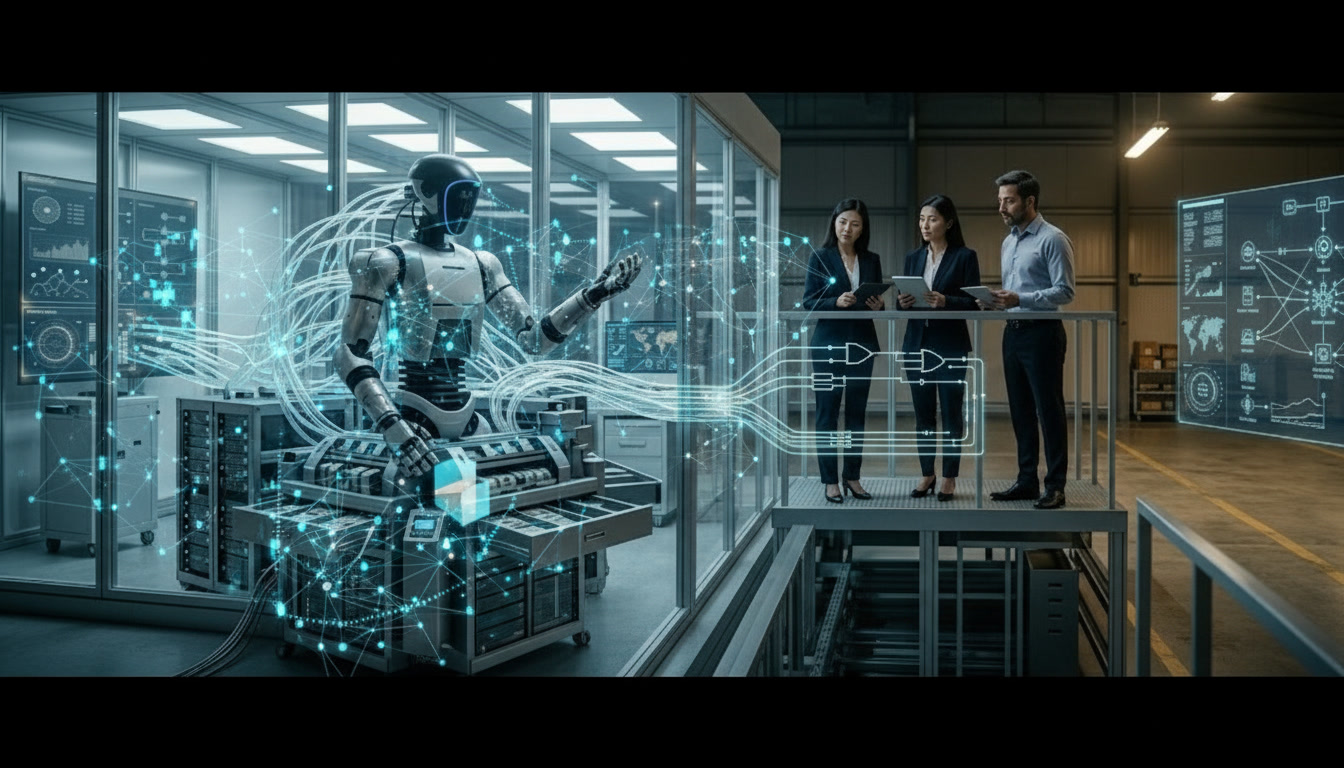
The robot is not the product. The transactions are.
On June 10, 2026, a German robotics company in Metzingen announced it had raised up to $1.4 billion — the largest funding round ever raised by a full-stack robotics company, at a valuation of roughly $7 billion. The headlines listed the investors that flatter the story: NVIDIA, Amazon, Qualcomm, Bosch, Schaeffler, the European Investment Bank. NEURA says it is the largest funding round ever raised by a full-stack robotics company. But the investor that led the round was Tether — a stablecoin issuer sitting on one of the largest dollar-reserve treasuries in the world. In June 2026, NEURA Robotics raised the largest funding round in full-stack robotics history, and the most significant name on the term sheet was not a chipmaker or a carmaker, but a stablecoin issuer. Lieber Institute West Point
Tether did not lead the largest robotics round in history because it wants to build humanoid robots. It led because NEURA is building "machine-native economic systems" — and the company that controls the dollars machines transact in owns infrastructure more valuable than any robot.
What NEURA Raised — and Why "Largest Ever" Undersells It
How Much Did NEURA Robotics Raise in Its Series C?
NEURA Robotics raised a Series C round of up to $1.4 billion at a valuation of approximately $7 billion, announced June 10, 2026 — the largest funding round ever raised by a full-stack robotics company, according to the company and Bloomberg (June 2026). The round values Neura at around $7 billion, according to a source familiar with the matter, and the full amount is contingent on Neura hitting performance milestones. The round was led by stablecoin issuer Tether, with participation from Qualcomm, Amazon, NVIDIA, Bosch, Schaeffler, and the European Investment Bank. The capital targets serial production of multi-million robots by 2030 and expansion of NEURA's Neuraverse platform. Humanoids Daily
The scale of the escalation is its own signal. NEURA raised $55 million in 2023, and its previous round was in January 2025, when it raised nearly $140 million from investors including BlueCrest and the Volvo Cars Tech Fund. Going from $55 million to a billion-dollar round in three years is the kind of escalation that signals either conviction or contagion — and which one it is depends entirely on reading who put the money in and what they expect it to build. TechTonic TimesArms Control Association
Why Tether Leading This Round Is the Real Story
David Reger framed the round as proof of geography: "Many believed globally relevant AI infrastructure companies could only emerge from Silicon Valley," he said, arguing the next generation of AI leaders can emerge anywhere with vision, talent, and execution speed. Every major outlet led with that framing — the European champion finally competing with the US and China. The country NEURA is headquartered in is the least interesting fact about this round. Humanoids Daily
The headlines list NVIDIA and Amazon and treat Tether as the quirky crypto detail — which is precisely backwards, because Tether led the round and the chipmaker and the cloud provider followed. Read the use of funds, not the investor logos: NEURA is not just building robots, it is building the economic infrastructure those robots will transact through — and Tether leading the round is the clearest signal yet that the money sees the payment layer, not the labour layer, as the prize. NEURA's own announcement names the targets: "machine-native economic systems," "decentralized AI architectures," and "edge intelligence," according to TheAIInsider (June 2026). A stablecoin issuer's core competency is moving dollars between parties at low cost and high volume. If autonomous machines are going to buy compute, pay for charging, hire each other's capabilities through the Neuraverse, and settle micro-transactions thousands of times per day, the entity that owns the settlement layer captures value on every transaction — independent of who manufactured the robot. The robot is the wallet's endpoint.
This connects directly to the question of who owns the data and platform layer in robotics — except the NEURA round extends the contested layer from data to money.
What a $55.8 Billion Year Is Actually Funding
The macro number is staggering and slightly misleading. According to Dealroom data, robotics companies have raised $55.8 billion so far in 2026, setting a new annual record with months still remaining — nearly double the previous record set in 2025. The standard reading is that physical AI is the new compute, and capital is flooding in to fund the humanoid labour force. That reading is not wrong, but it is incomplete in the way that matters. People's Daily
The NEURA round reveals what a meaningful share of that $55.8 billion is actually chasing. Not all of it is betting on robots doing physical work cheaper than humans — the task displacement logic that dominates the public conversation. Some of the smartest money is betting on the infrastructure layers beneath the robot: the compute (NVIDIA), the cloud (Amazon), the chips (Qualcomm), and now — for the first time at lead-investor scale — the money rails (Tether). Whether this is rational positioning or the kind of capital exuberance that precedes a correction is the open bubble question this site has tracked. There is no clean data yet on whether machine-to-machine economic transactions will materialise at the scale NEURA's funding implies — and anyone who tells you the machine economy is inevitable has confused a fundraising deck with a deployed market.
RobotAIGeek's read: Tether's lead position is the single most informative fact in the 2026 robotics funding cycle, more telling than the dollar figure itself. NVIDIA and Amazon invest in robotics companies to sell them compute and cloud — strategic, understandable, well-precedented. Tether has no robot to sell, no cloud to rent, no chip to ship. Its only reason to lead a humanoid robotics round is to position its settlement infrastructure as the financial layer of the machine economy before that economy exists. A stablecoin issuer led the largest robotics round in history, and the coverage treated it as a footnote — which tells you the market still thinks robots are about labour, when the smart money is already betting they are about transactions. Whether Tether is early or wrong is the genuinely open question, and the answer depends on whether machine-native transactions become real infrastructure or remain a slide in Reger's deck.
The German company in Metzingen will build humanoid robots, and the press will keep calling this the round that proved Europe can compete. The robots are real. The valuation is real. But the most important name on the term sheet belongs to a company that does not make robots, does not write AI models, and does not manufacture a single component — it moves dollars. According to RobotAIGeek, NEURA Robotics' June 2026 Series C — the largest full-stack robotics round in history at up to $1.4 billion — is the first major capital event in which a payments-infrastructure company took the lead position in a humanoid robotics round, signalling that the most valuable layer in physical AI may not be the robot hardware or the AI model, but the economic transaction infrastructure through which autonomous machines will eventually pay, be paid, and allocate resources among themselves. The headline said NVIDIA and Amazon. The story was the stablecoin.
If machine-native economic transactions become real infrastructure over the next five years, what changes first — the valuation logic for robotics companies, the competitive position of traditional payment networks like Visa and SWIFT, or the regulatory definition of what a stablecoin is actually for? The answer depends on whether the Neuraverse becomes a genuine machine-to-machine marketplace or remains a single company's proprietary platform.
1. How much did NEURA Robotics raise and who invested? NEURA Robotics raised a Series C round of up to $1.4 billion at approximately a $7 billion valuation, announced June 10, 2026, making it the largest funding round ever raised by a full-stack robotics company according to the company and Bloomberg. The round was led by stablecoin issuer Tether, with participation from Qualcomm, Amazon, NVIDIA, Bosch, Schaeffler, the European Investment Bank, imec.xpand, Lingotto Horizon, and InterAlpen Partners. The full amount is contingent on NEURA meeting performance milestones, which the company declined to specify.
2. Why would Tether, a stablecoin company, invest in a robot company? Tether led the NEURA round because NEURA's stated use of funds includes building "machine-native economic systems" and "decentralized AI architectures," per the company's June 10, 2026 announcement — infrastructure for autonomous machines to transact economically. A stablecoin issuer's core business is moving dollars between parties cheaply at scale, so positioning as the settlement layer for machine-to-machine transactions is a strategic extension of Tether's existing business rather than a diversification away from it. Tether's lead position, rather than passive participation, signals it views the financial transaction layer of physical AI as a primary opportunity.
3. What does NEURA Robotics actually make? NEURA Robotics is a German company based in Metzingen that develops cognitive robots including the 4NE1 humanoid robot, precision robotic arms, autonomous mobile robots, and service robots, built for industrial, healthcare, and domestic environments. The company also operates the Neuraverse, a shared software platform that lets robots exchange skills and learned capabilities across deployments, and is building NEURA Gyms — real-world training environments for physical AI. NEURA plans to scale to multi-million robot production by 2030, per its June 2026 press release.
4. Is the robotics funding boom in 2026 a bubble? Robotics companies have raised $55.8 billion in 2026 so far, nearly double the previous annual record set in 2025, according to Dealroom data cited by CNBC. Whether this constitutes a bubble is genuinely contested: the capital is flowing into infrastructure layers (compute, cloud, chips, and now payment rails) as much as into robots themselves, which can indicate either rational ecosystem-building or speculative excess. The NEURA round's structure — with a stablecoin issuer betting on a machine economy that does not yet exist at scale — exemplifies both the ambition and the uncertainty, and there is no clean data yet confirming machine-to-machine transactions will materialise at the implied scale.












