ANYbotics Gives ANYmal a Digital Badge for Secured Doors
ANYbotics has partnered with Swiss access-control group dormakaba and identification-technology company LEGIC Identsystems to let its ANYmal quadruped robot request and pass through electronically secured doors during unmanned inspection rounds, validated in a multi-week pilot at GE Vernova's Whitegate power station in Ireland, with commercial rollout planned later in 2026.

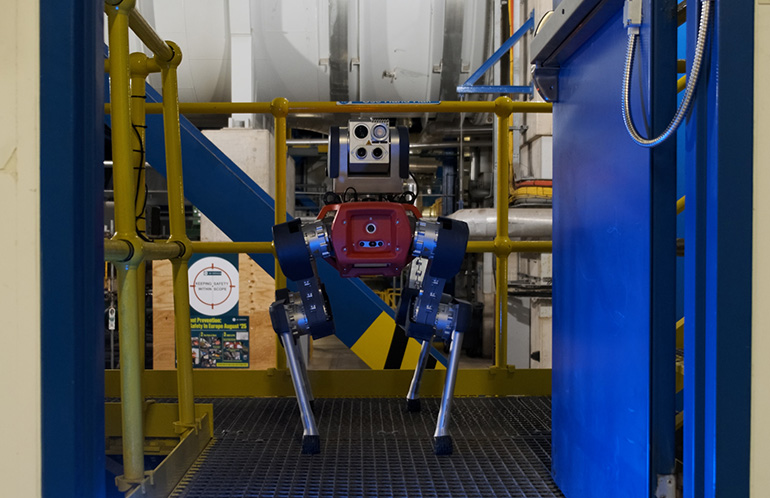
Autonomous inspection robots have spent the past several years learning to walk uneven floors, climb stairs, and read gauges without a human handler nearby. They have not learned to open a door. A locked or fire-rated door has functioned as a hard stop for a machine carrying no badge, no key card, and no standing authorization inside an access-controlled industrial site, leaving operators with two bad options: prop the door open and break fire-compartmentalization rules, or send a person back into the hazardous zone the robot was bought to keep them out of. That constraint just narrowed. On September 24, 2026, Zurich-based quadruped-robot maker ANYbotics said it has partnered with Swiss access-control group dormakaba and Swiss identification-technology company LEGIC Identsystems AG to let its ANYmal inspection robot request, receive, and log building access through secured doors the same way a badged employee does.
dormakaba, headquartered in Rumlang, Switzerland, is one of the world's larger access-control and security-hardware groups, supplying door closers, locks, and automated entry systems to airports, hospitals, and industrial sites worldwide. LEGIC Identsystems AG, based nearby in Wetzikon, Switzerland, occupies a narrower but foundational niche in the same market: it develops radio-frequency identification (RFID) chip technology for secure credentials, technology already licensed into a wide swath of the access-control hardware other vendors sell, from employee badges to hotel key cards. Set alongside ANYbotics, itself spun out of ETH Zurich in 2016 and now roughly 200 staff with more than US$150 million in funding raised to date, the three companies assemble a working stack: a mobile robot platform, a credential standard, and the door hardware that reads it.
A Two-Tier Fix Built for the Doors Already on the Wall
The partnership splits the door problem into two separate engineering jobs, solved with two different technologies, and it matters which one is further along. For unlocked doors on a robot's planned route, a radar sensor detects ANYmal's approach and triggers a retrofitted dormakaba ED 100 or ED 250 swing-door operator mounted on the existing door. The door opens, the robot passes through, and it closes again. Nothing about the door itself changes: the system is built to work on indoor, outdoor, and fire-rated doors without structural modification, and dormakaba's local teams handle the survey, quoting, and installation work through the same channels they already use for human-facing automatic doors. This half of the system is commercially available now.
Locked and access-controlled doors are the harder problem, and the one that actually required three companies rather than two. A radar sensor can tell a door that something is approaching, but it cannot tell the door whether that something is authorized to enter. To solve that, ANYmal carries a LEGIC security payload that gives the robot a trusted digital identity, the same category of credential a human employee carries in a badge. When ANYmal nears a protected doorway it sends an electronic access request into dormakaba's exos management platform, which weighs that request against the permissions already on file, allows or denies it, releases the lock when approved, and time-stamps the whole exchange for later review. A product manager on ANYbotics' workflow-integration team, Jacob Euler-Rolle, put the underlying logic plainly: a closed door was the one obstacle stopping the company's robots from reaching the most critical parts of a plant, and solving it with LEGIC and dormakaba let ANYmal reach those areas without rebuilding any infrastructure. Peter Fankhauser, ANYbotics' co-founder and chief executive, framed the commercial case in similar terms: customers do not buy robots, they buy a reduction in unplanned downtime and in the number of people sent into hazardous areas, and a robot that moves through doors under the same rules and the same audit trail as an authorized colleague delivers exactly that.
The Whitegate Pilot Turns a Pitch Into an Operating Record
Announcements of this kind live or die on whether anyone actually ran the system outside a demo booth, and this one has an answer. GE Vernova tested the joint solution in a live operating environment at its Whitegate power station in County Cork, Ireland, running ANYmal through several weeks of continuous testing. Over that stretch the robot repeatedly requested access, passed through controlled doors, and completed its inspection routes without a person stepping in to open anything for it. Brian Carroll, a maintenance engineer at GE Vernova Whitegate, described the practical payoff: letting the door open automatically for the robot let the site automate routine inspection runs across the whole facility while keeping fire and security barriers intact. That is a meaningfully different claim than a lab pilot. A power station is exactly the kind of site where a safety regulator asks hard questions about anything that touches a fire door, and a several-week continuous run inside one is the evidence a buyer's own safety team will want before signing off on the same setup elsewhere.
The three companies first showed the finished system publicly at the LEGIC connect26 conference in Zurich on September 17, 2026, a full week ahead of this week's formal announcement, using that industry audience to demonstrate rather than merely describe the access flow before taking the story to the wider market.
A Robot's Badge Raises the Same Questions a Human's Does
The phrase ANYbotics and its partners keep returning to, a robot moving through doors "like any authorized colleague," is doing real work as a security claim, not just a marketing line, and it invites the obvious follow-up: what happens when someone tags along behind the robot into a zone they are not cleared for. Euler-Rolle's answer is that tailgating remains exactly the risk it always was. The robot authenticates and passes through doors the same way a badged employee does, and it does not change a door's own anti-tailgating measures or weaken existing physical security layers such as mantraps, interlocks, cameras, or guard protocols. Someone tailgating a robot triggers the same standard countermeasures as someone tailgating a person, with one operational advantage in the robot's favor: its timestamped record of every badge scan and passage gives security staff a cleaner trail to review than a door a human simply propped open and forgot about.
A quadruped that can badge through a fire door is not simply a mobility upgrade but a transfer of accountability: every door it opens on its own becomes a door someone in a security office has to answer for, on demand, months later. David Fuller, dormakaba's chief innovation officer, cast that shift in industry terms, noting that the joint pilot shows access solutions moving beyond traditional human-only applications, with securely authenticating autonomous machines becoming an enabler for the next stage of industrial automation. That framing matters because it puts the access-control vendor, not just the robot maker, in the position of vouching for the machine's presence inside a secured perimeter.
What This Does to the Quadruped Field's Competitive Structure
ANYbotics is not the only company selling a four-legged inspection platform, and the door problem it just addressed is not unique to ANYmal. Boston Dynamics' Spot and Deep Robotics' quadrupeds compete for the same processing-industry customers, energy, metals, mining, and chemical sites running unmanned inspection rounds, and every one of those robots eventually reaches the same locked door ANYmal used to stop at. What ANYbotics has done is turn a shared engineering gap into a three-way supply chain relationship it now controls a piece of: a robot maker, a credential-technology licensor already embedded across the access-control industry, and a door-hardware group with installed base and service teams in place at the customer sites that matter. A rival quadruped vendor chasing the same processing-industry buyers now faces a choice between building an equivalent integration from scratch, negotiating its own three-way partnership, or ceding the access-controlled segment of these sites to ANYbotics for the time being. Because LEGIC licenses its credential technology broadly across the access-management industry rather than exclusively to ANYbotics, a competitor is not locked out of the underlying protocol, but it still has to do the integration and pilot work ANYbotics has already banked, and reference sites like Whitegate do not get built twice as fast the second time around.
That leaves a genuine question for a facility-security team evaluating any of these vendors, not just ANYbotics: what happens to the robot's access rights the moment its mission changes, its software updates, or the vendor relationship ends. A procurement or security manager should ask exactly how fast a robot's credential can be revoked from the access-management system if it is decommissioned, compromised, or reassigned, whether that revocation runs through the customer's own access-control administrator or requires the robot vendor's cooperation, and whether the audit log lives inside the customer's own security system or a third party's platform. Those are the same questions a security team already asks about a contractor's temporary badge, and the answer for a robot should be at least as tight, given that a robot's badge does not get handed back at the end of a shift.
The Next Marker to Watch Is the General-Availability Date
The specific thing to track from here is not whether the technology works, Whitegate already answered that, but whether the access-controlled payload actually ships as a broadly available add-on later in 2026 as promised, across both current ANYbotics deployments and future ANYmal hardware, rather than staying a single-site reference case. A second marker sits right behind the first: the partners say they are already evaluating expansion to elevators, gates, and turnstiles, the other common chokepoints inside large industrial sites beyond a single swing door. If that expansion moves from evaluation to a named pilot within the next two or three quarters, it signals the partners are building toward full-site autonomy rather than a point solution for one obstacle, which is the difference that determines whether a robot can actually reach, in Euler-Rolle's own estimate, the 30% to 50% of critical equipment that fire-rated compartmentalization puts behind restricted doors at a typical process facility. An inspection robot confined to the unrestricted half of a plant is a partial solution wearing a full-solution price tag; one that can legitimately reach the whole site is a different commercial proposition entirely, and that is the gap this partnership is now racing to close.
This account synthesizes ANYbotics', dormakaba's, and LEGIC Identsystems' public statements and industry reporting on the September 24, 2026 announcement. It is for general information purposes only and does not constitute investment, financial, or legal advice.
Hero image credit: ANYbotics.