
Anduril, Palantir Win US$192 Million Army TITAN Production Award
The US Army awarded US$192 million on September 1 to move its TITAN AI-enabled intelligence ground station into production, with Palantir as prime (US$127 million) and Anduril delivering hardware and shelter integration (US$65 million) for an initial eight systems over eighteen months. The award confirms the software-led contracting model survived its transition from prototype to production, and puts both defense-tech firms on a public manufacturing clock.

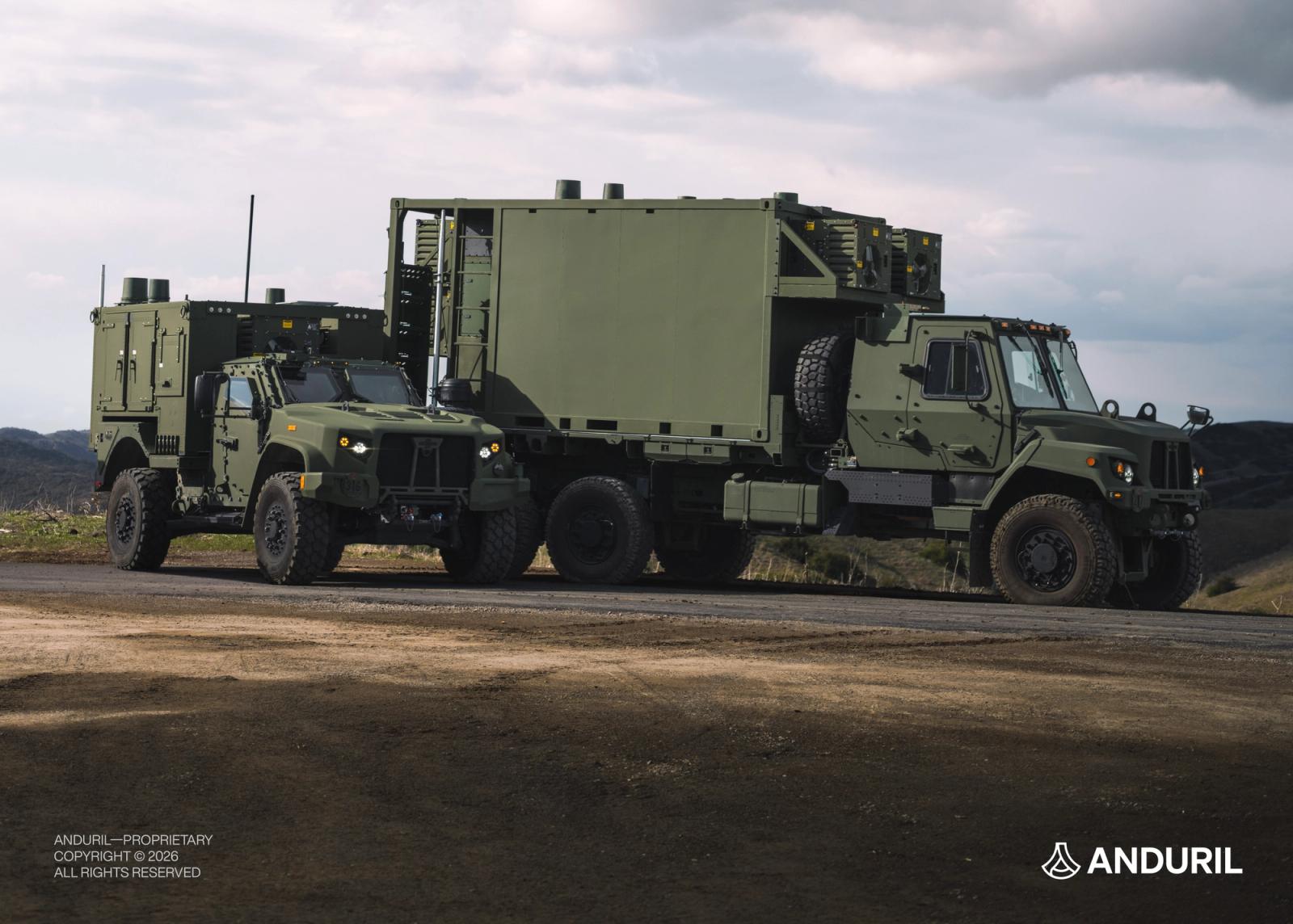
On September 1, the United States Army moved its most closely watched intelligence program out of the prototype era. Army Contracting Command awarded a combined US$192 million to Palantir Technologies and Anduril Industries to begin production of the Tactical Intelligence Targeting Access Node, known as TITAN, with Palantir taking US$127 million as prime contractor and Anduril US$65 million for hardware and shelter integration. The award covers an initial eight ground stations, four Advanced and four Basic variants, all to be delivered to Army units over the next eighteen months.
The decision closes a chapter the defense industry has argued about since 2024, when the Army handed a major hardware program to a software company for the first time and asked the traditional integrators to line up behind it. Production money is a different kind of endorsement than prototype money. The Army is no longer paying to find out whether the model works; it is paying for trucks.
TITAN is not a robot, but it is the nervous system the Army's autonomous and long-range systems increasingly report to. Each station is a crewed vehicle that pulls data from space, high-altitude, aerial, and terrestrial sensors into one AI-assisted picture, then turns that picture into targeting and mission command for long-range precision fires. The larger Advanced variant carries more onboard processing and integration capability; the Basic variant trades capacity for mobility and rapid deployment. In plain terms, the Army has bought a machine for shortening the distance between something being seen anywhere on a battlefield and something being done about it.
The Software Primes Take the Hardware Contract
The award's structure says as much as its size. Palantir, the Denver-based data and AI software company, won the original US$178 million prototype competition in March 2024 and delivered ten prototype systems shaped, in the program's telling, by four years of continuous soldier feedback. Akash Jain, president and chief technology officer of Palantir's government arm, framed the production win in exactly those terms: "TITAN was shaped by the Soldiers who used it, in the conditions they used it in, against the standard they set."
Anduril's US$65 million share buys the physical half of that promise. The company leads hardware design, development, and scaled manufacturing for the program, along with the shelter integration that turns a tactical truck into a mobile intelligence node, work it performed across the ten prototype vehicles. The rest of the team reads like a deliberate blend of old and new defense: L3Harris Technologies, Sierra Nevada Corporation, Strategic Technology Consulting, and World Wide Technology all contribute subsystems under the Palantir-led structure.
For readers tracking the defense-autonomy sector, the inversion is the story. For decades, hardware primes owned the platform and bought the software. On TITAN, a software company owns the program and contracts for the metal. The 2024 prototype award was itself a competitive upset, with Palantir's team selected over a rival led by RTX, the kind of incumbent that had owned Army sensor-fusion work for a generation. The arrangement survived the transition from prototype to production intact, which suggests the Army is satisfied with more than the technology; it is satisfied with the management model.
The incumbents did not disappear from the program; they were reorganized inside it. L3Harris and Sierra Nevada build subsystems they might once have integrated themselves, under a prime whose core asset is a data platform rather than a factory. Every traditional supplier now watching its own franchise programs age toward recompete will read the production award as a precedent, and every venture-backed defense firm will cite it in the next funding round. Both readings are correct, which is what makes the award consequential beyond its dollar figure.
What Eight Trucks Buy the Army
Eight systems in eighteen months is a modest production run by industrial standards and a meaningful one by procurement standards. Deep-sensing ground stations sit at the center of the Army's plan to make long-range fires useful: a missile that can reach hundreds of kilometers is only as good as the sensor chain that finds, confirms, and prices its target. TITAN's job is to compress that chain, fusing feeds that today arrive in separate systems staffed by separate specialists.
The split between variants sketches how the Army intends to field that capability. Four Advanced stations, with the heavier processing loadout, anchor higher echelons where the volume of sensor data is largest and the targeting decisions carry the longest reach. Four Basic stations push a lighter version of the same picture toward formations that move often and set up fast. The ratio will matter to industry observers: if the fleet plan that follows this initial buy leans toward the Basic variant, the program becomes a volume manufacturing story; if it leans Advanced, it becomes a systems-integration story, and the two favor different suppliers.
The AI framing deserves a sober reading. TITAN is crewed, and its machine learning assists human analysts rather than replacing the targeting decision. What the program actually tests is whether AI-assisted fusion can run reliably on vehicles in the field, on Army networks, under Army maintenance, rather than in a contractor's demonstration environment. That is the same deployment question hanging over every autonomous system the service buys, from loitering munitions ordered by the hundreds to logistics robots, and TITAN's production run will generate the answer at fleet scale before most of those programs reach it.
There is also a quieter industrial signal in the award's timing. The production contract lands as defense-technology firms work to prove they can graduate from venture-funded prototypes to rate manufacturing, a transition where capital has been flowing faster than delivered hardware across the sector. Eight vehicles will not settle that debate, but they create a public, dated, contracted test of it.
Anduril's Factory Bet Meets a Production Clock
Anduril Industries, headquartered in Costa Mesa, California and founded in 2017, built its business on the argument that defense hardware should be developed like commercial products, at company expense and ahead of contract, then sold as finished capability. The company makes autonomous aircraft, counter-drone systems, underwater vehicles, and the Lattice software that coordinates them, and it has spent heavily on manufacturing capacity to back the thesis. Earlier this year it entered a US$20 billion enterprise agreement framework with the Army covering future work, a number that describes ambition and access rather than booked revenue.
That makes the TITAN production award a useful, unglamorous checkpoint. Shelter integration, the work of packaging computing, power, cooling, and workstations into a protected box that survives roads, weather, and soldiers, is exactly the kind of engineering that separates companies that ship from companies that demo. It is not the frontier of autonomy. It is the discipline autonomy depends on, and the eighteen-month clock on eight vehicles is a schedule against which the company's manufacturing claims can be publicly measured.
The procurement lesson travels well beyond defense. Buyers evaluating any autonomy vendor, military or industrial, learn more from a delivered production unit with a maintenance history than from any prototype milestone. The Army has structured TITAN so that evidence must now arrive on a dated contract schedule, in public view, which is precisely the standard commercial robotics buyers should borrow when a vendor's pitch leans on pilots rather than fleets.
The Eighteen-Month Clock
The delivery window also defines the risk. Between now and 2028, the program must show that AI-enabled fusion hardware can be built at rate, fielded to units, and kept running by soldiers rather than field service engineers. The failure modes are known and mundane: parts obsolescence inside an eighteen-month build, software baselines drifting away from fielded hardware, training pipelines that lag deliveries. None of them photograph well at a trade show, and all of them decide whether the ninth station ever gets ordered. Any slip will be public, because congressionally watched programs do not fail quietly, and any success will be a template, because the Army rarely buys one of anything that works. Both contracting parties describe the eight stations as an initial delivery, which is how larger fleet plans begin when production performance holds up.
For the two contractors, the division of consequences is clean. Palantir has to prove the software company can govern a hardware supply chain through low-rate production, not just a prototype cycle. Anduril has to prove its factories can hold a schedule on someone else's program, a harder discipline than holding one on your own. Both bets are now on paper, funded, and dated.
The verdict the award itself delivers is not provisional: the Army has decided that the software-led model for battlefield intelligence hardware is worth production money, and the burden of proof has moved from the challengers who proposed it to the schedule that will test it.
This analysis synthesizes the contracting parties' public statements and published contract disclosures; figures reflect those sources as of September 2, 2026.
Image: Anduril Industries.
This article is provided for general information purposes only and does not constitute investment, procurement, legal, or engineering advice.











