KAIST's RAIBO2 Triples the Endurance Ceiling for Legged Robots
A KAIST-built quadruped named RAIBO2 completed the Sangju Dried Persimmon Marathon on a single battery charge with no recharging or battery swap, and the September 24, 2026 Nature paper behind that run details a system-level co-design method that roughly triples prior quadruped range benchmarks and points to what sustained, energy-efficient legged locomotion means for inspection, patrol, and logistics robot buyers.

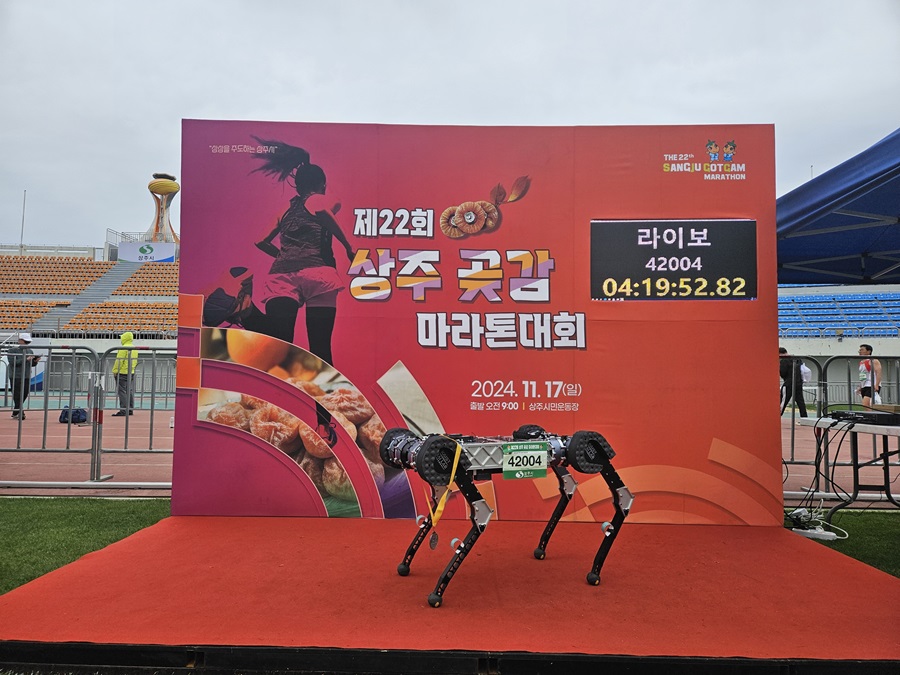
RAIBO2, a 42-kilogram quadruped built by a team at the Korea Advanced Institute of Science and Technology (KAIST), completed the 42.195-kilometer Sangju Dried Persimmon Marathon in North Gyeongsang Province, South Korea, on November 17, 2024, finishing in 4 hours, 19 minutes and 52 seconds on a single battery charge, with no recharging stop and no battery swap. The mechanical engineering team behind the robot, led by professor Hwangbo Jemin, published the engineering analysis of that run in Nature on September 24, 2026. Nature maintains a dedicated sister journal for robotics research specifically because papers in the field rarely clear the bar for its own main pages; this one did, and Korean coverage has already flagged it as the first Korean-led robotics research to appear there.
The headline fact, a robot dog finishing a marathon, is the least useful part of the story for anyone who buys or specifies legged robots for a living. What the Nature paper actually documents is a design method: treating a quadruped's mechanical structure, its electrical and power systems, and its locomotion control as one coupled system rather than three components optimized on separate benchmarks and bolted together afterward. That distinction, system-level co-design against component-level optimization, is the part with a shelf life longer than one race result, and it is the part worth unpacking for anyone weighing a legged platform for inspection, patrol or logistics work, where the battery, not the gait, decides how much a robot can actually get done in a shift.
Two-Thirds of a Legged Robot's Energy Budget Disappears as Heat
The KAIST team's own energy audit of RAIBO2 found that roughly two-thirds of the electricity a legged robot draws from its battery is lost as heat inside its motor windings and drive electronics, a phenomenon engineers call copper loss. The remaining third leaks out through joint friction, the slip of a foot against the ground and the jolt absorbed at each footfall. None of that energy moves the robot forward. It is the standing tax a legged machine pays simply for having legs, and it is largely invisible to a specification sheet that lists battery capacity in watt-hours and calls the job done.
Adding a bigger battery does not fix a tax problem; it makes the tax base larger. A heavier battery means a heavier robot, and a heavier robot spends more energy holding itself up and swinging its own legs before it has moved a single meter forward. Hwangbo's team went the other direction. They cut leg weight until each of RAIBO2's four legs weighed 1.1 kilograms, about a tenth of the robot's total 42 kilograms, and spent the mass they freed up on a larger battery instead. They designed low-resistance motor-driver circuitry and mounted it inside the robot itself rather than in a separate housing, cutting electrical losses and giving the control system more bandwidth to react per footstep. A reinforcement-learning-trained gait controller, tuned in simulation across slopes, stairs and icy surfaces before ever touching a real track, was rewarded specifically for landing softly, avoiding slip and drawing less current at each joint. On downhill stretches, the same joints that had spent energy climbing were used to recover some of it back into the battery. Testing found the robot covered the most distance per unit of energy at a cruising speed near 3 meters per second, slow enough to keep impact losses down, fast enough that the constant electrical draw of its onboard computer and sensors was not spread across a needlessly long trip.
A legged robot's usable range is set less by how much energy its battery holds than by how much of that energy survives the trip from battery cell to footfall. That is the argument Nature's editors were evidently willing to run on their main pages: not a claim about how far a robot can go, but a validated method for keeping high movement performance and energy efficiency from trading off against each other, tested against real marathon telemetry, voltage, current, temperature and Global Positioning System (GPS) position, speed and elevation, logged continuously across four hours on an actual road course rather than reconstructed from a treadmill run in a controlled lab.
Twenty Kilometers Was the Ceiling; RAIBO2 Roughly Tripled It
The efficiency claim is measured in cost of transport, a standard robotics metric equal to the energy a mover spends per unit of body weight carried per unit of distance covered. Lower is better. RAIBO2 posted a cost of transport of 0.25 across the marathon course, against a human running benchmark of 0.37 cited in the same study, making it the first quadruped robot on record to beat that human figure under this specific comparison. That is a narrow, well-defined claim about energy spent per kilogram per meter, not a broader statement that a robot now outperforms a human runner at movement in general, and treating it as the latter would overstate what the number actually measures.
The distance figure is easier to place against the commercial market buyers already know. Boston Dynamics' Spot, the most widely deployed commercial quadruped, is speced for roughly 90 minutes of duty-cycled runtime per charge rather than a continuous-distance rating, reflecting how most of its inspection missions are short walks punctuated by stops, not sustained road travel. Unitree's B2, a competing industrial quadruped, is rated for around 20 kilometers of unloaded walking on a charge, which lines up with the roughly 20-kilometer ceiling KAIST's team cites as the prior benchmark for continuous quadruped range. RAIBO2 used about 1,280 watt-hours of its 2,016 watt-hour battery to finish the 42.195-kilometer course, leaving enough charge by the team's own estimate for another 25 kilometers, putting its full-charge range close to 65 kilometers, roughly triple that prior ceiling.
The record for sheer cumulative distance by a legged robot actually belongs to a different kind of demonstration and is worth separating from this one. A Chinese-built quadruped named Xingzhe No.1 covered 134 kilometers in 2015 by circling a 95-meter indoor track for more than 54 hours straight, swapping batteries along the way to keep going. That is a legitimate distance record, achieved at a slow walking pace, indoors, across multiple charges. RAIBO2's result is a different category of claim: one continuous battery charge, an outdoor road marathon course with real elevation change, run at a sustained pace alongside human competitors rather than looped on a gym floor. No commercial quadruped platform on the market today, Spot, Unitree's line or ANYbotics' ANYmal among them, has completed anything resembling that specific combination in a public event.
What Extra Range Actually Buys a Fleet Operator
For a buyer evaluating legged robots for field work, range translates directly into fleet math. A platform that needs recharging every 90 minutes or every 20 kilometers has to be relieved by a second unit, or paused, on any route or shift longer than that, which means charging infrastructure has to exist somewhere along the way. A platform that can cover 40 to 60 kilometers on one charge changes that math for perimeter patrol, pipeline or rail-corridor inspection, and disaster response, exactly the missions Hwangbo pointed to directly: four-legged robots handle rough terrain well, he said, but at mountainous or disaster sites where it is hard to secure a charging location, range becomes the limit on how useful that terrain-handling ability actually is. Extending range through system-level efficiency rather than a bigger, heavier battery pack also avoids the usual tradeoff, where more capacity adds weight that eats into the very efficiency gain a buyer is paying for.
The commercialization trail behind RAIBO2 is real but still small, and buyers should read it at that scale rather than a larger one. Raion Robotics, the KAIST spinout Hwangbo founded in 2023 to carry the lab's work into product form, sold nine RAIBO2 units last year and is targeting production of 50 four-legged robots this year, alongside a proof-of-concept project with South Korea's Ministry of National Defense and research into chemical, biological and radiological detection payloads. The company is also pursuing waterproofing, dust resistance and wide-temperature certification, the unglamorous durability work that separates a research platform from a product a customer can deploy without a graduate student on standby. Nine units and a fifty-unit target is early-stage volume by any industrial standard, a signal of direction rather than proof of market readiness.
A Marathon Finisher That Cannot Read a Road
The honest caveat sits in how RAIBO2 actually got around the course. The robot carried a camera but no onboard software to interpret what that camera saw. A human operator steered it remotely for the full 42.195 kilometers, meaning the achievement is power-autonomous, no recharging, no battery swap, but not navigation-autonomous, since a person was still in the control loop the entire time. Two independent roboticists who reviewed the work, Sarah Bergbreiter of Carnegie Mellon University and Katie Byl of the University of California, Santa Barbara, both praised the efficiency and stability result while flagging this gap directly; Byl described the robot as running blind and compared the setup to recent humanoid racing robots that needed a human support team jogging alongside for battery swaps, a lighter version of the same dependency.
Lee Choongin, the study's lead author, has said adding autonomy costs power, and the team is now working on smaller onboard sensing and compute specifically so added perception does not erase the efficiency gain the marathon was built to demonstrate. RAIBO2 itself is also a hand-built research unit, designed and assembled largely by the researchers who study it, not a production line item. Reproducing this exact performance across a manufacturable fleet, at a cost a customer will pay and with the durability an outdoor deployment demands, is the harder half of the commercialization story and remains open work rather than a finished result. Treating a single, human-steered marathon as proof that legged robots are ready for unsupervised field duty would overstate what the data in Nature actually shows.
At the finish line inside Sangju's city stadium, the scoreboard read 04:19:52.82 next to the robot's race number, 42004, and the researchers who had jogged alongside it for four hours knelt beside the machine with their own medals around their necks while it stood on the track, legs still warm from four hours of motor current, with more charge left in its battery than most commercial quadrupeds carry in total. That image, not the marathon result itself, is the one worth keeping in view: a field robot built to spend its stored energy on distance rather than losing it to heat and friction along the way, still tethered to a human hand on the controls, with the harder engineering work of making it see for itself still ahead.
This account synthesizes KAIST's public statements and published research on the September 24, 2026 Nature publication, along with independent reporting on the underlying study. It is for general information purposes only and does not constitute investment, financial, or legal advice.
Hero image credit: KAIST.