China Shipped 23,000 Humanoid Robots. Only 5 Percent Can Hold a Shift.
China shipped roughly 23,000 humanoid robots in the first half of 2026, but only about 5 percent operate stably on real production lines, industry data shows.

China's humanoid robot industry has spent 2026 measuring itself in shipment counts, financing rounds, and public demonstrations, and by every one of those metrics the year has been a record. What the industry has been considerably slower to publish is a number that matters more to the buyers actually evaluating this technology: how many of those robots can work a real production shift without a technician standing nearby to intervene. Industry data circulating this month puts a figure on that question for the first time with real specificity, and it is a sobering one. Of roughly 23,000 humanoid robots shipped domestically in China during the first half of 2026, only about 5 percent are operating stably on production lines. The other 95 percent remain in research labs, trade-show demonstrations, or pilot programs that have not yet cleared the bar of continuous, unsupervised industrial use.
That gap between shipment volume and deployment reliability is the single most important number for any procurement team currently evaluating a Chinese humanoid or semi-humanoid robot vendor, more important than a company's funding round, its headline payload specification, or the choreography of its latest stage demonstration. A robot that ships is not the same as a robot that works, and the industry's own infrastructure response to this gap, a purpose-built facility in Beijing generating training data at industrial scale, is a more honest signal of where the technology actually stands than any single company's marketing claims.
The Factory That Manufactures Data Instead of Robots
The Shijingshan Embodied Intelligence Training Center, operating out of Beijing's Shougang Park science and technology district, exists specifically to close that reliability gap, and its own stated output capacity is the clearest evidence of how large the underlying data problem is. The center runs more than 100 high-degree-of-freedom humanoid robots across dedicated training zones designed to simulate real industrial and service scenarios, generating close to 20 million high-quality data entries annually, recordings of robots attempting, failing, and correcting physical tasks under controlled but realistic conditions. That figure is worth sitting with: a single facility in one Chinese district is producing tens of millions of training data points a year because the industry concluded, correctly, that the reason humanoid robots fail on real production lines has less to do with mechanical design than with the sheer volume of physical-world interaction data needed to teach a robot's control model how to handle the countless small variations, a part sitting a few degrees off its expected orientation, a surface with unexpected friction, a lighting change, that a demo-stage routine is scripted to avoid entirely.
This is the practical explanation for the 5 percent figure. A robot can be mechanically sound, well-funded, and impressive in a ninety-second demonstration video while still lacking the breadth of training data required to generalize to the unscripted variation of an actual factory floor. China's policy apparatus has effectively acknowledged this as a structural, not incidental, problem: on September 9, the government formally recognized "embodied-intelligence robot application technician" as an official occupation, with defined specializations in data collection and robot training. Creating a government-recognized job category for the people who collect and label the data robots need to become reliable is a strong signal that Beijing sees the data bottleneck, not manufacturing capacity or model architecture, as the actual constraint standing between China's current shipment volume and a meaningfully higher reliability rate.
The Exception That Explains the Rule
Not every company is stuck on the wrong side of that 5 percent line, and the companies that have cleared it show what separates a demonstration robot from a working one. Beijing-based Anyverse Dynamics, a semi-humanoid robotics startup founded in 2025 by a former Horizon Robotics executive, shipped its first batch of K15 robots this month to Envision's battery manufacturing plant in France, following a contract worth more than 500 million yuan, approximately US$70.4 million, and a certification process that made the K15 the first embodied-intelligence robot to clear full European Union industrial safety and cybersecurity standards. That deployment did not happen because Anyverse Dynamics skipped the reliability problem. It happened because the company built its commercial strategy around narrow, well-defined tasks, loading and unloading specific components inside a battery plant, rather than the broad, generalized dexterity that trade-show demonstrations favor, and narrow task scope is precisely the variable that determines how much training data a robot actually needs before it can operate unsupervised.
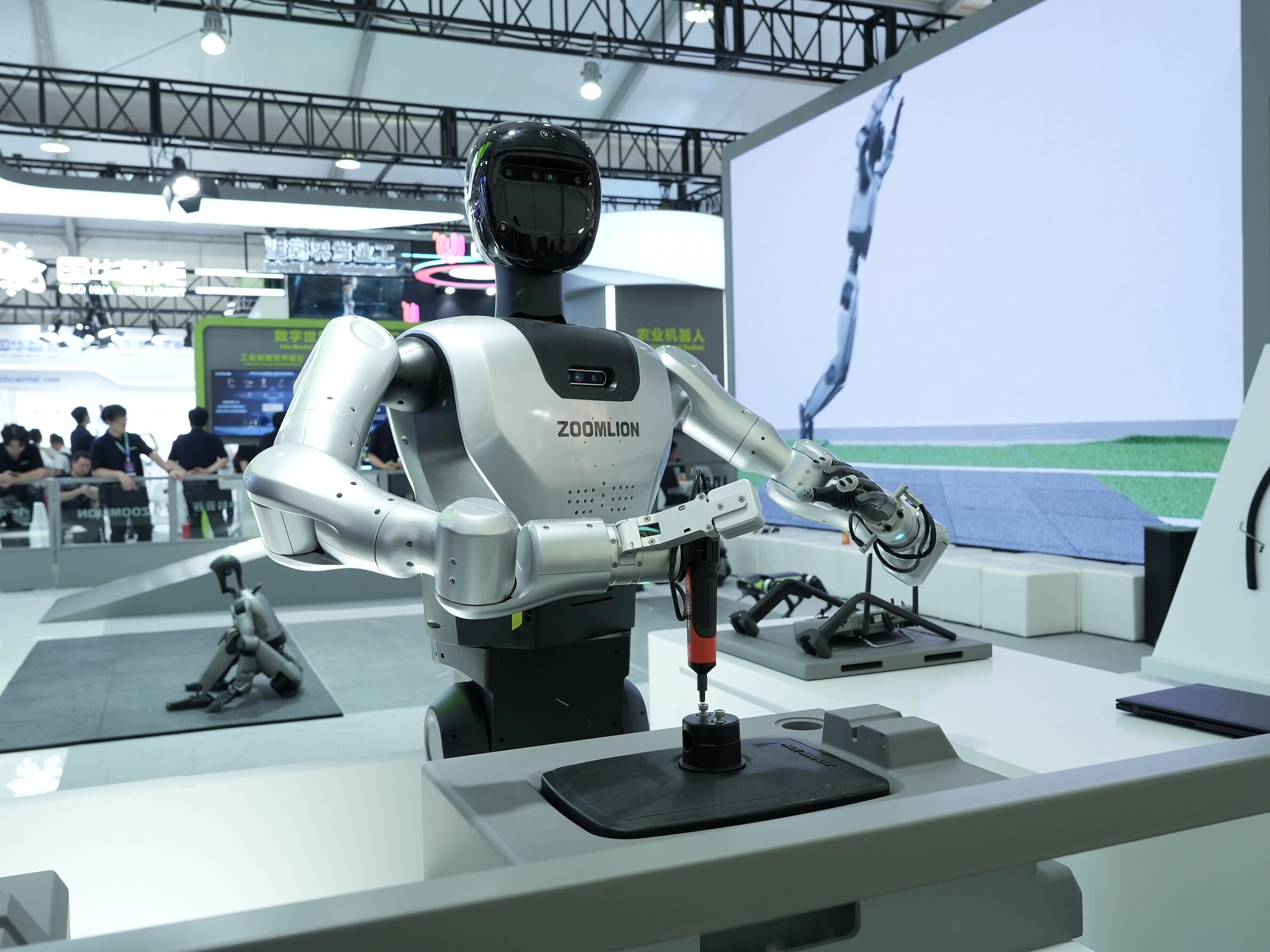
Industrial equipment maker Zoomlion offers a parallel case from the exhibition side of the industry rather than the deployment side. At the World Robot Conference earlier this year, the company demonstrated its bipedal Z01 humanoid performing precision tasks, including operating a screwdriver on a fixed assembly point, alongside its wheeled Z03 platform and quadrupedal robot-dog units, positioning the robots specifically around manufacturing pain points like flexible sorting, precision assembly, and wire-harness handling rather than showcasing general-purpose dexterity. Companies with existing heavy-industry customer relationships and decades of experience selling equipment that has to survive a real jobsite, rather than starting purely as an artificial-intelligence research effort building a humanoid robot from a blank sheet, appear to be converging on the same lesson Anyverse Dynamics reached independently: reliability comes from narrowing scope to a well-understood task set, not from maximizing the number of things a robot can theoretically do.
Why the Market Data Still Looks Strong Despite the Reliability Gap
None of this changes the fact that China's mobile and humanoid robot sector overall has posted genuine, verifiable growth in 2026, and buyers should not read the 5 percent reliability figure as evidence the underlying market opportunity is smaller than advertised. It means the opportunity is concentrated in a narrower set of companies and use cases than the aggregate shipment and funding numbers suggest. A procurement team benchmarking vendors purely on shipment volume, total funding raised, or degrees of freedom in a spec sheet is measuring exactly the variables that do not correlate with whether a robot will still be working reliably ninety days after installation. The variables that do correlate, task scope narrowness, whether a vendor has a facility or partnership generating task-specific training data at scale, and whether a company has a live industrial reference deployment longer than a pilot quarter, are harder to find in a press release and require the kind of direct vendor questioning that most procurement processes currently skip in favor of comparing spec sheets.
That mismatch between what gets marketed and what actually predicts reliability is not unique to China's humanoid robotics sector, but the scale of the gap here, 23,000 units shipped against a 5 percent stable-operation rate, is unusually stark and unusually well quantified compared with equivalent figures from humanoid robotics efforts in the United States, Japan, or Korea, where shipment volumes remain far lower and comparable reliability statistics have not been publicly disclosed at all. That relative transparency is itself informative: an industry confident its demonstration robots already reflect deployment reality has less incentive to publish a number this unflattering, and China's willingness to put a hard percentage on the gap, paired with a new government-recognized occupation aimed directly at closing it, suggests the country's robotics policymakers view naming the problem honestly as a prerequisite to solving it rather than a competitive liability to obscure.
The Diligence Questions This Actually Changes
For a buyer or investor evaluating a Chinese humanoid or semi-humanoid robotics vendor over the next year, the 5 percent figure reframes which questions matter in vendor diligence. Ask a vendor not how many robots it has shipped, but how many are operating today without a technician present for more than a single shift. Ask not what tasks the robot can theoretically perform, but what specific, narrow task set the vendor has actually validated in a paying customer's facility, and for how long. Ask whether the vendor has its own data-generation infrastructure, a training center, a fleet of teleoperated units collecting real-world interaction data, a partnership with a facility like Shijingshan, or whether it is relying on the same limited public datasets every other entrant in the field can also access. Companies that can answer those three questions with specific, checkable facts, the way Anyverse Dynamics can point to a live contract inside a French battery plant rather than a demo reel, are the ones most likely to be part of the 5 percent a year from now rather than still counted among the 95 percent still working toward it.
The next signal worth watching is whether China's shipment-to-reliability ratio actually improves over the second half of 2026 now that the Shijingshan facility and its 20-million-data-point annual output have had a full year to feed back into vendor training pipelines, and whether the newly created embodied-intelligence application technician occupation succeeds in scaling the workforce needed to generate that data faster than shipment volumes themselves are growing. If that ratio moves toward 10 or 15 percent by early 2027, it will mark the point where China's humanoid robotics industry graduates from a demonstration economy into an industrial one. If it does not move, the shipment and funding headlines will keep outrunning the deployment reality underneath them, and buyers who priced their procurement decisions off the headlines rather than the reliability data will be the ones left explaining the gap to their own boards.
This analysis draws on public industry data, government policy announcements, and company disclosures describing China's humanoid robotics production and deployment activity. It is for general information purposes only and does not constitute investment, financial, or legal advice.
Hero image credit: Zoomlion.