

描述
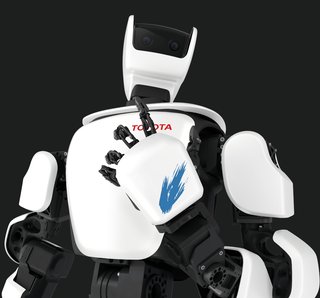
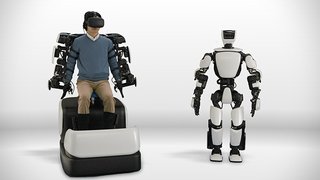
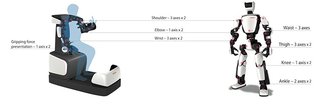
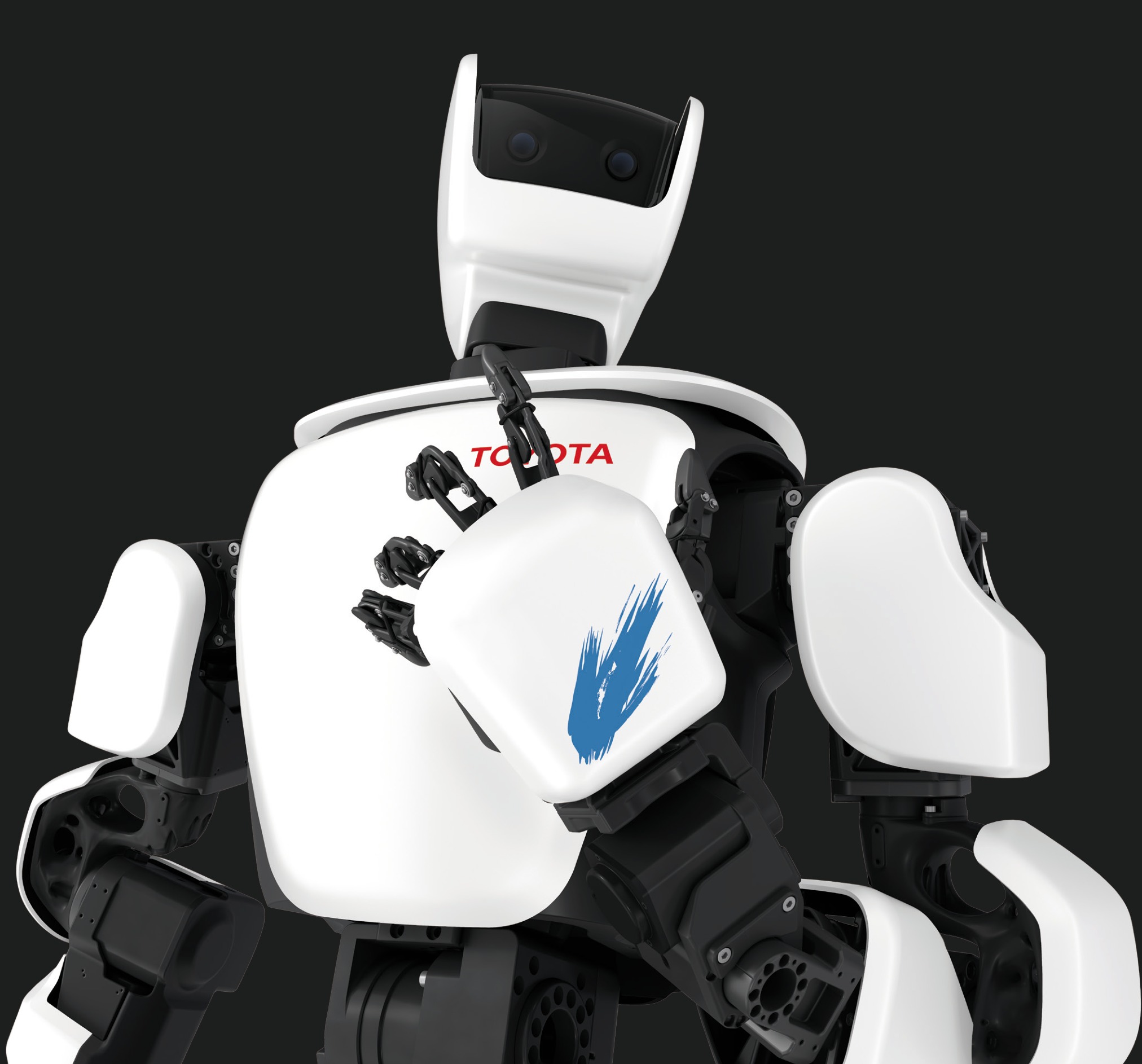
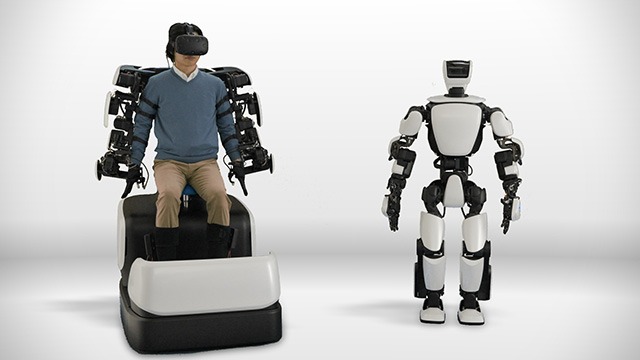
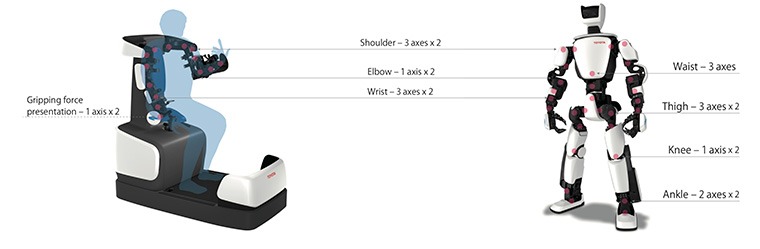
T-HR3 is Toyota's third-generation humanoid, revealed in November 2017, and the shift it represents is from position to force. The first two generations, in 2005 and 2010, played the trumpet and the violin — exercises in putting joints exactly where you want them. T-HR3 instead controls the torque at each joint, which is what lets it touch things, and people, safely. It stands 1,540 mm, weighs 75 kg, and has 32 torque-controlled joints plus ten fingers: three axes at each shoulder, one at the elbow, three at the wrist, three at the waist, three at each thigh, one at each knee and two at each ankle. Every one carries a Torque Servo Module — motor, reduction gear and a Cr-N alloy thin-film torque sensor developed with Tamagawa Seiki and Nidec Copal — so the robot senses and shares force rather than simply resisting it. It is driven by a Master Maneuvering System: a seat rig of 14 axes plus two, 850 x 1,500 x 1,450 mm and 170 kg, with master arms mapped to the robot's joints, a master foot that lets the operator walk in place, a data glove and a head-mounted display giving the robot's point of view. Because force passes both ways, the operator feels what the robot touches. Self-interference prevention stops robot and operator fighting each other, and whole-body balance control keeps it upright when something pushes back. Toyota positions it as a platform rather than a product, for homes, medical facilities, construction sites, disaster zones and eventually space. NTT DOCOMO later demonstrated operating it remotely over 5G.
功能特色
- Third-generation Toyota humanoid, revealed November 2017
- Height 1,540 mm, weight 75 kg
- 32 torque-controlled joints plus 10 fingers
- Joint layout: shoulder 3 axes, elbow 1, wrist 3, waist 3, thigh 3, knee 1, ankle 2
- Torque Servo Modules at every joint: motor, reduction gear and Cr-N alloy thin-film torque sensor
- Torque sensor developed with Tamagawa Seiki
- sensor film with Nidec Copal Electronics
- Master Maneuvering System: 14 axes plus 2, 850 x 1,500 x 1,450 mm, 170 kg
- Master arms, master foot for walking in place, data glove and head-mounted display
- Force is shared both ways — the operator feels what the robot touches
- Self-interference prevention keeps robot and operator from disrupting each other
- Whole-body coordination and balance control against external forces
- Demonstrated under 5G remote operation with NTT DOCOMO
- Intended settings: homes, medical facilities, construction, disaster areas, space
技術規格
已驗證| 物理參數 | |
| 重量 | 75 kg |
|---|---|
| 外形尺寸 | H 1.54 m |
| 移動能力 | |
| 移動類型 | 兩足行走, 類人型機器人 |
| 自由度 | 32 |
| 作業環境 | Research settings; intended for homes, medical facilities, construction, disaster areas and space |
| 感知與計算 | |
| 感測器 | Cr-N alloy thin-film torque sensors at every joint, cameras for the operator's head-mounted display |
| 連線方式 | Master Maneuvering System link; demonstrated over 5G with NTT DOCOMO |
技術規格
已驗證| 物理參數 | |
| 重量 | 75 kg |
|---|---|
| 外形尺寸 | H 1.54 m |
| 移動能力 | |
| 移動類型 | 兩足行走, 類人型機器人 |
| 自由度 | 32 |
| 作業環境 | Research settings; intended for homes, medical facilities, construction, disaster areas and space |
| 感知與計算 | |
| 感測器 | Cr-N alloy thin-film torque sensors at every joint, cameras for the operator's head-mounted display |
| 連線方式 | Master Maneuvering System link; demonstrated over 5G with NTT DOCOMO |
圖片
 martti
 martti
 martti
圖片貢獻
影片
機器人論壇
正在載入論壇...
評分
常見問題
What is the Toyota T-HR3?
T-HR3 is Toyota's third-generation humanoid, revealed in November 2017, and the shift it represents is from position to force. The first two generations, in 2005 and 2010, played the trumpet and the violin — exercises in putting joints exactly where you want them.
Who makes the Toyota T-HR3?
The Toyota T-HR3 is made by Toyota, a robotics company based in Japan.
How much does the Toyota T-HR3 cost?
Toyota has not publicly announced pricing for the Toyota T-HR3. You can enquire through RobotAIGeek for current pricing.
What is the Toyota T-HR3 used for?
The Toyota T-HR3 is designed for 發展, 研究, and 遠端. It is used in 研究, 建築, and 醫療保健 settings.
How much does the Toyota T-HR3 weigh?
The Toyota T-HR3 weighs 75 kg.
How many degrees of freedom does the Toyota T-HR3 have?
The Toyota T-HR3 has 32 degrees of freedom.
When was the Toyota T-HR3 released?
The Toyota T-HR3 was announced in 2017 and is not yet generally available.
與同類機器人對比
看看這款機器人與最接近的同類產品相比表現如何
- Toyota T-HR3 vs University of Tehran Surena IV
- Toyota T-HR3 vs ROBROS IGRIS-C
- Toyota T-HR3 vs WIRobotics ALLEX
- Toyota T-HR3 vs KANGAROO
- Toyota T-HR3 vs InMoov