Pudu Robotics Unveils One Brain, Multiple Embodiments Strategy in Europe
Pudu Robotics used its first European Partner Summit in Amsterdam to unveil a "One Brain, Multiple Embodiments" strategy, showing six product lines from cleaning robots to humanoids running on a shared AI stack for the first time in Europe.

Pudu Robotics used its first European Partner Summit, held in Amsterdam on November 5 under the banner "AI in Action: Scaling Impact Across Europe, Together," to lay out how a single shared intelligence layer will run every robot it sells on the continent, from a restaurant delivery cart to a full-sized humanoid. The Shenzhen-based company, which builds commercial service and industrial robots and has operated in Europe for several years, calls the approach "One Brain, Multiple Embodiments": one AI system, PuduFM, paired with an orchestration layer called PuduAgent OS, running across six separate hardware lines shown together in Europe for the first time.
One Software Stack, Six Different Machines
The architecture splits a robot into two layers. PuduFM, which Pudu calls its Embodied Foundation Model, handles perception, reasoning and task planning. PuduAgent OS sits above it as the orchestration layer that lets an operator assign, monitor and sequence tasks. Motion control, the part of the system that depends on a machine's physical form, stays specific to each robot. The pitch to buyers is that a skill built for one robot body, such as recognizing a spill or queuing a delivery request, does not have to be rebuilt from scratch when Pudu ships a new chassis.
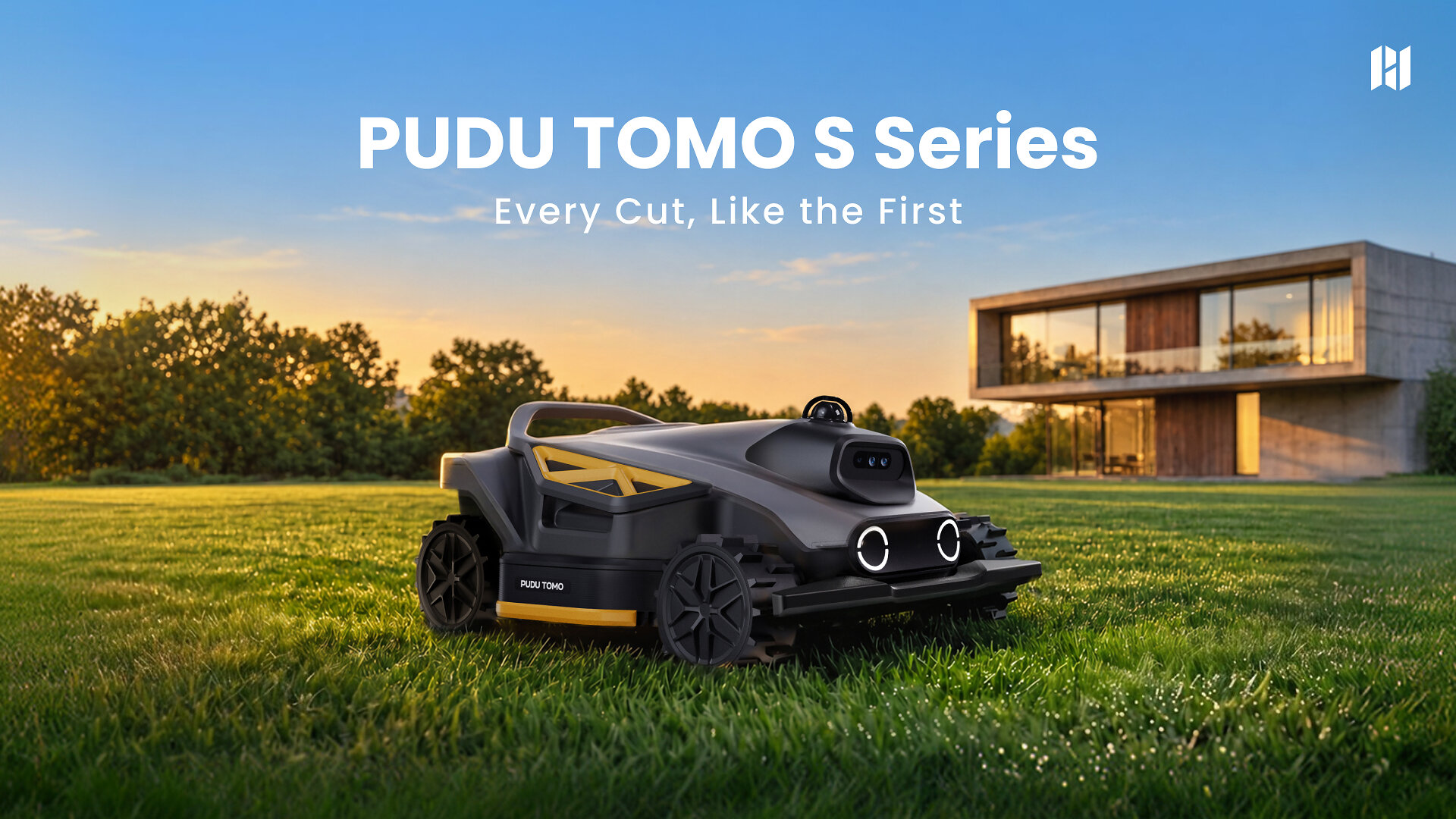
That matters commercially because Pudu's six product lines shown in Amsterdam span very different use cases. BellaBot Pro is a delivery and service robot built for restaurants and retail floors, with multimodal interaction and a 65-centimeter clearance path for navigating tight aisles. CC1 Pro is a four-in-one commercial cleaner that sweeps, scrubs, vacuums and dust-mops, with AI-based detection of cleaning performance. MP2000 is an autonomous pallet robot rated for a 2,000-kilogram payload with a 20-second fork insertion cycle, aimed at warehouse and logistics floors. The D5, D7 and D9 lines move up through quadruped, semi-humanoid and full humanoid form factors built for embodied AI tasks. GT3, GT5 and GT7 are commercial robotic mowers for grounds crews, golf courses and sports fields. The newest addition, the TOMO S Series, is Pudu's first consumer product: a home lawn mower with a self-sharpening cutting system called SharpLoop, announced on November 3, two days before the Amsterdam event.
Why Europe Gets the Full Lineup First
Felix Zhang, Pudu's founder and chief executive, told partners in Amsterdam that the company's next phase of growth depends less on new hardware and more on making robots easier to deploy and commercially viable at the scale integrators actually need. Bella Sun, Pudu's vice president and general manager for Europe, argued the region should be among the first markets to put the shared-brain strategy into practice rather than a later rollout market. The sequencing is a reasonable bet for a Chinese robotics exporter facing scrutiny over supply chains and data handling in some Western markets: Pudu says its European revenue has grown more than 60 percent a year on average over the past two years, it operates in more than 20 European countries, and it already serves 16 industries across more than 900 distinct application scenarios on the continent. Naming EDEKA, Albert Heijn, Carrefour, Marriott, Pizza Hut and Paris's Charles de Gaulle Airport as customers is Pudu's way of signaling that its European business is past the pilot stage and into repeat procurement by large retail, hospitality and travel operators.
The infrastructure to back that claim went in before the strategy announcement. On October 30, six days before the summit, Pudu opened a European headquarters in Germany that combines office space, a showroom, warehousing, training, sales and after-sales repair under one roof. For buyers, that sequencing answers the question that usually kills a cross-border robotics deal: who services the machine when something breaks eight months after installation. A shared-brain software architecture is a weaker sales pitch if the hardware behind it has no local repair capacity, and Pudu appears to have built the service layer first and announced the software strategy second.
The Bet Behind a Shared Brain
The underlying wager is that embodied AI companies win by amortizing one expensive thing, a general-purpose foundation model trained on manipulation, navigation and perception data, across as many hardware forms as possible, rather than building a bespoke AI stack for every robot chassis. It is the same logic Tesla and Figure apply to humanoids and that Boston Dynamics has moved toward with Atlas, but Pudu is testing it across a wider spread of form factors than most rivals attempt at once, from a wheeled cleaning robot to a bipedal humanoid to a mower. The commercial case is straightforward: if a skill such as obstacle avoidance or voice-command handling can migrate from a cleaning robot to a humanoid without a full redevelopment cycle, Pudu's research and development cost per additional product line should fall over time, and its newer, harder-to-build lines, the D7 and D9 humanoids in particular, can inherit maturity from the simpler robots that came before them.
The risk sits on the other side of that same bet. A single shared brain concentrates failure modes: a flaw in PuduFM's perception or planning layer does not stay contained to one product line, it potentially touches every robot built on top of it, from a restaurant floor to a warehouse dock to a customer's back garden. Pudu has not published independent, third-party verified failure-rate or uptime data for PuduFM across its product range, so buyers evaluating the pitch are, for now, taking the company's own word that cross-body skill transfer works as advertised in the field rather than only in a product demo. That is a standard limitation across the embodied-AI sector in 2026, not one unique to Pudu, but it is the detail a procurement team should ask for before signing a multi-site rollout that spans several of Pudu's six lines at once.
A Localization Pattern Other Chinese Exporters Are Copying
Pudu is not alone in building a European service shell before leaning on a software story. UBTECH and DEEP Robotics have each expanded European distributor and service networks over the past year rather than relying purely on direct export, and Unitree has worked through regional integrators for its quadrupeds rather than opening wholly-owned facilities. What sets Pudu's move apart is the scale of the commitment: a full-function German headquarters combining a showroom, warehousing, training and repair under one roof is a heavier capital outlay than a distributor agreement, and it signals Pudu expects European demand across its six product lines to be large enough, and sustained enough, to justify fixed local infrastructure rather than treating the region as an export market serviced from Shenzhen. For a European buyer, that distinction is the practical difference between a robot vendor and a robot supplier with accountability on the ground when a unit fails during a contracted uptime window.
It also reflects a broader shift in how Chinese robotics companies are approaching markets where data-handling and supply-chain scrutiny have grown since 2025. Building local repair capacity, local training staff and a local showroom reduces the number of questions a European procurement team has to ask about where a unit goes for maintenance or where operational data is processed during servicing, even if it does not fully answer where PuduFM's training and inference happen at the model level. Pudu has not detailed where PuduFM is hosted or trained for its European deployments, and that remains the more consequential unanswered question for buyers in regulated sectors such as healthcare or airport logistics, where Pudu already has a foothold through Charles de Gaulle Airport.
What a Buyer Actually Evaluates
For a European operations or procurement lead, the Amsterdam announcement is less about any single robot and more about contract structure. Buying into "One Brain, Multiple Embodiments" is effectively a bet that Pudu's software roadmap, not just its hardware, will keep improving the specific machines already on a company's floor, because upgrades to PuduFM are meant to benefit every connected robot rather than requiring a hardware refresh. That changes how a service contract should be negotiated: the relevant question shifts from "what does this robot do today" to "what is Pudu's committed cadence for shipping model updates, and do they reach machines already in the field." The newly opened German headquarters gives Pudu a concrete answer on the hardware-service side of that question. The software-update commitment is the part still resting on the company's own account.
Six product lines unveiled together also signals where Pudu expects near-term European demand to concentrate: logistics and pallet handling with MP2000, grounds maintenance with the GT mower line, and a consumer entry with TOMO S that puts Pudu, for the first time, in direct competition with established home robotics brands rather than only commercial integrators. The next concrete marker to watch is whether Pudu publishes deployment or uptime figures specific to its European installed base, separate from the global 130,000-unit total the company has cited in earlier 2026 announcements, since a Europe-specific number would be the clearest sign of whether the Amsterdam strategy is translating into completed rollouts rather than signed intent.
This article is for general information purposes only and does not constitute investment, financial or professional advice.
This analysis synthesizes company statements made at Pudu Robotics' November 2026 European Partner Summit and public market activity.