China's RoboScience Raises Fresh Capital to Scale Embodied AI
RoboScience, a Beijing embodied-AI startup founded by two Stanford-trained roboticists, closed its fifth funding round in under two years to scale its Visics model and REX G1 wheeled humanoid.


RoboScience, a Beijing-based embodied-AI company founded by two Stanford-trained roboticists, has closed an A2 funding round worth several hundred million RMB (roughly tens of millions of US$), its fifth capital raise since the company launched less than two years ago. The round was led by Amber Capital, Hongruida Investment, and Shanghai Semiconductor Industry Investment, with a follow-on group that includes 360's strategic investment arm and several listed-company investment platforms, underscoring how much Chinese institutional capital is still willing to commit to embodied-AI startups even as some investors elsewhere in the sector pull back.
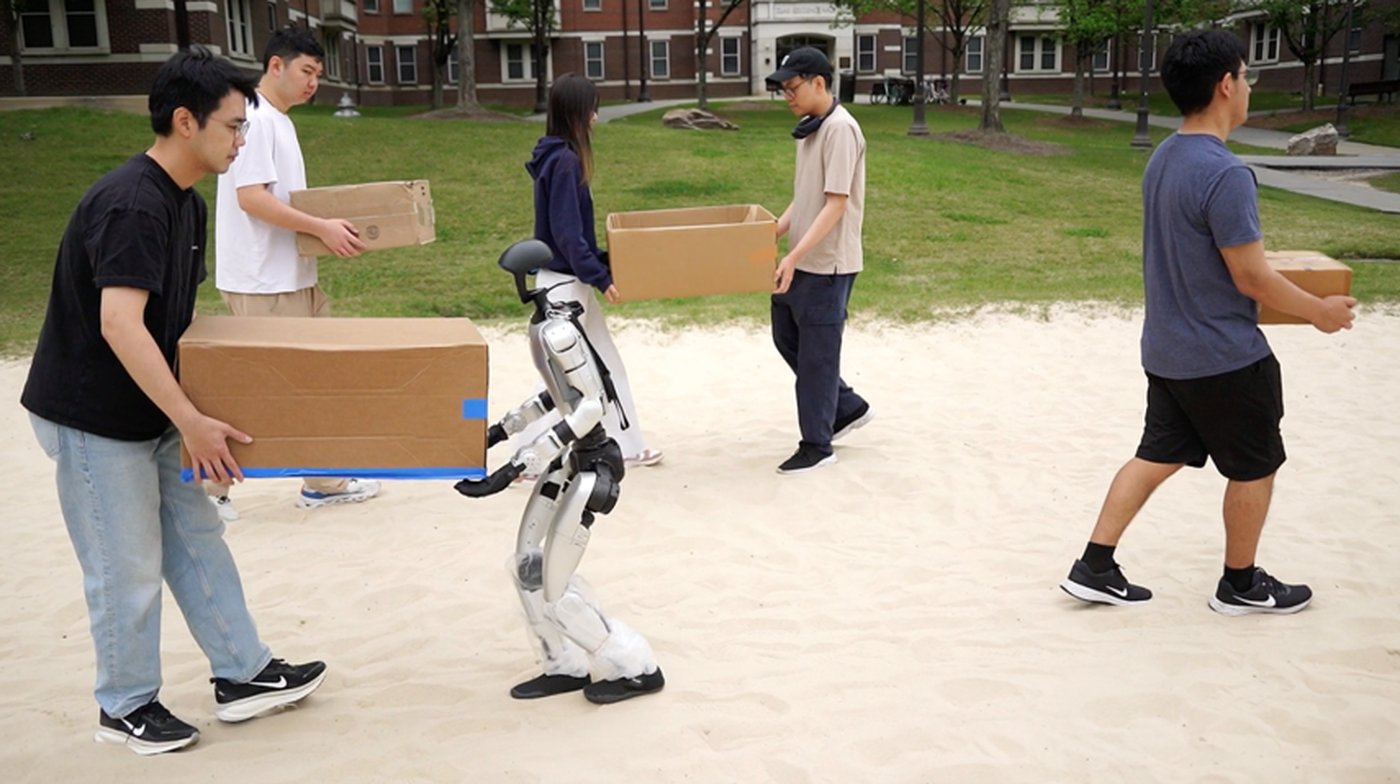
RoboScience, legally registered as Beijing Jike Future Technology Co., Ltd., builds across the embodied-AI stack rather than shipping a single robot: a simulation engine called RoboMirage for generating training data, a general-purpose embodied model called Visics that runs across different robot hands and bodies, and a wheeled humanoid called REX G1 that the company unveiled at the World Robot Conference in Beijing in August. The company pairs that hardware and model work with an Embodied-AI-as-a-Service offering built on Tencent Cloud, selling its technology through three channels: direct API access, software controllers for other companies' hardware, and full robot delivery for specific industrial or service scenarios.
Two Stanford Researchers Betting the Model Matters More Than the Body
The founders' backgrounds explain the company's model-first strategy. Shao Lin trained in Leonidas Guibas's geometric computing group at Stanford before working with Jeannette Bohg on robotic manipulation, and now holds an assistant professorship at the National University of Singapore alongside his role at RoboScience. Tian Ye studied at Stanford's AI Lab under Andrew Ng, then spent roughly seven years at Apple leading technical work on the company's on-device AI platform, the kind of large-scale deployment experience that is rarer in China's embodied-AI founder pool than deep robotics-hardware expertise is. The pair founded RoboScience at the end of 2024 and began operations in early 2025, which makes five funding rounds in under two years an unusually fast cadence even by the standards of China's current embodied-AI financing boom.
That speed is itself a signal worth reading carefully. Investors backing a company through five rounds in under two years are either reacting to genuinely differentiated technical progress or to a market environment where capital is chasing embodied-AI deal flow faster than due diligence can normally keep pace, and in China's current funding climate, both explanations are plausible at once. RoboScience's REX G1 demo at WRC, in which the wheeled humanoid performed a short conducting routine with a baton, got coverage mainly for the stunt value, but the robot's underlying specifications, 22 degrees of freedom, a combined 10-kilogram dual-arm payload, and 2,070 TFLOPS of onboard compute running the Visics model locally, are closer to what a buyer evaluating the platform for logistics, factory, or retail deployment would actually weigh.
Why a Model-and-Service Pitch Is a Different Bet Than a Robot Company
Most of China's humanoid and embodied-AI headlines this year have gone to companies racing to ship hardware at volume, chasing unit-shipment numbers as the primary proof of commercial traction. RoboScience's three-tier go-to-market, API access, third-party hardware controllers, and full robot delivery, reads as a deliberate bet against that race, positioning the company's model and simulation stack as the product that travels across robot bodies rather than tying its fortunes to one humanoid design winning the market. The Embodied-AI-as-a-Service layer built with Tencent Cloud is the clearest expression of that strategy: it lets RoboScience monetize its AI stack through companies that already have robot hardware and need a brain, rather than competing directly with every hardware maker for the same industrial contracts.
That positioning carries real commercial risk alongside its appeal. A company selling models and controllers that run on other vendors' hardware is betting that the market will fragment across many robot body designs long enough that a hardware-agnostic layer has lasting value, rather than consolidating quickly around two or three dominant platforms the way China's humanoid race has shown some signs of doing. If consolidation happens faster than RoboScience's bet assumes, a model-and-service company without its own scaled hardware line risks becoming a feature of whichever platform wins, rather than a standalone business. The counterargument, and likely the one RoboScience's investors are underwriting, is that embodied-AI models are still far enough from commodity status that a genuinely superior model layer can command its own pricing power regardless of which hardware it runs on, a thesis closer to how enterprise software investors think about platform risk than how hardware investors typically price a robotics bet.
What the Investor Roster Signals About Where the Money Sees Value
The round's lead investors are worth reading for what they reveal about where institutional capital currently sees the most durable value in China's embodied-AI buildout. Shanghai Semiconductor Industry Investment's participation points toward RoboScience's compute and chip-adjacent positioning, since a fund built around semiconductor exposure is underwriting the company's onboard-compute approach as much as its robotics ambitions. The presence of multiple listed-company investment platforms among the follow-on investors suggests publicly traded industrial and technology groups are treating embodied-AI exposure as a strategic hedge worth taking through venture-style stakes rather than waiting to acquire proven technology once it reaches commercial scale, a pattern that has become increasingly common across China's robotics financing market over the past year.
For procurement teams and systems integrators outside China watching how embodied-AI financing is unfolding, RoboScience is a useful test case for a specific question: whether a model-and-service company that explicitly avoids betting everything on one robot body can scale fast enough to matter before the market consolidates around hardware winners. The company's next concrete marker will be whether its API and controller business signs disclosed enterprise customers running Visics on third-party hardware at production scale, which would validate the hardware-agnostic thesis in a way that another funding round, however large, cannot.
The REX G1 Demo Buyers Should Look Past, and the One They Should Not
The baton-conducting routine that drew most of the public attention to REX G1's debut is the kind of demo that photographs well and tells a buyer almost nothing about deployability, which is precisely why it is worth separating from the specifications underneath it. A robot holding a conductor's baton for a minute or two is a controlled, low-force, low-precision task chosen for stage presence rather than a stress test of manipulation or mobility. The dual-arm payload figure, a combined 10 kilograms, and the onboard compute figure, 2,070 TFLOPS running the Visics model locally rather than offloading inference to the cloud, are the numbers that actually map onto whether REX G1 could handle a real logistics-sorting or light-assembly task, and neither of those numbers was the point of the conference demo.
Buyers evaluating Chinese embodied-AI platforms for pilots in 2027 should treat conference demos across this entire category with the same discipline: a company that can run a model locally at usable latency without a cloud round-trip has solved a genuinely harder engineering problem than a company that can make a robot wave a baton, even though the baton gets the headline. RoboScience's decision to run Visics onboard at WRC, rather than demoing a cloud-tethered version, is the detail worth asking the company to reproduce in a site visit before weighting it heavily in a procurement decision, since onboard inference latency tends to degrade in ways a staged demo does not reveal.
What China's Embodied-AI Funding Pace Means for Overseas Buyers
Five funding rounds in under two years is fast even against the backdrop of China's current embodied-AI financing pace, and it raises a question that matters more to overseas buyers than to RoboScience's domestic investors: how much of this capital intensity is being spent on technology that will still exist as a coherent product in three years, versus technology built for the next funding round's pitch deck. Companies raising this frequently are under constant pressure to show a visible milestone, a new round, a new demo, a new partnership, every few months, which can pull engineering resources toward whatever is most fundable in the short term rather than whatever most strengthens the underlying platform.
That dynamic does not make RoboScience's technology weaker on its own merits, but it does mean an overseas procurement team evaluating the company as a long-term vendor relationship, rather than a one-off pilot, should weight operational signals, disclosed enterprise deployments, measured uptime, documented integration timelines, more heavily than funding announcements when deciding whether to commit a production workflow to the platform. A fifth round closing is a signal that investors still believe in the story. It is not, by itself, a signal that the Embodied-AI-as-a-Service layer is ready to run a customer's warehouse floor without an on-site RoboScience engineer nearby.
A Funding Round That Tests a Thesis, Not Just a Balance Sheet
What makes this round worth tracking is less the amount, undisclosed beyond the "several hundred million RMB" range, and more the fact that Shanghai Semiconductor Industry Investment's participation ties RoboScience's compute strategy to a fund whose entire mandate depends on betting correctly on which parts of the AI hardware stack will matter most over the next several years. That is a different kind of validation than a generalist venture fund writing a check on growth metrics alone, and it is the detail that should carry the most weight for anyone trying to read this round as a signal rather than just a number.
This article synthesizes public funding disclosures and company statements related to RoboScience's A2 financing round. It is for general information purposes only and does not constitute investment advice.