Sereact and Otto Group Put AI Robots on Europe's Returns Line
Otto Group is deploying ten NVIDIA-powered robotic arms built by Sereact to sort returns at a Polish logistics center, with a conditional path to 25 robots and policy fixes landing in days rather than weeks.

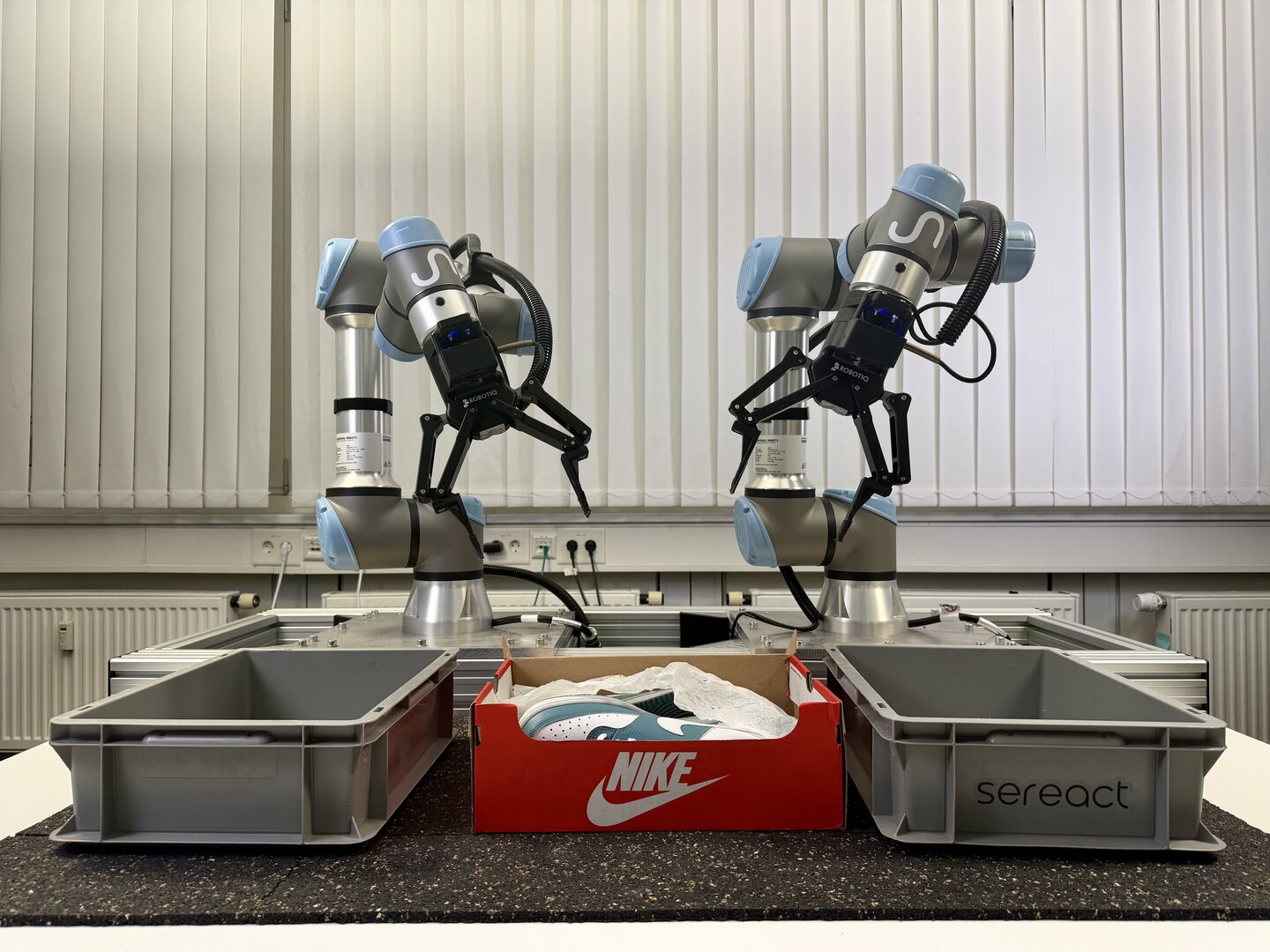
Otto Group and Sereact have started running AI-controlled robotic arms on a returns line at an Otto Group logistics center in Poland, with ten dual-arm systems inspecting and sorting customer returns as of this week. The deployment, announced Wednesday, is the first phase of a program that could grow to 25 robots if early results hold, and it marks one of the largest production tests yet of physical AI software built specifically for the chaos of a returns dock rather than the predictable flow of a forward-pick warehouse.
Sereact is a Germany-based robotics software company whose core product, a physical AI model called Cortex, is built to handle objects a robot has never seen before. That is the defining problem of a returns operation: unlike a fulfillment line stocked with known SKUs, a returns conveyor carries whatever customers send back, in whatever condition they send it, with no guarantee the packaging, label, or item itself matches what the system expects. Sereact's pitch to logistics operators is that Cortex can look at an unfamiliar item, decide how to grip it, judge its condition, and route it to the right bin, all without being retrained on that specific product first.
The deployment splits cleanly into two phases that tell a buyer most of what they need to know about how seriously Otto Group is testing this. Phase one puts ten robotic arms on the floor in Poland, handling inspection and sortation of returned apparel, electronics, and general merchandise. If that phase clears Otto Group's performance bar, roughly 15 additional arms would follow, bringing the total to 25 and opening the door to a wider rollout across the group's logistics network. That is a structure built for a company that has been burned before by automation pilots that look good in a demo and fall apart at scale. It commits real capital to phase one while keeping phase two, and any network-wide expansion, conditional on the robots actually working on Otto Group's own returns volume.
A Returns Dock Is a Harder Problem Than a Pick Line
Warehouse automation has spent the better part of a decade solving forward logistics: get a known item off a shelf and into a box. Returns automation has lagged for a structural reason. A returns dock sees damaged packaging, mismatched labels, items with no barcode at all, and products the facility has never stocked before. Traditional pick-and-place systems, trained on a fixed catalog of SKUs, tend to fail exactly where returns work gets hard, which is why so much of it still runs on manual inspection.
Sereact's answer leans on NVIDIA's physical AI stack rather than building simulation infrastructure from scratch. The company uses NVIDIA Isaac Sim and Isaac Lab to take real picks captured on the Otto Group line and multiply them into thousands of simulated variants, then applies NVIDIA's Cosmos world foundation models to re-render those variants across different garment states, packaging types, materials, and lighting conditions. New grasping and sorting policies are post-trained on NVIDIA Blackwell GPUs and tested against held-out cases before anything reaches the production floor. The practical claim that follows from this pipeline is speed of iteration: when the robots hit an item type they handle poorly, Sereact says a fix can come back as a tested policy update within days rather than the weeks a conventional retraining cycle takes.
"A robot that only knows yesterday's catalog is of little use in a returns center," said Dr. Ralf Gulde, Sereact's co-founder and chief executive. The line captures the commercial logic buyers should take from this deal: Otto Group is not purchasing a fixed-function returns robot, it is purchasing a model that is supposed to keep learning the shape of its own returns stream without a multi-week engineering cycle every time the product mix shifts.
Otto Group's Bet Sits Inside a Larger Capital Commitment
The Sereact deployment is not an isolated experiment. It builds on a medium-term commitment from Otto Group to invest roughly EUR 350 million, approximately US$380 million, in technology and AI across its operations, a figure that signals the retailer treats physical AI as infrastructure spending rather than a one-off pilot budget line. Otto Group runs one of Europe's largest e-commerce and mail-order businesses, with brands spanning fashion, logistics, and financial services, and returns handling is one of its most persistent cost centers, since every returned item has to be inspected, graded, and either restocked, liquidated, or discarded before it generates any further revenue.
"Returns are notoriously hard to automate, and physical AI has the potential to change that," said Martin Umland, group vice president for supply chain management at Otto Group. The statement is notable less for what it claims than for what it does not: Umland is not promising a finished solution, he is describing returns automation as a problem the group is still actively testing a fix for, which lines up with the conditional, phased structure of the deal itself.
Sereact has been building a track record in exactly this niche. In July 2026, the company announced a deployment with CEVA Logistics handling returns for Zalando at sites in Germany and Poland, giving it operating data from a different retail vertical before taking on Otto Group's volume. The Otto Group deal is a separate commercial relationship with a different operator and a different scope, but the pattern is consistent: Sereact is building its commercial base specifically around the hardest, least automated segment of e-commerce logistics rather than competing head-on in forward-pick automation, where incumbents like established warehouse robotics vendors already have deep customer bases.
Why Returns Economics Make This Deal Different
The economics of a returns dock explain why Otto Group is willing to fund a phased robotics trial rather than wait for the technology to mature elsewhere first. A returned item generates cost at every stage before it generates any revenue: inbound freight, unpacking, inspection, condition grading, repackaging, and a routing decision on whether the item goes back to inventory, to a liquidation channel, or to disposal. Labor for that work is difficult to staff consistently, because inspection volume swings with sales seasonality in a way that is hard to plan shift schedules around, and the work itself is repetitive enough that turnover runs high at many third-party logistics sites. A system that can absorb volume swings without a corresponding swing in headcount changes the unit economics of the whole operation, not just the labor line.
That is also why the vendor field around returns automation looks different from the vendor field around forward-pick automation. Established warehouse robotics suppliers built their businesses on sortation and piece-picking for known catalogs, where a new SKU can be onboarded into a system on a predictable schedule. Returns work breaks that model, because the input stream is not curated by the retailer, it is whatever customers choose to send back, in whatever packaging and condition they choose to send it in. Vendors who built their core technology around a closed, known catalog face a harder retrofit into returns than a company like Sereact, which built its grasping and classification models around uncertainty from the start. That positioning is a large part of why Otto Group, a company with the scale to build its own automation in-house if it chose to, is instead buying a specialized vendor's software layered onto commodity robotic arms.
What Buyers Should Watch Before the Next Phase
For automation buyers evaluating physical AI vendors, the structure of this deal is as instructive as the technology underneath it. A ten-robot phase one with a defined, performance-gated path to 25 robots is a reasonable template for de-risking a physical AI purchase: it limits capital exposure to a single site, gives the operator real production data before committing further, and puts the burden of proof on the vendor rather than the buyer's balance sheet. Procurement teams evaluating similar pitches from physical AI vendors should ask for the same structure, a bounded first phase with explicit, measurable triggers for expansion, rather than accepting a vendor's roadmap for scale as a given.
The harder question for Otto Group, and for any retailer weighing a similar deployment, is what happens when phase one's results are ambiguous rather than clearly good or bad. Physical AI systems built on simulation-to-real pipelines tend to perform well on the variation they were trained to expect and unpredictably on the variation they were not, and a returns dock generates new variation constantly as product lines, packaging, and customer behavior shift. The speed of Sereact's update cycle, days rather than weeks, matters precisely because it is this long tail of edge cases, not the easy majority of returns, that will determine whether 25 robots becomes 250 or stays a contained pilot.
There is also a question of how portable this deployment is beyond Otto Group's own network. Sereact's simulation-to-real pipeline depends on having enough real picks from a given site to generate useful synthetic variation, which means the model's performance at a new operator's facility is unlikely to simply transfer from Otto Group's data. Any logistics buyer evaluating Sereact, or a competitor pitching a similar simulation-driven approach, should ask specifically how much site-specific data collection and retraining time precedes a system reaching production-grade accuracy, since that ramp period, not the headline robot count, is usually where a physical AI deployment's real cost sits.
This article is for general information purposes only and does not constitute investment, financial, or procurement advice. It synthesizes company statements and public disclosures regarding the deployment, without independent verification of performance data from the Otto Group site.