PsiBot Deploys Robots at Li-Ning's Smart Logistics Center
PsiBot has moved its embodied AI picking robots into trial operation at Li-Ning's East China Smart Logistics Center, handling mixed-SKU order picking for real customer orders alongside integrator Hengyan Technology.

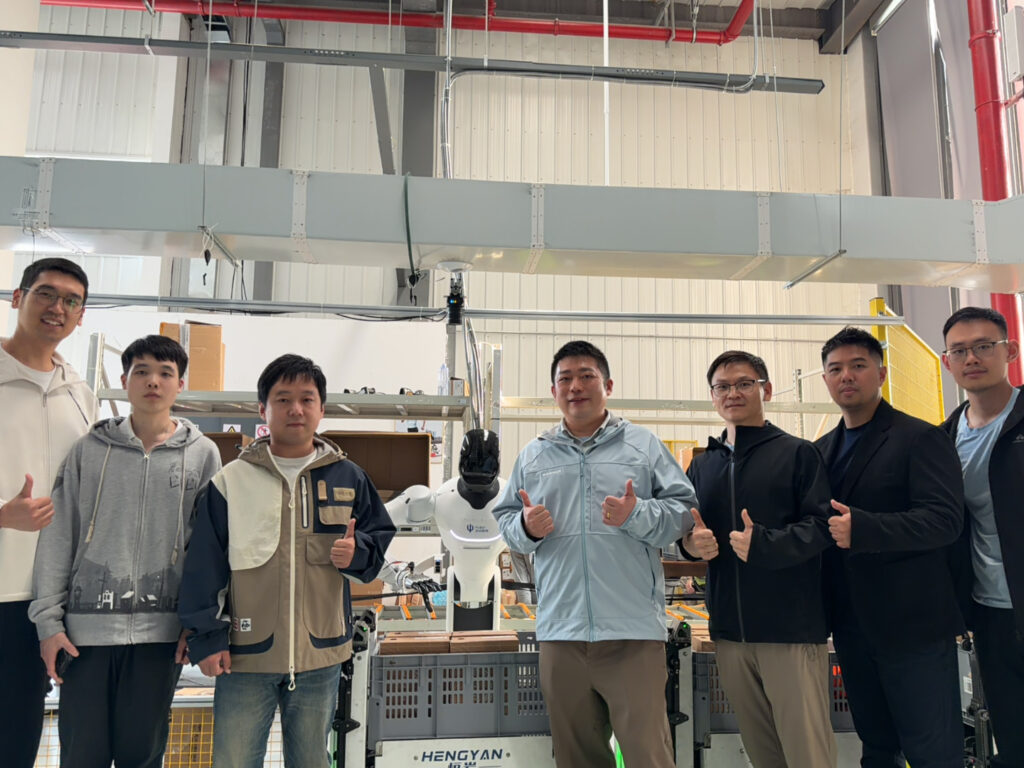
A robot arm reaching into a mixed bin of sneakers and apparel, under warehouse lighting that shifts throughout the day, and sorting each item into the correct outbound order box without a human resetting its parameters between SKUs, is the specific task PsiBot says its embodied robot systems are now handling inside Li-Ning's East China Smart Logistics Center. The Beijing-based embodied AI startup confirmed this week that the deployment, built jointly with automation integrator Hengyan Technology, has moved from testing into trial operation, meaning the robots are now working against real customer orders rather than a staged demonstration environment.
PsiBot, known in China as Lingchu Intelligence, builds robot foundation models trained to generalize across manipulation tasks rather than hand-coded for a single warehouse layout, and runs its research through a joint lab with Peking University alongside active collaboration with Beihang University. The company published two separate technical papers this same week, one accepted at the CoRL 2026 robotics conference on reinforcement-learning post-training for generative robot policies, the other at NeurIPS 2026 on generating stable robot motion from data captured at inconsistent frame rates, giving the Li-Ning deployment a research pedigree that most warehouse-automation vendors pitching a single integration case cannot claim.
Why Bin Picking Is the Task Everyone Avoids Until Last
Order picking into containers, moving loose or lightly organized items from storage into an outbound box matched to a specific customer order, is one of the last warehouse tasks logistics operators have been able to fully automate, and the reason is almost entirely perceptual rather than mechanical. A robot arm capable of lifting a shoebox is not the hard engineering problem; recognizing which item in a cluttered bin matches the current order, planning a grasp that will not damage soft apparel or a boxed shoe, and doing so consistently as lighting conditions shift between a loading dock at midday and a warehouse aisle lit by overhead fixtures at night, is where most pick-and-place systems have historically failed outside tightly controlled pilot conditions. PsiBot's own description of the Li-Ning deployment leads with exactly that capability set, mixed SKUs, items stacked rather than neatly presented, and variable lighting, rather than with a throughput number, which is itself a tell about what the company considers the actual achievement here.
That ordering matters to a procurement team evaluating warehouse robotics vendors. A system that claims a high picks-per-hour rate under ideal, curated conditions is a common and relatively cheap claim to make; a system willing to be judged first on whether it handles the messy, inconsistent bin conditions that define a real apparel and footwear warehouse is making a harder, more verifiable claim, even without a published throughput figure attached to it yet. PsiBot has not disclosed unit counts, picks-per-hour rates, or order volumes handled since the trial began, which is a real gap in the public record; buyers evaluating a similar deployment should expect to request that data directly rather than infer it from this announcement.
What Li-Ning Gains From Being an Early Commercial Proving Ground
Li-Ning, the Chinese sportswear and footwear brand built around its gymnast founder's Olympic legacy, is not a robotics company, and its decision to host a trial-stage embodied AI deployment inside live logistics operations, rather than waiting for the technology to mature at a vendor's own test facility, says something about how Chinese retail and apparel logistics operators are currently weighing the risk of early adoption against the cost of falling behind competitors already automating warehouse picking. Footwear and apparel are a harder category for pick automation than uniform, rigid goods like electronics or packaged consumer products precisely because individual items vary in shape, softness, and packaging within the same SKU family, which is likely why PsiBot and Hengyan chose this facility specifically as a proving ground rather than a more forgiving product category.
For a logistics operator weighing whether to trial a similar embodied AI picking system, the Li-Ning deployment offers a useful template more than a verified performance benchmark at this stage: a named integration partner handling the physical warehouse-systems side, a robotics vendor supplying the perception and manipulation model, and a phased rollout that starts in trial operation against real orders rather than committing to a full facility conversion before the harder edge cases, damaged packaging, unusual item orientations, inventory that does not match the expected bin, have been proven out at volume.
Why the Integrator Partnership Matters as Much as the Robot
Hengyan Technology's role as co-delivery partner on the Li-Ning project is easy to treat as a footnote, but it reflects a pairing structure that is becoming the standard path by which embodied AI robotics companies reach commercial warehouses in China: a research-driven robotics startup supplies the perception and manipulation model, while a systems integrator handles the conveyor, shelving, lighting, and warehouse-management-system integration that a pure AI lab rarely has the operational experience to execute on its own. PsiBot's core competency, demonstrated through its CoRL and NeurIPS research, is training robot policies that generalize across tasks and recover from imperfect training data. Retrofitting that capability into an existing, operating logistics center, without halting order fulfillment during the installation, is a different discipline entirely, and it is the discipline Hengyan is apparently supplying.
For a logistics operator evaluating embodied AI vendors, that division of labor is a useful filter. A robotics company arriving without a named integration partner, or proposing to handle the full warehouse-systems integration itself, is taking on operational risk outside its core expertise, and buyers should weigh that against vendors like PsiBot that are explicit about which partner owns which part of the deployment. The Li-Ning installation's trial-operation status, handling live orders without yet converting the full facility, is itself a function of this phased, partnered approach: Hengyan and PsiBot appear to be validating the integration incrementally rather than committing the entire site to an unproven system on day one.
Where This Fits in China's Crowded Warehouse Robotics Field
China's warehouse and logistics robotics sector is already dense with vendors competing on autonomous mobile robots, goods-to-person shelving systems, and increasingly on exactly the kind of fine-grained manipulation task PsiBot is now demonstrating at Li-Ning. Most of the established players in that field built their businesses on moving inventory to a stationary human picker rather than replacing the picker's own hands, which is precisely the gap PsiBot and a handful of other embodied AI startups are now trying to close. Order picking into containers has remained a largely human task even at warehouses that have otherwise automated nearly everything else around it, which is why a credible, data-backed claim of handling mixed SKUs and variable lighting carries more competitive weight than it might in a less automated logistics category.
That competitive backdrop is also why PsiBot's research publications matter commercially, not just academically. A startup entering a field already crowded with automation vendors needs a credible technical differentiator beyond simply being the newest entrant, and demonstrating published, peer-reviewed progress on the exact failure modes that have kept bin picking manual, inconsistent grasp planning, poor generalization across SKUs, degraded performance under real-world data conditions, is a more durable form of differentiation than a single customer announcement would be on its own.
The Research-to-Deployment Pipeline Buyers Should Watch
PsiBot's decision to publish technical research at CoRL and NeurIPS in the same week it disclosed a commercial warehouse deployment is not incidental. Both papers address problems directly relevant to bin picking: training robot policies to keep improving from the data generated by real interactions rather than plateauing after initial training, and generating smooth, stable motion from training data that was not captured at a consistent frequency, a common problem when a robot's demonstration data comes from multiple sources with different recording setups. A company shipping research that targets its own deployment's hardest technical problems, rather than publishing unrelated academic work alongside a separate commercial pitch, is a reasonable signal that the Li-Ning system is meant to keep improving from its own operating data over time rather than shipping as a static, fixed-capability product.
That improvement loop is also the company's own stated plan for what comes next: PsiBot says it intends to keep collecting operating data from the Li-Ning site, stress-test the system under a wider range of conditions, and work on raising pick success rates before expanding beyond footwear into broader retail warehousing categories. None of that expansion has a disclosed timeline, and the trial-operation status itself means Li-Ning has not yet committed to a facility-wide rollout. The milestone worth tracking from here is not this week's announcement but whether PsiBot discloses a success-rate figure, an expanded product category, or a second named customer within the next few months, each of which would mark the difference between a single successful pilot and a system Chinese retail logistics operators are actually choosing to scale.
This article synthesizes PsiBot's public statements and its concurrent technical publications. It is for general information purposes only and does not constitute procurement advice.