Rhoda AI's Robots Recover Mid-Task on the Factory Floor
Rhoda AI showed its video-prediction robots recovering from unplanned disruptions in a live factory demo, as the Palo Alto startup targets paid industrial deployments before the end of 2026.

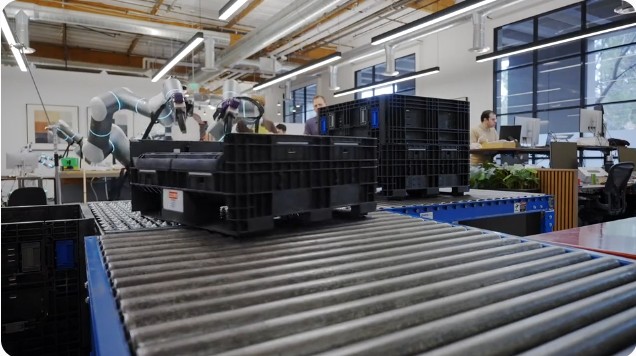
Rhoda AI showed dual-arm industrial robots recovering from mid-task disruptions that engineers introduced on the spot, in a video demonstration published Sunday by former Meta chief technology officer Mike Schroepfer as part of his "Field Trips with Schrep" series. In one sequence, a robot unpacking a box of ball bearings grabbed a bearing still wrapped in packing paper, released it back into the tote, and regrasped only the paper, without a human resetting the scene. Rhoda is targeting paid production deployments on wheeled industrial bases before the end of 2026.
Rhoda AI, headquartered in Palo Alto, California, builds what it calls robot foundation models using an approach the company names Direct Video Action: a video-prediction model forecasts what a task should look like several seconds ahead, and a separate inverse dynamics model converts those predicted video frames into motor commands for the robot's arms. Founder and chief executive Jagdeep Singh, who previously built and sold the fiber-optic networking company Infinera, is aiming the technology at repetitive industrial material handling: kitting, parts sorting, inspection hand-offs, and the kind of conveyor-to-fixture transfer work that occupies a large share of factory and warehouse labor but has resisted full automation because every box, bag, and bin arrives slightly differently.
Three Demonstrations Built Around Deliberate Disruption
The video's central claim rests on what Schroepfer and Singh did to the robot mid-demo rather than on the tasks themselves. In the bearings sequence, a dual-arm robot unpacked a ten-kilogram box, removed the packing paper, and emptied loose bearings into a collection tote. When Singh crumpled extra paper and added it to the box as an unplanned variation, the robot located and removed it without additional instruction. A second demonstration trapped a sheet of paper inside an upside-down plastic bag; the robot repositioned the bag before extracting the paper, a sequencing problem that required recognizing the bag needed to be reoriented before the contents became reachable. A third sequence moved automotive radar units from a conveyor belt to an inspection fixture and then to an output slot. When Singh manually shifted a unit's position and rotated its orientation between runs, the robot adjusted its grasp to match rather than attempting the same fixed motion and failing.
A fourth, less polished segment showed teleoperated data collection on electronics component reels, which the company presented plainly as data gathering rather than an autonomous capability, a distinction that matters because conflating the two is one of the more common ways robotics demo reels overstate readiness.
What a Video-Prediction Model Is Actually Doing
The mechanism is easier to picture than the name suggests. Instead of training a robot directly on joystick-and-camera data to map pixels to motor commands, Rhoda first trains a model on enormous volumes of ordinary video to predict what the next few seconds of a scene should plausibly look like, the same kind of forecasting skill that lets a video-generation model fill in a plausible next frame. A second, smaller model then translates that predicted video into the specific joint movements and gripper commands needed to make the real robot match it. Singh said on the call that after this large-scale video pretraining, a new task typically requires only ten to twenty hours of teleoperation data to specialize the model, a fraction of the hundreds of hours some rival approaches require per task. Inference runs in the cloud, with low-level, time-critical control handled onboard the robot, and the models shown were described as undistilled and unquantized, meaning they are running at full computational weight rather than the compressed versions typically needed to hit factory-floor latency and cost targets.
That last detail is a real constraint and not a technicality. A model that has not yet been distilled or quantized for production is, by definition, still a research artifact: it demonstrates what the architecture can do under generous compute, not what a customer will get once Rhoda has to compress the model to run economically across a fleet of robots on a factory network. Companies evaluating Rhoda, or any physical-AI vendor at a similar stage, should ask specifically whether the performance shown in a demo survives the compression step that precedes commercial deployment, because that step routinely erodes the headline numbers that get the most attention.
The Recovery Behavior Is the Commercial Argument
Most robot demonstration videos are run exactly as rehearsed, with the scene reset between takes and no deviation introduced once filming starts. That convention exists because handling an unplanned deviation is one of the harder problems in robotic manipulation, and showing failure on camera carries obvious reputational cost. Rhoda's choice to have Singh actively disrupt three separate demonstrations, rather than simply running clean passes, is a different kind of evidence than a typical capability reel, because it addresses the specific objection procurement teams raise about pilot programs that look flawless in a vendor's facility and then stall on a real production line the first time a part arrives out of position.
The commercial logic follows directly from that gap. A robot that performs a task correctly only when conditions exactly match its training scenario requires a human supervisor stationed nearby to intervene on every deviation, which erases much of the labor-cost case for deploying it in the first place. A robot that can notice a dropped part, a misoriented unit, or an unexpected object and recover without a human resetting the scene changes the staffing model from one supervisor per robot to one supervisor covering a bank of robots, which is the actual arithmetic that determines whether a physical-AI deployment pays for itself inside a plant's first full year of use.
A Published Benchmark, and What It Does Not Yet Cover
Rhoda has put one hard number behind the broader claim: an earlier scaling study from the company reported an 84.7 percent at-speed completion rate for its largest tested model on one industrial manipulation task, meaning the robot finished the task correctly and within a production-relevant time window on roughly five out of six attempts. That figure is useful because it is specific and task-bound rather than a marketing average, but it also describes one task under test conditions, not a fleet operating continuously across a real production line with its own power fluctuations, lighting changes, and part-supplier variation. Rhoda has not yet published uptime, mean-time-between-failures, or multi-shift reliability data, which are the metrics that actually determine whether a physical-AI system survives procurement scrutiny once the demo phase ends.
Running inference in the cloud raises a related, unresolved question for any buyer evaluating the system: a factory floor losing network connectivity, even briefly, is a routine event that a purely onboard control system can often absorb and a cloud-dependent one cannot. Rhoda has not detailed how the system degrades, or whether it degrades gracefully at all, when that link drops, and that gap belongs on the list of questions a procurement team should raise before treating the Schrep video as evidence of production readiness rather than evidence of a promising architecture.
What the Deployment Target Signals
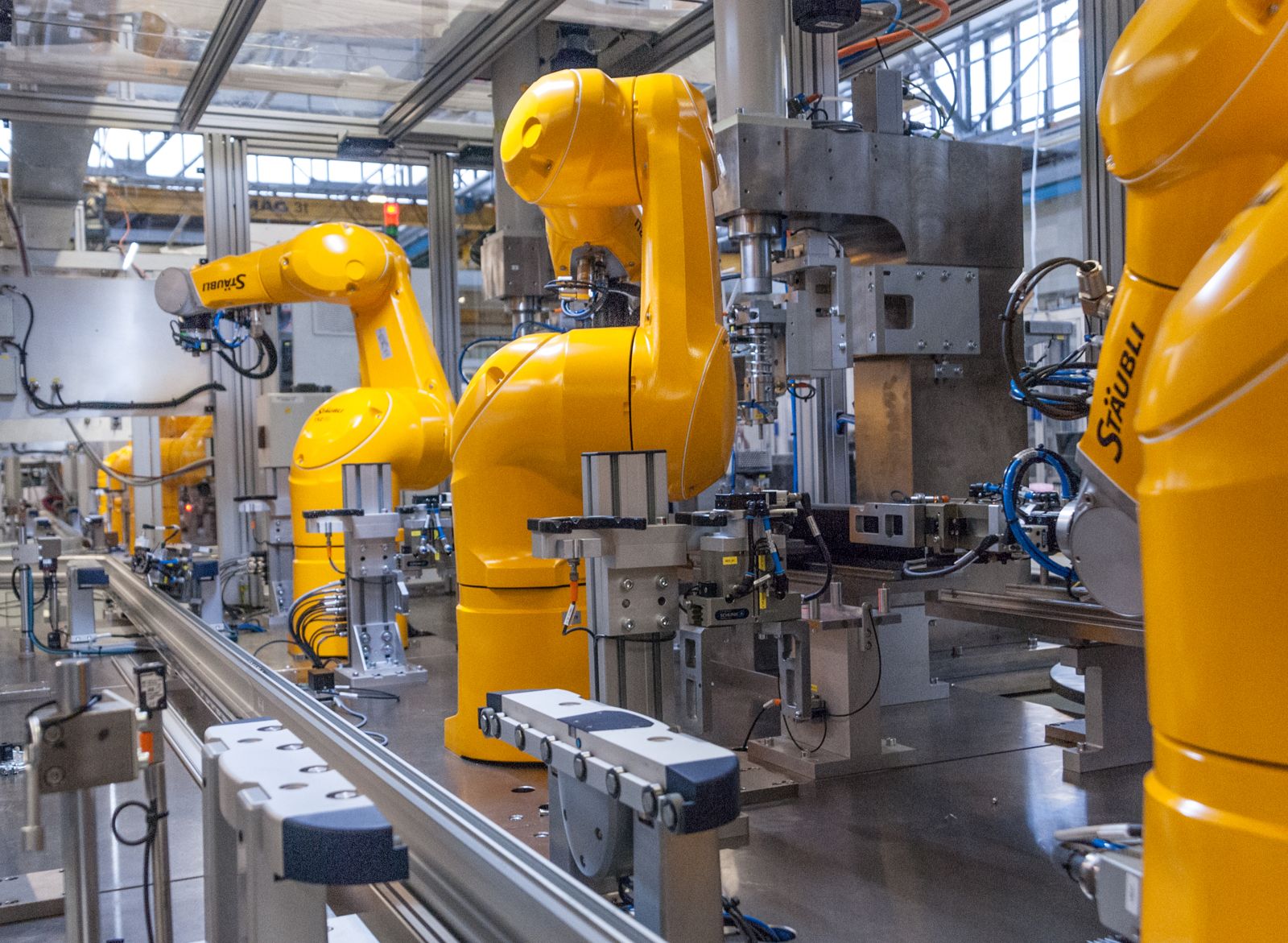
Rhoda's stated plan is to put the technology onto wheeled industrial mobile bases and reach paid production deployments before the end of 2026, backed by what the company calls a remote Robot Operations Center for oversight and intervention. That operations-center model is itself an admission that the system is not yet expected to run unsupervised, and it mirrors the staffing pattern several other physical-AI vendors have adopted during their own early commercial rollouts: a centralized human team monitoring and occasionally taking over for a distributed fleet of robots, rather than the fully autonomous operation that marketing materials across the sector tend to imply. For a buyer, that detail is informative rather than disqualifying. It describes a company moving deliberately from research demonstration toward a specific, bounded commercial offering, with a human safety net built into the rollout plan instead of promised away.
Whether Rhoda hits that end-of-2026 target will depend less on the capability shown in Sunday's video than on how the undistilled models shown there perform once compressed for production cost and latency, and on how the cloud-dependent inference pipeline behaves the first time a customer's network has a bad day. The bearings box emptied cleanly on camera. The harder test is the one nobody films: a full shift, a flaky connection, and no engineer standing by to add the crumpled paper back in.
This account draws on Rhoda AI's published research materials and the "Field Trips with Schrep" video demonstration, current as of publication.
Disclaimer: This article is provided for general information purposes only and does not constitute investment, financial, or procurement advice. RobotAIGeek makes reasonable efforts to verify facts at the time of publication but cannot guarantee complete accuracy of details that may change after publication. Readers evaluating physical-AI vendors should request current performance, reliability, and deployment data directly from the companies involved.