Robots With Living Skin Need More Than Skin
A robotic finger grew its own human skin in 2022. A robotic face learned to smile with it in 2024. Both are real, both are published, and neither can leave the culture medium. The constraint is not making the skin. It is everything skin needs in order to stay alive.

Two published studies, two years apart, and neither construct can leave the culture medium.
A robotic finger grew its own human skin in 2022. A robotic face learned to smile with it in 2024. Both are real, both are published, and neither can leave the culture medium.
Living skin robots get described as a materials advance — a better covering than silicone, with self-healing thrown in. The research describes something harder. Skin is not a covering. It is a system that depends on other systems, and the lab's own roadmap says so in those words.
What Living Skin on a Robot Means
Living skin on robots is cultured human tissue grown onto a robotic structure. University of Tokyo researchers covered a robotic finger in 2022 and a robotic face in 2024. The tissue wrinkles, stretches, and repairs with help, but requires constant nutrients, moisture, and sterility to stay alive.
Living skin on a robot is cultured human dermis and epidermis grown or anchored onto a mechanical structure. It matters now because syndicated coverage of the 2022 finger recirculated in September 2026 without reference to the 2024 advance, leaving readers with a picture two years out of date. For anyone judging where the technology sits, the governing fact is that both demonstrations remain laboratory constructs.
Can Robots Have Real Human Skin?
Only in laboratory conditions. Researchers at the University of Tokyo's Biohybrid Systems Laboratory, led by Professor Shoji Takeuchi, grew cultured human skin onto a robotic finger in a 2022 study published in Matter (DOI: 10.1016/j.matt.2022.05.019), and in June 2024 anchored living skin to a robotic face that can smile, published in Cell Reports Physical Science. Takeuchi has said the tissue is much weaker than natural skin and cannot survive long without constant nutrient supply and waste removal, which keeps both demonstrations confined to culture conditions.
Two Studies, Two Different Problems
The finger study immersed a three-joint robotic structure in a collagen hydrogel seeded with human dermal fibroblasts to form a dermal layer, then applied human keratinocytes to create an epidermis. The skin fitted perfectly because it was grown in place. As Takeuchi put it, the model "is not grown separately then cut to size and adhered to the device; our method provides a more complete covering and is more strongly anchored too."
That method does not scale to shapes you cannot immerse. Two years and two papers apart, the problems solved were different ones, and Figure 1 sets out which was which.
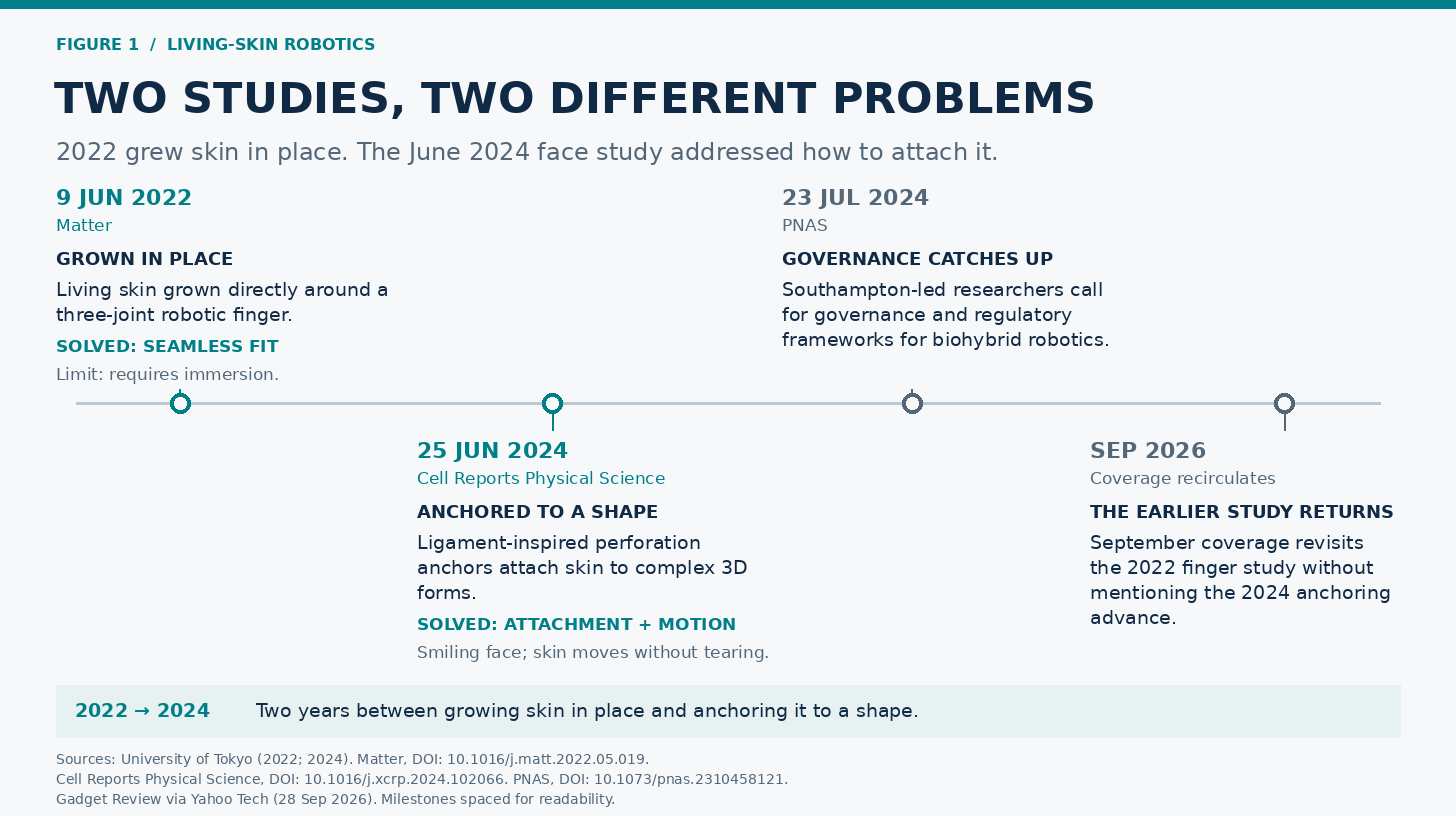
The 2024 work is the harder achievement. Takeuchi described the gap it closed directly: during the finger research he "felt the need for better adhesion between the robotic features and the subcutaneous structure of the skin." His team borrowed from human skin ligaments, cutting V-shaped perforations into solid material so collagen could penetrate and hold. The result, per the University of Tokyo, is that "the skin can move with the mechanical components of the robot without tearing or peeling away."
What the Skin Has and Has Not Done
The distance between the two halves of Figure 2 is the distance between a laboratory result and anything resembling a product.
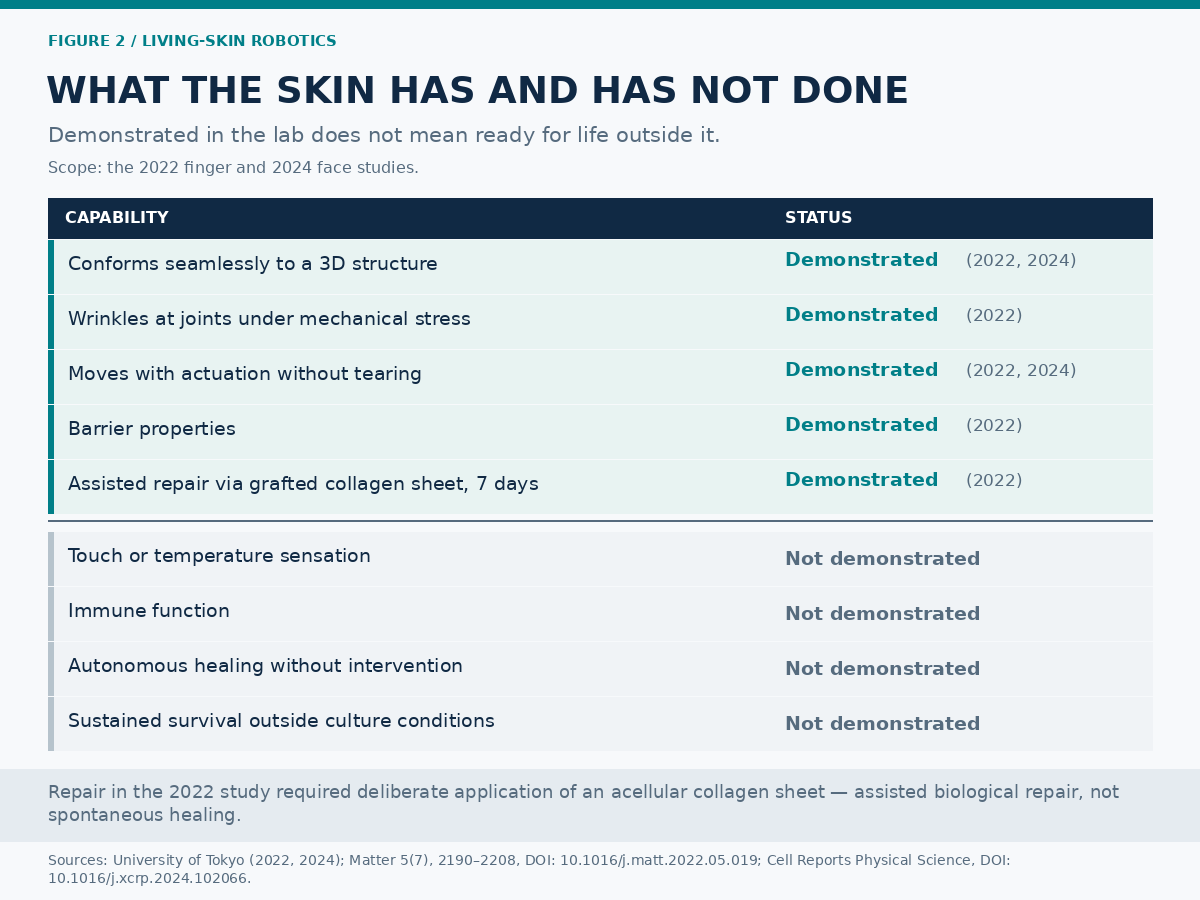
The repair result deserves precision, because it is the one most often compressed into "self-healing." Researchers cut the dermal layer and grafted an acellular collagen sheet over the wound. The paper records what followed: after seven days of culture, the boundary between the grafted sheet and the dermis equivalent became unclear, with tissues stained at three and seven days to track cell migration into the graft. The sheet had to be applied deliberately. Takeuchi's own 2024 framing was more measured than the headlines it generated: "biological skin repairs minor lacerations as ours does."
The epidermis took longer still. Growing it required culturing keratinocytes for a further period on top of the dermal layer, with the completed skin equivalent on the finger cultured for more than fourteen days in total.
Why Better Skin Needs More Than Skin
Think of it as organ transplantation running backwards. A transplant moves tissue from a body that sustained it into another body that can. Biohybrid skin moves tissue onto a machine that sustains nothing — so perfusion, thermal regulation, waste clearance and protection from contamination all have to be rebuilt in engineering.
Takeuchi has been consistent about the constraint. The skin is "much weaker than natural skin and can't survive long without constant nutrient supply and waste removal," he said in 2022. In 2024 he added the contamination problem: "if sterility is not maintained, bacteria can enter and the tissue will die."
"In the future, we will develop more advanced versions by reproducing some of the organs found in skin, such as sensory cells, hair follicles and sweat glands," Takeuchi said in 2022. The word is his. Skin is not one thing a robot can be given — it is a set of them, and each one arrives with a requirement attached. He has since extended the list to sweat glands, sebaceous glands, pores, blood vessels, fat and nerves. Figure 3 maps each to the support it would need.
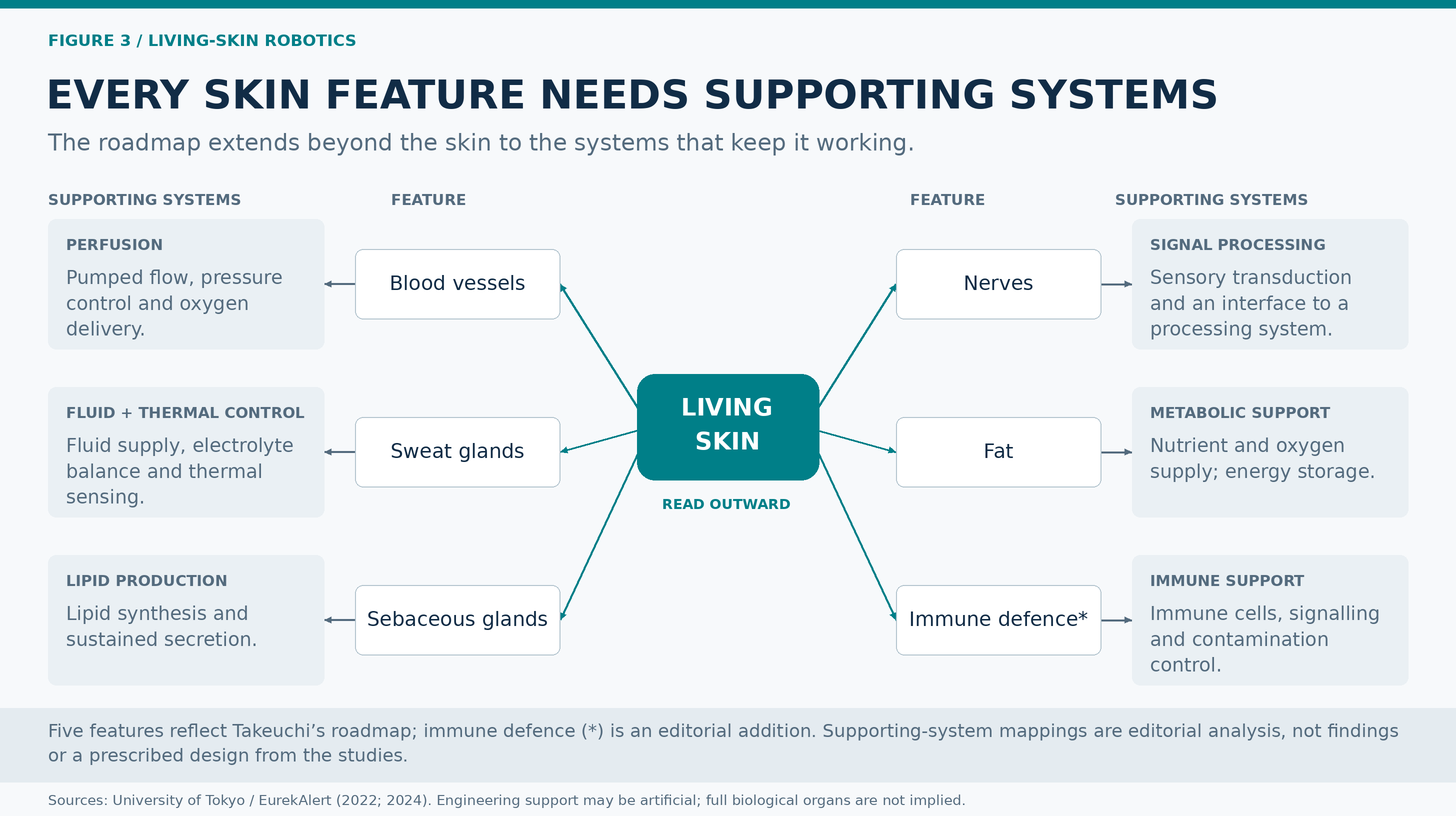
The connection to the rest of humanoid robotics is direct and underappreciated. Humanoid robots currently overheat because they carry no evaporative cooling — they copied a body that sweats, minus the sweating. Sweat glands sit on Takeuchi's roadmap. Delivering them means delivering fluid supply, electrolyte balance and thermal sensing into a machine that has none of the three.
Skin is not a covering. It is a dependency.
Governance Before Capability, or After
Takeuchi's position is that the material argument settles itself. "I think living skin is the ultimate solution to give robots the look and touch of living creatures since it is exactly the same material that covers animal bodies," he said in 2022. He has since told Al Jazeera the cultured skin "aims to replicate the full range of biological functions found in human skin." The argument holds: silicone will never self-repair or carry biological nerves, and the adhesion obstacle fell in two years.
A second group is working the other end. On 23 July 2024, Rafael Mestre, Aníbal Astobiza, Victoria Webster-Wood, Matt Ryan and Taher Saif published "Ethics and responsibility in biohybrid robotics research" in PNAS, a team spanning the University of Southampton and institutions in the United States and Spain. It identifies three areas where the field raises issues existing frameworks do not cover: interactivity, how bio-robots interact with humans and the environment; integrability, how and whether humans might assimilate bio-robotic organs or limbs; and moral status. The paper proposes risk assessments, consideration of social implications, and increased public understanding.
Mestre's framing is comparative rather than alarmed. The challenges, he said, "are not dissimilar to those encountered in the regulation of biomedical devices, stem cells and other disruptive technologies." Co-author Matt Ryan, a political scientist, named the harder part: if debates around embryonic stem cells, human cloning or artificial intelligence have taught us anything, it is that humans rarely agree.
The two positions differ on sequencing rather than facts, and the life-support constraint gives both more room than either assumes. A construct that cannot leave a culture medium is neither an imminent product nor, yet, an imminent governance subject. What would change that is a published demonstration of vascularised tissue surviving on a robot outside culture conditions, and as of October 2026 none exists.
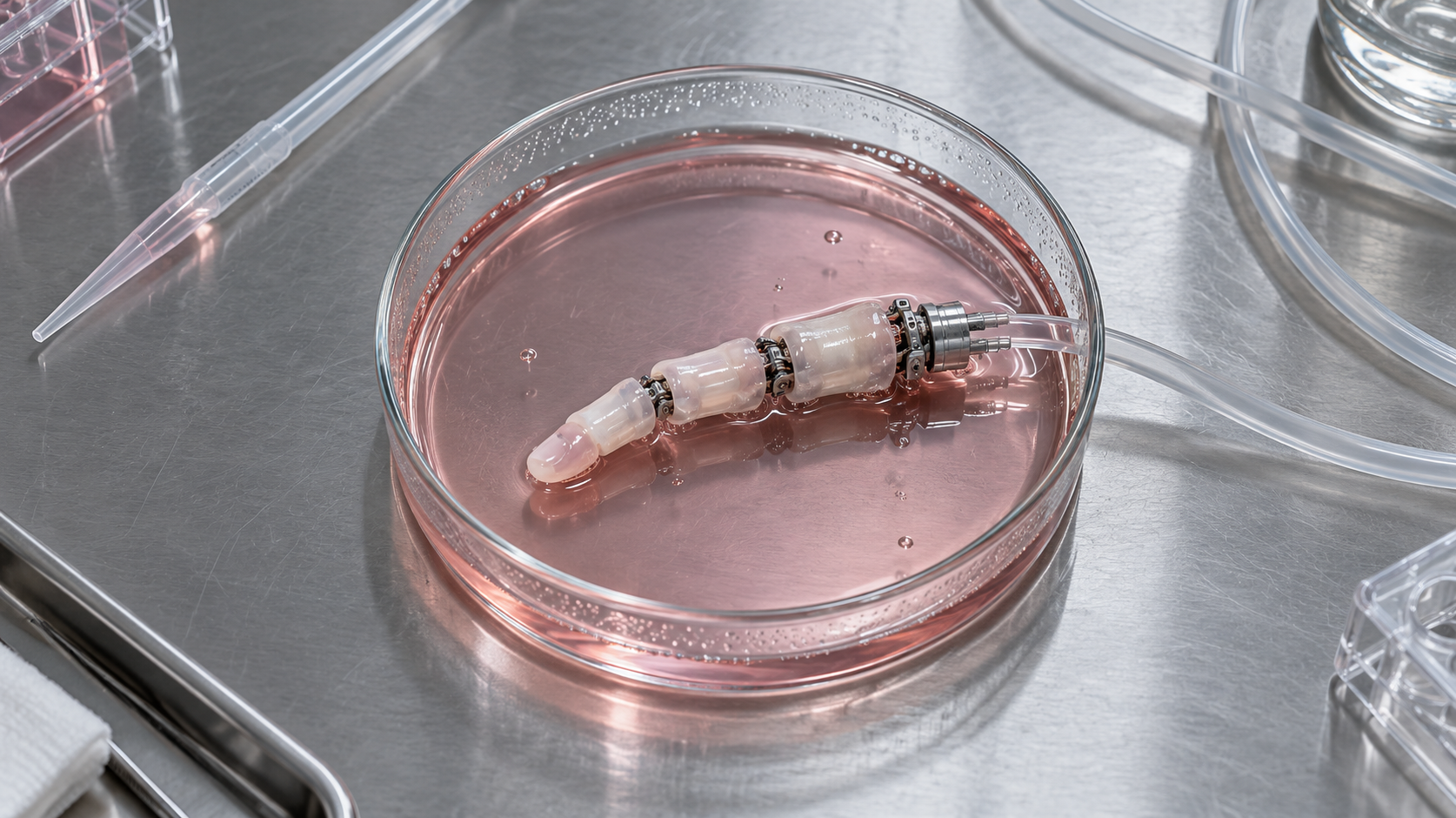
The finger sits in a dish. That is not a detail of the photograph — it is a specification. Takeuchi's team solved seamless fit in 2022 and solved adhesion in 2024, two genuinely hard problems in two years, and the roadmap from here reads sensory cells, hair follicles, sweat glands, sebaceous glands, pores, blood vessels, fat and nerves. Every one of those is a thing a body already runs and a machine does not. The 2022 study recirculated again in September 2026 while the 2024 result, which is the one that moved the field, went largely uncovered. What arrives next will not be a better face. It will be whatever first keeps the tissue alive once the dish is taken away.
1. Can robots have real human skin?
Only in laboratory conditions. The University of Tokyo's Biohybrid Systems Laboratory grew cultured human skin onto a robotic finger in a 2022 study in Matter (DOI: 10.1016/j.matt.2022.05.019), and anchored living skin to a smiling robotic face in a June 2024 study in Cell Reports Physical Science (DOI: 10.1016/j.xcrp.2024.102066). Both remain research constructs. Takeuchi has said the tissue cannot survive long without constant nutrient supply and waste removal.
2. How is living skin grown on a robot?
In the 2022 finger study, the robotic structure was immersed in a collagen hydrogel seeded with human dermal fibroblasts to form a dermal layer, then human keratinocytes were applied to create an epidermis. The 2024 face study used a different approach — V-shaped perforation-type anchors cut into the structure, inspired by human skin ligaments, letting collagen penetrate and hold skin onto complex shapes that cannot be immersed.
3. Does the skin really heal itself?
Not autonomously. In the 2022 study, researchers cut the dermal layer and grafted an acellular collagen sheet over the wound. The paper records that after seven days of culture the boundary between the grafted sheet and the dermis equivalent became unclear, with tissues stained at three and seven days to track cell migration. The sheet had to be applied deliberately, making this assisted biological repair rather than spontaneous healing.
4. How long does the skin survive?
No published figure for maximum survival duration was located. The 2022 study cultured the completed skin equivalent on the finger for more than fourteen days. Takeuchi stated that the skin is much weaker than natural skin and cannot survive long without constant nutrient supply and waste removal, and in 2024 that if sterility is not maintained, bacteria enter and the tissue dies. Both constraints confine the work to controlled culture environments.
5. When will robots with living skin be available?
No manufacturer has announced a product and no commercial timeline exists. The unresolved problems — vascularisation or nutrient delivery, attachment to larger structures, and maintenance outside culture conditions — are research programmes rather than development milestones. Applications named by researchers include humanoid robots, prosthetic coverings, and platforms for medical or cosmetic testing, all described as long-term directions.
6. Is putting human cells on robots ethical?
The question has no settled answer, and a governance framework is being actively proposed. In PNAS on 23 July 2024, Mestre and colleagues published "Ethics and responsibility in biohybrid robotics research," identifying three areas of unique concern: interactivity, integrability, and moral status. The paper calls for risk assessments, consideration of social implications, and greater public understanding, with co-lead author Rafael Mestre comparing the challenge to the regulation of biomedical devices and stem cells.
Schema note: This numbered FAQ block is structured for FAQPage schema markup; figures carry ImageObject markup, the AEO Answer Block carries speakable markup, and the article carries Article schema with the author as a Person entity.