Shared Loads Are the Unsolved Humanoid Job
Georgia Tech's US$700,000 NSF award treats a shared humanoid carry as research, not a product. Buyers should not accept solo-robot demos as proof of teaming.

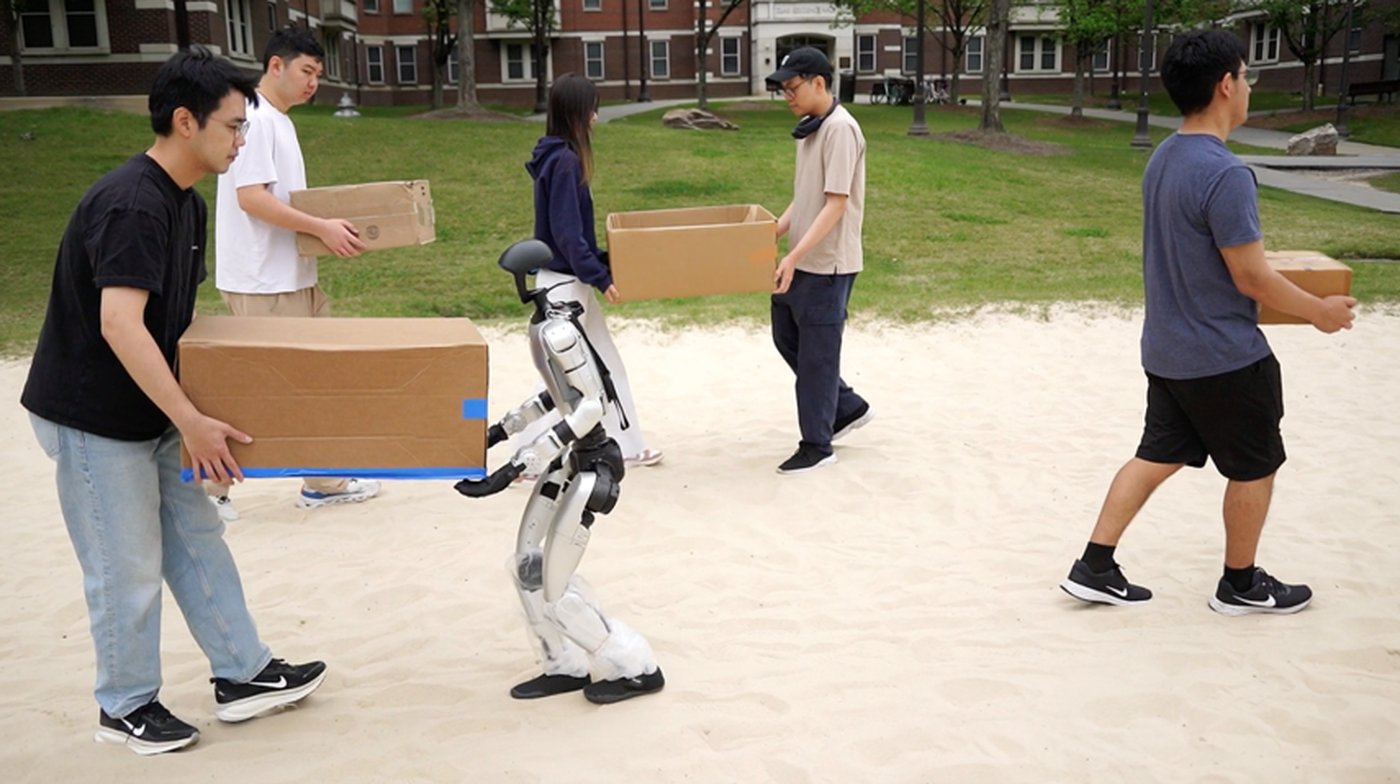
A Georgia Tech team led by Ye Zhao has a new National Science Foundation grant to study how a person and a humanoid robot can carry objects together and move through crowded, uneven, and stair-filled spaces. The George W. Woodruff School of Mechanical Engineering announced the award on 30 October 2026. The grant is US$700,000 under the Mind, Machine and Motor Nexus program. NSF records it as award 2611346. The title names a shared-carry study: people and humanoid robots moving objects together, finding a path through other people, and exchanging cues in both directions. The sum is small next to a humanoid factory budget. The problem it funds is the one that shows up the moment a robot leaves a scripted cell and has to share a load with a person.
A grant aimed at the handoff, not the demo
Zhao, an associate professor in the Woodruff School, leads co-principal investigators Mohsen Moghaddam, Chris Wiese, and Anqi Wu. Moghaddam is the Gary C. Butler Family Associate Professor, with appointments in industrial and systems engineering and in mechanical engineering. Wiese is an associate professor in psychological and brain sciences. Wu is the James Edenfield Assistant Professor in computational science and engineering. The mix matters more than the titles. A shared carry is a controls problem, a sensing problem, a trust problem, and a learning problem at the same time.
The project will look at how people and humanoid robots communicate, adapt to each other, transport objects safely, and navigate crowded spaces, uneven terrain, and stairs. The technical path named in the school announcement is wearable sensing plus robot sensing, human-state estimation, and reinforcement learning. The school lists shop floors, warehouses, care settings, building sites, farms, and emergency work as the places this kind of teaming could matter. Those are application targets, not sites already under contract.
Georgia Institute of Technology is a public research university in Atlanta. This is a campus research award, not a product launch and not a startup round. No robot brand, no pilot customer, and no hardware specification appear in the announcement. Treating the grant as a deployment would overread it. Treating it as irrelevant to buyers would underread it. The methods it funds are exactly the methods a later procurement team will be asked to accept on faith.
Why a shared carry breaks today's humanoid pitch
Most humanoid footage shows a robot acting alone. A tote moves from a shelf to a conveyor. A part seats in a fixture. The person, if present, stands outside the work envelope. Cooperative transport is the opposite arrangement. Two agents hold one object. Force on one side changes the load on the other. A pause, a stumble, or a misunderstood cue becomes a safety event, not a missed cycle.
Social navigation adds a second failure mode. Crowded aisles, uneven floors, and stairs are where legged robots are supposed to beat wheeled carts. They are also where a robot that cannot read human intent becomes a moving obstacle. Bidirectional communication, the phrase in the project title, means the robot should not only receive a command. It should give the person a readable signal of what it is about to do. Without that return path, the person guesses. Guessing is how shared lifts go wrong in warehouses today, even between two people.
The US$700,000 scale sets expectations. It can fund a team, a sensing setup, and a learning stack. It cannot fund a factory pilot or a certified safety case. Buyers who see a university headline and ask for a delivery date are asking the wrong question. The right question is which behaviors a later vendor will claim to have solved, and which of those claims still sit at research stage.
Zhao's published comment points the same way. He framed the distant aim as taking humanoids out of one-off shows and turning them into tools people can rely on at work and in public. That is a direction, not a result. The grant starts the work. It does not finish it.
What operations leaders can take from a research award
A practical reader can still use the award as a checklist. If a vendor promises a humanoid that carries loads with people, ask four questions that this project treats as open.
First, what does the person wear, and what does the robot sense without that wearable? A system that works only when every coworker wears a sensor pack will not survive a real shift.
Second, how does the robot estimate human intent when the cue is late, partial, or wrong? Human-state estimation is the research topic, not a brochure feature.
Third, what happens on stairs and uneven ground while the object is still in both hands? Flat-floor demos do not answer that.
Fourth, how does the robot tell the person it is about to yield, stop, or change grip? Bidirectional communication is the difference between a tool and a silent partner.
None of those questions is answered by a US$700,000 award. The award tells a buyer that a serious public funder still treats them as research. That is useful skepticism. It should sit next to any 2026 pitch that shows a humanoid walking a part across a clean floor and calls the job done.
Where the money sits against commercial claims
The comparison is about problem stage, not about competing products. Prices for the commercial systems are not part of this award and are marked N/A.
The gap between the first row and the second is the editorial point. Commercial humanoids are being sold into tasks a robot can do alone. The Georgia Tech project is aimed at tasks a robot must do with someone. Those are different products. A plant that needs the second should not accept evidence from the first.
Reinforcement learning on a shared load also raises a data issue the announcement does not solve. Learning from people means recording people. Wearable sensing in a workplace is a privacy and consent problem as well as a controls problem. The school note does not describe a data policy, a worksite partner, or an institutional review scope. Those gaps belong in the file. They do not weaken the award. They limit what anyone should claim about field readiness.
A small award with a precise boundary
US$700,000 will not buy a humanoid fleet. It can buy a clearer definition of the job humanoid fleets still cannot show. Cooperative transport and social navigation are named, funded, and unsolved in this announcement. That is a better planning input than another walking demo.
How a buyer uses a research headline without overreading it
The temptation with a university award is to file it under science and move on. That misses the purchasing use. Humanoid proposals arriving in 2026 and 2027 will borrow the language of this grant without having done the work. Cooperative, social, bidirectional, and human-aware are already easy words on a slide. A buyer who has read the award can ask the vendor to map each word to a test.
Cooperative transport should mean a shared object with measurable force at both grips, a defined abort if either grip slips, and a recorded recovery that does not drop the load. Social navigation should mean a crowded path with people who are not actors in a fixed script, including someone who stops, turns, or steps backward. Bidirectional communication should mean a cue the person can see or hear before the robot changes force or direction, not a log file written after the motion. Human-state estimation should mean a method that still works when the wearable is missing, because a real crew will not wear one every hour.
If the vendor cannot show those tests, the honest label is a solo robot with a person nearby. That can still be a useful machine. It is not the machine described in award 2611346. Paying a humanoid price for a solo robot is a commercial choice. Paying it because the brochure said teaming is a category error.
The team composition is a hint about what the tests will have to include. Controls researchers can make a robot track a force. They cannot, by themselves, tell you whether a nurse, a picker, or a site supervisor will trust the cue. Wiese's role in psychological and brain sciences is a marker that trust and teamwork are inside the scope, not a later brochure add-on. Wu's role in computational science is a marker that the learning stack is part of the award, not a purchased black box. Moghaddam's industrial-engineering appointment is a marker that the work is aimed at work systems, not only at a lab gait. None of that produces a product. It does tell a reader which disciplines a serious teaming claim should be able to point to.
Limits that should stay visible
Several limits are already clear from the announcement, and they should not be filled in with optimism. There is no industry partner named. There is no robot platform named. There is no statement of how many participants, how many hours, or which workplace will be studied. There is no safety standard cited. There is no timeline beyond the fact of the award announcement on 30 October 2026. The National Science Foundation page for the award number did not render a public abstract in a standard fetch on the same day, so the school announcement remains the usable primary text. Claims that appear only as loading placeholders should not be upgraded into findings.
Wearable sensing deserves a specific caution. A research protocol can ask volunteers to wear sensors and can stop the session when consent ends. A warehouse, a ward, or a construction crew cannot. Any later commercial system that depends on the same wearable will have to survive shift changes, lost devices, and workers who refuse. If the Georgia Tech work eventually shows that teaming fails without the wearable, that negative result would be as useful to a buyer as a positive demo. The announcement does not promise either result. It funds the attempt.
Reinforcement learning adds a second caution. A policy that improves in a lab motion-capture room can still fail when the floor is wet, the load is flexible, or the person changes grip without warning. The award names reinforcement learning as a method. It does not name a success rate, because there is not one yet. Vendors who cite university learning research as if it were a field statistic are mixing categories. A buyer should separate a funded method from a measured outcome every time.
What this changes in a 2026 shortlist
A shortlist meeting can use the award without pretending it is a product review. Score solo material handling on cycle time, uptime, and service. Score shared carrying as unproven unless the vendor brings the four tests above onto the buyer's floor. Keep US$700,000 in view as a scale check. A grant of that size is a serious campus project. It is not evidence that the behavior is cheap, mature, or insurable. If a proposal prices a teaming function as a software option on top of a walking robot, ask what data, what sensor, and what abort logic the option contains. If the answer is a vision model and a hope, the option is not the function Zhao's team just received public money to study.
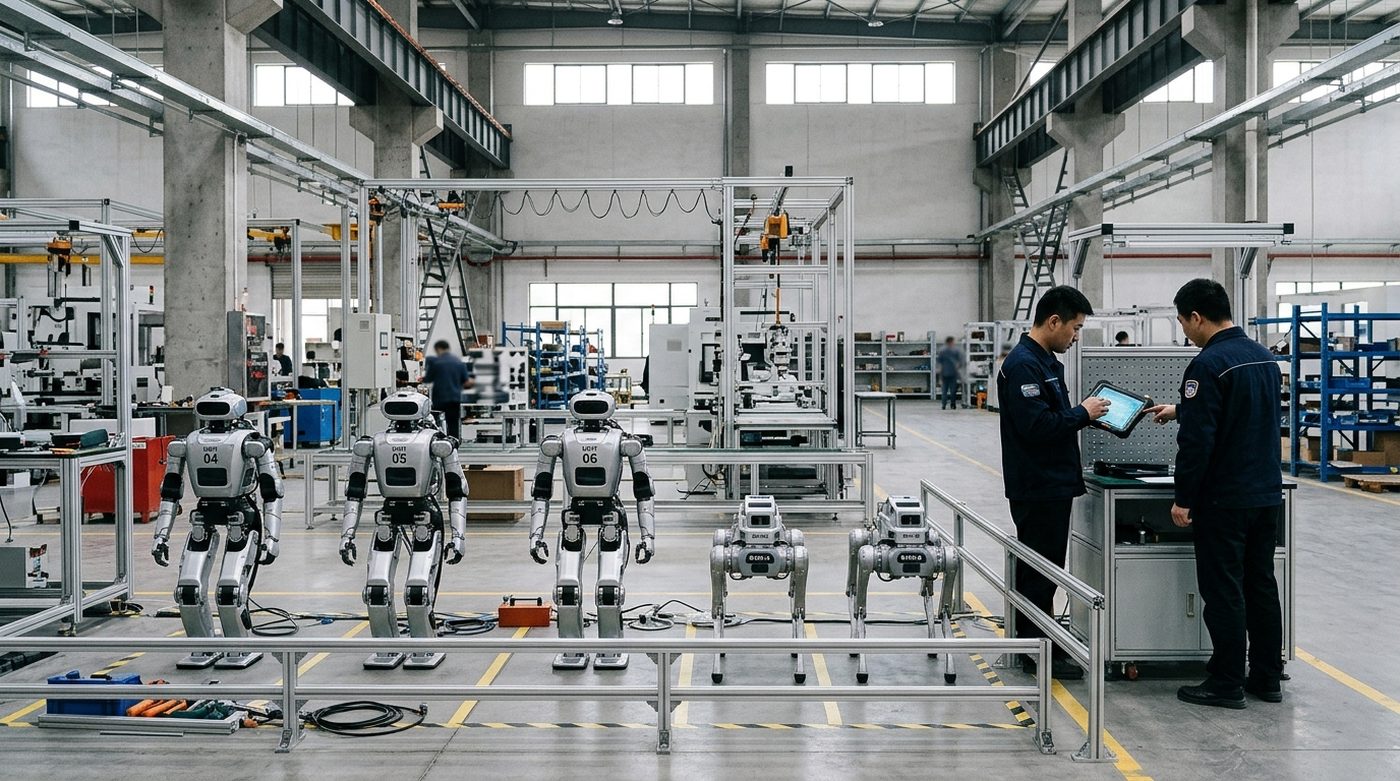
The wider humanoid market can keep shipping robots that work alone. Those machines will move totes, present parts, and walk aisles. They will not, on current public evidence, share a ladder carry or a patient-adjacent lift with a person under a tested cue. The Georgia Tech award draws that line in public, with a funder, a team, and a project number. That line is the article. The dollar figure is only the proof that someone decided the line was worth a formal study.
Factories, hospitals, and construction sites that want a robot to share a lift should budget for a human process around the machine until a vendor can show the four behaviors above on their floor. The Georgia Tech grant is a sign that the science for those behaviors is still being built. It is not a substitute for a site trial.
Image credit: George W. Woodruff School of Mechanical Engineering, Georgia Institute of Technology, photograph published with the 30 October 2026 award announcement.
This article is for general information only. It is not engineering, procurement, investment, or legal advice. Figures reflect the university announcement available on 30 October 2026 and may change.