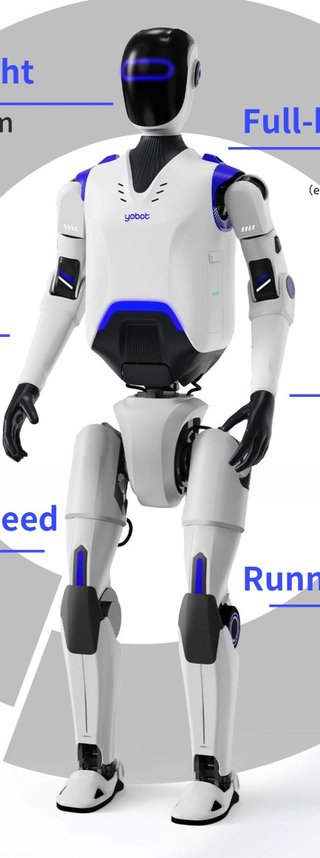


DESCRIPTION
yobot R2V1 est un Educational-Robots de Openmind Intelligent Robot. Il est conçu pour Research, Humanoid locomotion research, education. Chiffres clés : 43 kg, 120 min d'autonomie, 22 degrés de liberté.
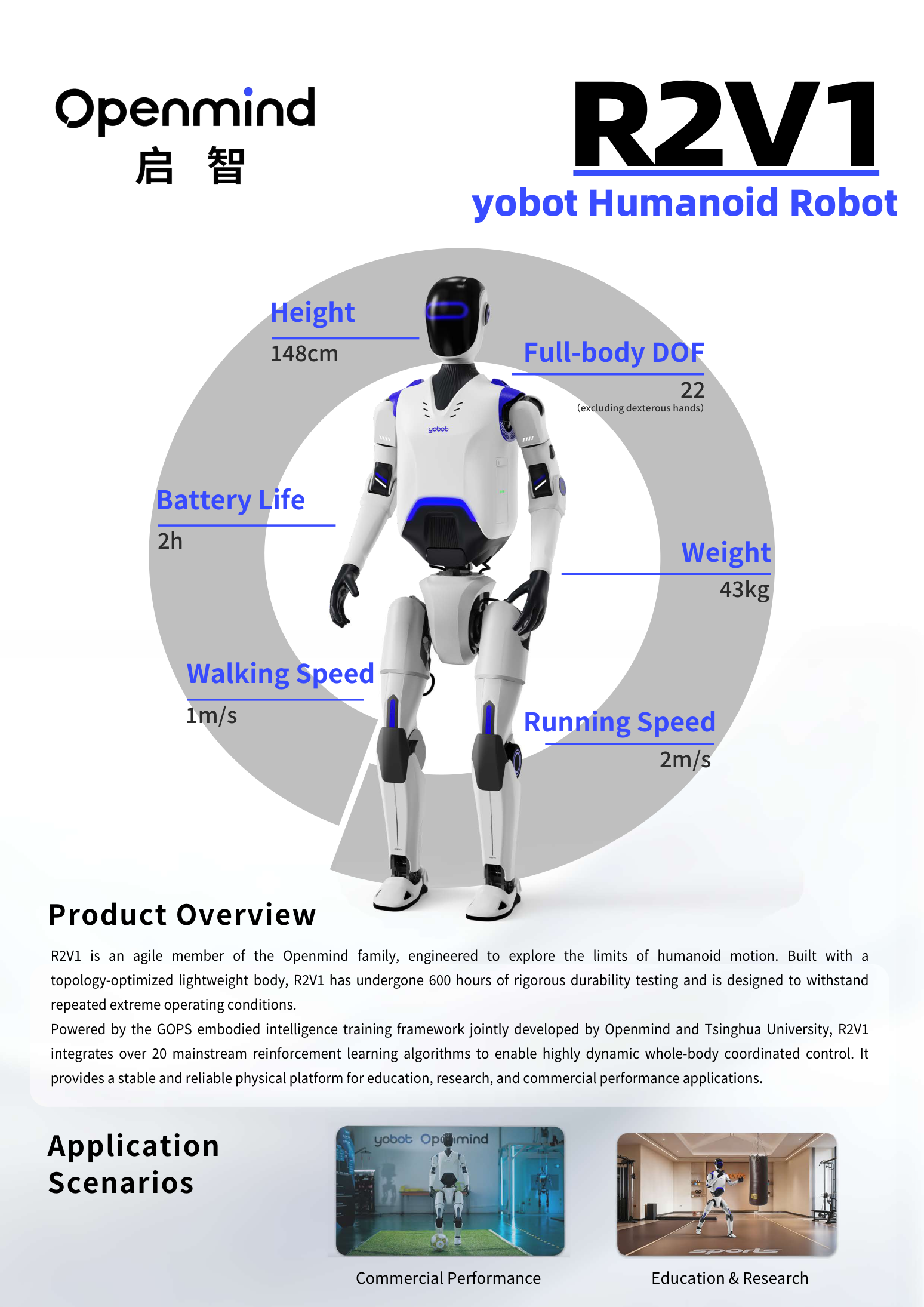
The R2V1 is the agile member of the yobot family, engineered to explore the limits of humanoid motion rather than to carry things. Its body is topology-optimised for lightness — 148 cm and 43 kg — and it has been through 600 hours of durability testing designed around repeated extreme operating conditions, which is the kind of number that matters for a machine sold to research groups who will abuse it. Motion runs on GOPS, the embodied-intelligence training framework Openmind developed with Tsinghua University, integrating more than thirty mainstream reinforcement-learning algorithms for highly dynamic whole-body coordinated control. Twenty-two degrees of freedom excluding hands split as four per arm, two at the waist and six per leg, walking at 1 m/s and running at 2 m/s. Compute is 157 TOPS across eight Cortex-A78AE cores and 1,024 CUDA cores. The sensor fit is deliberately minimal — an IMU as standard, with LiDAR, depth cameras, microphone and speaker all optional — because the platform is sold as a physical base for education, research and commercial performance, to be instrumented as the customer needs.
FONCTIONNALITÉS
- Topology-optimised lightweight body at 148 cm and 43 kg
- 600 hours of rigorous durability testing under repeated extreme operating conditions
- 22 degrees of freedom excluding dexterous hands — arms 4 each, waist 2, legs 6 each
- GOPS embodied-intelligence training framework developed with Tsinghua University, integrating 30+ mainstream reinforcement-learning algorithms
- 1 m/s walking and 2 m/s running
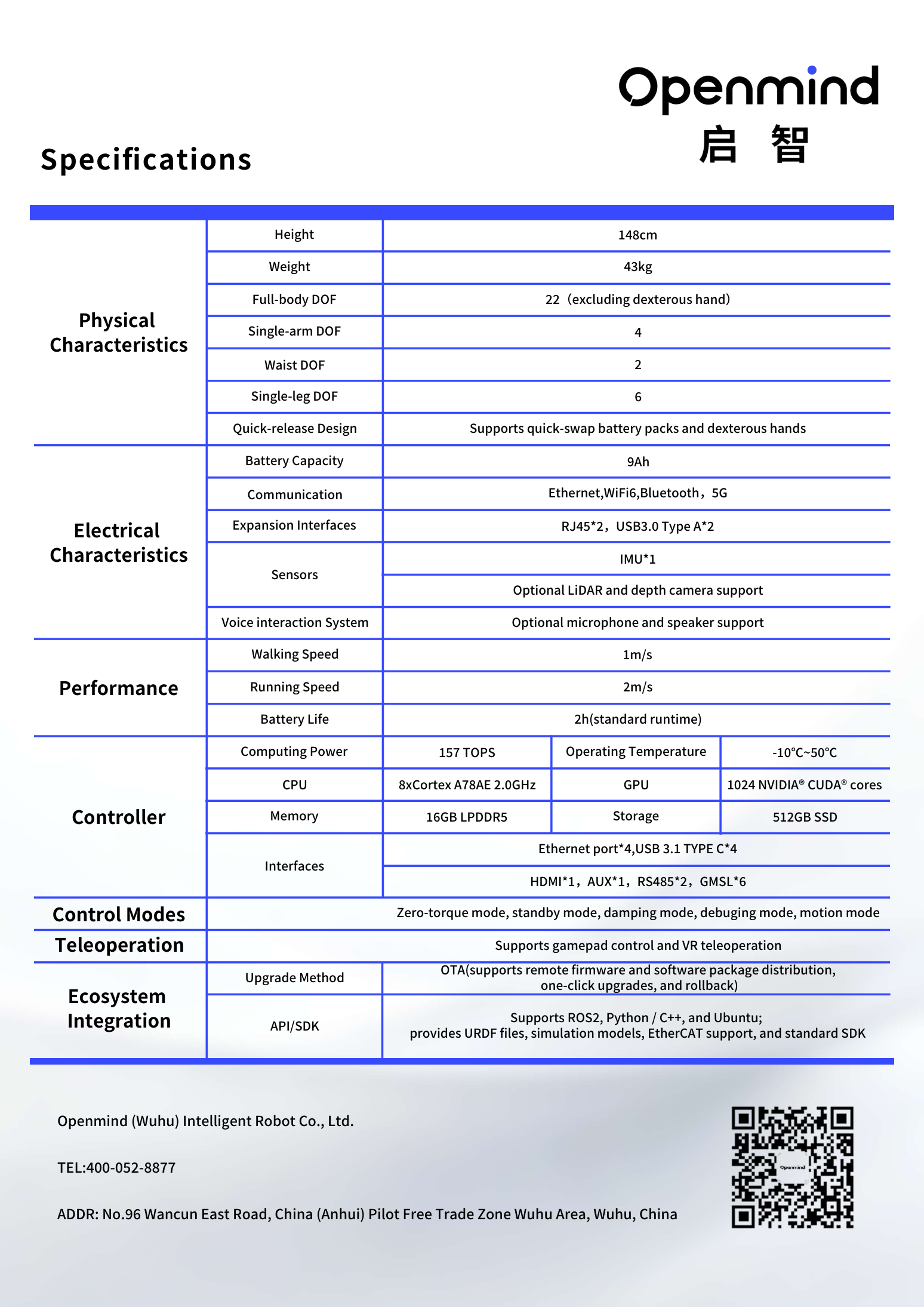
- 157 TOPS from 8 Cortex-A78AE cores at 2.0 GHz and 1,024 NVIDIA CUDA cores with 16 GB LPDDR5 and 512 GB SSD
- five control modes — zero-torque, standby, damping, debugging and motion
- quick-swap battery packs and dexterous hands
- gamepad and VR teleoperation
- ROS 2, Python and C++ on Ubuntu with URDF files, simulation models, EtherCAT support and a standard SDK
- OTA updates with one-click upgrade and rollback
- optional LiDAR, depth camera, microphone and speaker.
CARACTÉRISTIQUES TECHNIQUES
| Physique | |
| Poids | 43 kg |
|---|---|
| Dimensions | H 1.48 m |
| Mobilité | |
| Type de déplacement | Bipedal |
| Degrés de liberté | 22 |
| Vitesse | 3.6 km/h |
| Manipulation | Moyenne |
| Environnement | -10°C to 50°C |
| Actionneurs | 22 DoF excluding dexterous hands — single arm 4, waist 2, single leg 6; topology-optimised lightweight structure; quick-release design for battery packs and dexterous hands |
| Alimentation | |
| Autonomie de la batterie | 2 h |
| Perception et calcul | |
| Capteurs | IMU, optional LiDAR, optional depth camera, optional microphone and speaker |
| Connectivité | Ethernet, Wi-Fi 6, Bluetooth and 5G; RJ45 x2 and USB 3.0 Type A x2 expansion; Ethernet port x4, USB 3.1 Type C x4; HDMI x1, AUX x1, RS485 x2, GMSL x6 |
| Logiciel / IA | GOPS embodied-intelligence training framework developed with Tsinghua University, integrating 30+ reinforcement-learning algorithms for highly dynamic whole-body coordinated control; five control modes (zero-torque, standby, damping, debugging, motion); ROS 2, Python and C++ on Ubuntu with URDF, simulation models, EtherCAT and standard SDK; OTA with one-click upgrade and rollback |
FORUMS DU ROBOT
Chargement des forums...
CARACTÉRISTIQUES TECHNIQUES
| Physique | |
| Poids | 43 kg |
|---|---|
| Dimensions | H 1.48 m |
| Mobilité | |
| Type de déplacement | Bipedal |
| Degrés de liberté | 22 |
| Vitesse | 3.6 km/h |
| Manipulation | Moyenne |
| Environnement | -10°C to 50°C |
| Actionneurs | 22 DoF excluding dexterous hands — single arm 4, waist 2, single leg 6; topology-optimised lightweight structure; quick-release design for battery packs and dexterous hands |
| Alimentation | |
| Autonomie de la batterie | 2 h |
| Perception et calcul | |
| Capteurs | IMU, optional LiDAR, optional depth camera, optional microphone and speaker |
| Connectivité | Ethernet, Wi-Fi 6, Bluetooth and 5G; RJ45 x2 and USB 3.0 Type A x2 expansion; Ethernet port x4, USB 3.1 Type C x4; HDMI x1, AUX x1, RS485 x2, GMSL x6 |
| Logiciel / IA | GOPS embodied-intelligence training framework developed with Tsinghua University, integrating 30+ reinforcement-learning algorithms for highly dynamic whole-body coordinated control; five control modes (zero-torque, standby, damping, debugging, motion); ROS 2, Python and C++ on Ubuntu with URDF, simulation models, EtherCAT and standard SDK; OTA with one-click upgrade and rollback |
Images
 martti

 martti
 martti
Contributions d'images
Vidéos
FORUMS DU ROBOT
Chargement des forums...
NOTES
QUESTIONS FRÉQUENTES
What is the yobot R2V1?
The R2V1 is the agile member of the yobot family, engineered to explore the limits of humanoid motion rather than to carry things.
Who makes the yobot R2V1?
The yobot R2V1 is made by Openmind Intelligent Robot, a robotics company based in China.
How much does the yobot R2V1 cost?
Openmind Intelligent Robot has not publicly announced pricing for the yobot R2V1. You can enquire through RobotAIGeek for current pricing.
What is the yobot R2V1 used for?
The yobot R2V1 is designed for research, humanoid locomotion research, education, and commercial performance and exhibition. It is used in entertainment, research, and education settings.
How much does the yobot R2V1 weigh?
The yobot R2V1 weighs 43 kg.
How fast is the yobot R2V1?
The yobot R2V1 can move at speeds of up to 3.6 km/h.
What is the battery life of the yobot R2V1?
The yobot R2V1 runs for 2 h on a charge.
How many degrees of freedom does the yobot R2V1 have?
The yobot R2V1 has 22 degrees of freedom.
COMPARER AVEC DES ROBOTS SIMILAIRES
Voyez comment ce robot se positionne face à ses alternatives les plus proches
- yobot R2V1 vs Robovie-Z
- yobot R2V1 vs Lanxin H6 Standard
- yobot R2V1 vs Mini Pi
- yobot R2V1 vs Mini Pi Plus
- yobot R2V1 vs YMBot Type E3