

BESCHREIBUNG
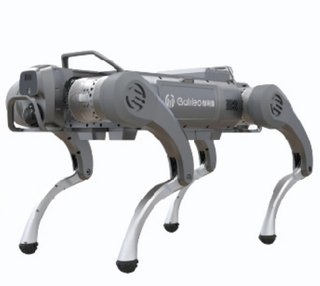
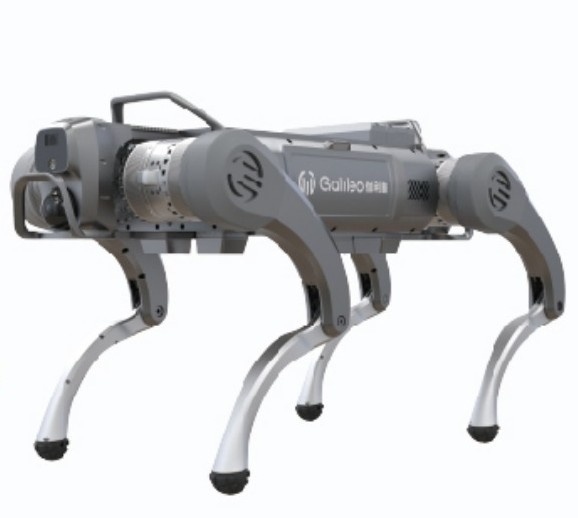
The Galileo E1 is the medium industrial grade of the family and the point where the specification changes character rather than just scaling. It doubles the C1's weight to 50 kg but multiplies its maximum load nearly seven-fold to 100 kg, with 30 kg as the rated working payload. Twin LiDARs become standard — one front, one rear, each covering a full 360 degrees horizontally and 90 vertically to 30 m — and a second X86 processor joins the ARM CPU, giving the perception and autonomy headroom the smaller grade leaves optional. It climbs 30 cm continuous steps and can mount an 80 cm platform head-on, walks at up to 4 m/s, and Galileo quotes a measured range above 16 km, the longest in the family.
FUNKTIONEN
- Steps up to medium industrial grade with twin LiDARs as standard and a 100 kg maximum load
- 1000 x 452 x 550 mm standing at 50 kg
- Motion speed adjustable from 0 to 4.0 m/s
- 30 kg rated payload capacity with a 100 kg maximum load
- Maximum climbable slope of 30 degrees or more
- continuous steps of 30 cm or more
- front-facing 80 cm elevation platform
- 30 Ah (1440 Wh), 48 V battery giving 2.5 hours under payload and 4.5 hours unloaded, with a range of >16 km (measured)
- LiDAR: 2 units, one front and one rear, 30 m detection range, 0-360 degrees horizontal and 0-90 degrees vertical
- Domestic ARM-based low-power high-performance CPU with 8 cores and 8 threads, 8 GB RAM and 64 GB solid-state storage
- WiFi 6 wireless networking with optional 4G and 5G
- communication bandwidth of 6 Mbps or less
- 1920 x 1080 camera at 25 fps, 2 megapixels
- IP67 protection
- Operating temperature from -20 to 55 degrees Celsius
- Removable battery supporting automatic charging at up to 960 W
- Charger input 100-240 V
- Optional voice interaction
- supplied with a remote-control handle
- Customisable payloads including dual-spectrum gimbals, 4G/5G and BeiDou/GPS/RTK modules, robotic arms, compact radar, cargo carriers, demolition tools and explosion-proof equipment
- Low-power standby mode of 365 days or more with remote wake-up support
- Lithium battery with autonomous charging supported
- Secondary development supported
TECHNISCHE DATEN
Verifiziert| Physisch | |
| Gewicht | 50 kg |
|---|---|
| Abmessungen | L 1 m × W 452 mm × H 550 mm |
| Traglast | 30 kg |
| Mobilität | |
| Bewegungsart | Vierbeiner |
| Geschwindigkeit | 14.4 km/h |
| Einsatzumgebung | All-weather industrial and outdoor use; IP67; -20 to 55 degrees Celsius, -20°C to 55°C |
| Aktoren | Bionic quadruped with articulated legs |
| Energie | |
| Akkulaufzeit | 2.5-4.5 h |
| Sensorik & Rechenleistung | |
| Sensoren | LiDAR, 1920x1080 camera at 25 fps |
| Konnektivität | WiFi 6, optional 4G and 5G; Ethernet, USB and RS485 external interfaces |
| Software / KI | Autonomous navigation and obstacle avoidance with multi-sensor fusion |
TECHNISCHE DATEN
Verifiziert| Physisch | |
| Gewicht | 50 kg |
|---|---|
| Abmessungen | L 1 m × W 452 mm × H 550 mm |
| Traglast | 30 kg |
| Mobilität | |
| Bewegungsart | Vierbeiner |
| Geschwindigkeit | 14.4 km/h |
| Einsatzumgebung | All-weather industrial and outdoor use; IP67; -20 to 55 degrees Celsius, -20°C to 55°C |
| Aktoren | Bionic quadruped with articulated legs |
| Energie | |
| Akkulaufzeit | 2.5-4.5 h |
| Sensorik & Rechenleistung | |
| Sensoren | LiDAR, 1920x1080 camera at 25 fps |
| Konnektivität | WiFi 6, optional 4G and 5G; Ethernet, USB and RS485 external interfaces |
| Software / KI | Autonomous navigation and obstacle avoidance with multi-sensor fusion |
Bilder
 martti
 martti
Bildbeiträge
Videos
ROBOTER-FOREN
Foren werden geladen...
BEWERTUNGEN
HÄUFIG GESTELLTE FRAGEN
What is the Galileo E1?
The Galileo E1 is the medium industrial grade of the family and the point where the specification changes character rather than just scaling. It doubles the C1's weight to 50 kg but multiplies its maximum load nearly seven-fold to 100 kg, with 30 kg as the rated working payload.
Who makes the Galileo E1?
The Galileo E1 is made by Galileo Technology, a robotics company based in China.
How much does the Galileo E1 cost?
Galileo Technology has not publicly announced pricing for the Galileo E1. You can enquire through RobotAIGeek for current pricing.
What is the Galileo E1 used for?
The Galileo E1 is designed for inspektion, überwachung, transport, and industrial inspection in toxic, hazardous and high-risk workplaces. It is used in energie, forschung, fertigung, and sicherheit & patrouille settings.
What is the payload capacity of the Galileo E1?
The Galileo E1 has a payload capacity of 30 kg.
How much does the Galileo E1 weigh?
The Galileo E1 weighs 50 kg.
How fast is the Galileo E1?
The Galileo E1 can move at speeds of up to 14.4 km/h.
What is the battery life of the Galileo E1?
The Galileo E1 runs for 2.5-4.5 h on a charge.
MIT ÄHNLICHEN ROBOTERN VERGLEICHEN
Sehen Sie, wie sich dieser Roboter gegenüber seinen nächsten Alternativen schlägt
- Galileo E1 vs Galileo E1-W
- Galileo E1 vs MagicDog Y1
- Galileo E1 vs MOVENEW T1
- Galileo E1 vs EXPLORER S01
- Galileo E1 vs Galileo C1