
SoftBank and Yaskawa Prove Physical AI Can Tame Deformable Objects
SoftBank and Yaskawa showcased a Physical AI system that can manipulate tangled wire harnesses, using NVIDIA-powered simulation, synthetic data, and cloud training. The demo is a small but important step in Japan's wider push to deploy robots across industry and care work.

SoftBank and Yaskawa Prove Physical AI Can Tame Deformable Objects
SoftBank Corp. and Yaskawa Electric Corporation, working with NVIDIA, announced on July 13, 2026 that they had successfully demonstrated a Physical AI system capable of handling deformable objects — the kind of soft, shape-shifting items that have long defeated conventional industrial robots. The joint test, run on SoftBank's forthcoming "AI Data Center GPU Cloud," showed a robot arm picking up tangled wire harnesses and placing them cleanly into a box, a task that sounds mundane on a factory floor but has proven notoriously difficult to automate.
Why Wires and Cloth Have Stumped Robots for Decades
Traditional robot control software assumes a target object's shape and position are known in advance. That works fine for rigid parts like bolts or circuit boards, but it breaks down for cables, cloth, or bags, which sag, tangle, and bend differently every time they are picked up. Yaskawa Electric addressed the problem with a Vision-Language-Action (VLA) model — an AI architecture that reads camera footage alongside plain-language task instructions and generates the robot's next move on the fly. In the demonstration, the VLA system recognized the state of each wire harness in real time and fed grasping instructions back to the robot, letting it adapt instead of following a rigid script.
Inside SoftBank's Physical AI Assembly Line
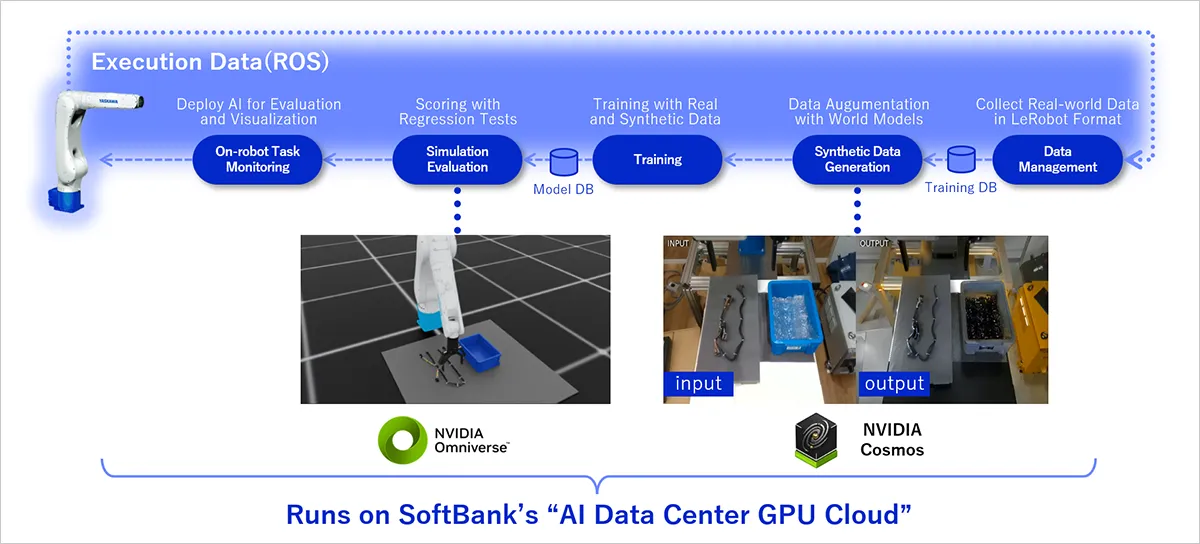
The breakthrough was not just the algorithm — it was the pipeline built to train it. SoftBank's development tool runs entirely on its AI Data Center GPU Cloud, due to launch commercially in October 2026 under the company's Neocloud business, powered by its "Infrinia AI Cloud OS." The workflow moves through three stages: robots first collect motion and sensor data, which NVIDIA Cosmos world models multiply into synthetic training data to cover cases too rare or costly to capture physically; engineers then train and refine AI models on the cloud's GPU clusters while checking behavior in an NVIDIA Omniverse simulation before anything touches a real machine; finally, the validated model deploys to the physical robot. SoftBank says the same collected data, model outputs, and synthetic datasets can be reused across other tasks and robots, rather than starting each new deployment from scratch.
"Companies can efficiently establish a Physical AI development environment and advance the learning cycle on the AI Data Center GPU Cloud," SoftBank said in its announcement, framing the platform as infrastructure any engineering team, not just robotics specialists, can use.
A Bigger Bet Behind One Demo
The wire-harness test lands amid a much larger Japanese push into Physical AI. Japan's AIST, under the Ministry of Economy, Trade and Industry, is coordinating roughly 200 researchers across 14 institutions, including Cambridge, Carnegie Mellon, and Osaka University, with AI pioneer Yoshua Bengio also involved, to build foundation models that let robots perceive and act in real-world settings. More than 30 Japanese companies, among them Honda, Sony, NEC, and Fujitsu, are backing a related SoftBank-linked venture called Noetra, with the government committing roughly 387.3 billion yen, about $2.38 billion, this year alone. Tokyo's stated goal is deploying 10 million robots by 2040 to offset a shrinking workforce, particularly in manufacturing, logistics, and elder care.
For SoftBank and Yaskawa, the wire harness box is a small, deliberately unglamorous proof point. Success at that scale is what will determine whether Physical AI graduates from research showcase to factory-floor reality, and whether Japan's multi-billion-yen bet pays off before its labor shortage deepens further.
Q&A
What is Physical AI, in plain terms? It is technology that lets robots use AI to interpret camera and sensor data, then decide how to move, instead of following pre-programmed, rigid instructions.
Why is handling deformable objects such a hard problem for robots? Items like wires, cloth, and bags change shape and position every time they are touched, so robots cannot rely on fixed assumptions about where and how to grip them.
What role does NVIDIA play in this system? NVIDIA's Omniverse libraries handle simulation testing, Cosmos generates synthetic training data, and its Physical AI Factory Blueprint helps structure the overall development pipeline.
When does SoftBank's AI Data Center GPU Cloud go live commercially? SoftBank plans to launch it in October 2026 as part of its Neocloud business, running on its Infrinia AI Cloud OS.












