
Forterra says 100+ Lancer autonomous ATVs have supported Ukraine’s front lines for nine months
Forterra disclosed that more than 100 Lancer autonomous all-terrain vehicles have supported Ukrainian forces for nine months, completing over 1,100 missions since October 2025. The Polaris-based robots have hauled an estimated 777,440 pounds of supplies, traveled more than 2,500 miles, and conducted 52 casualty evacuations in what the company calls the largest US defense-tech autonomous ground vehicle deployment to face combat.
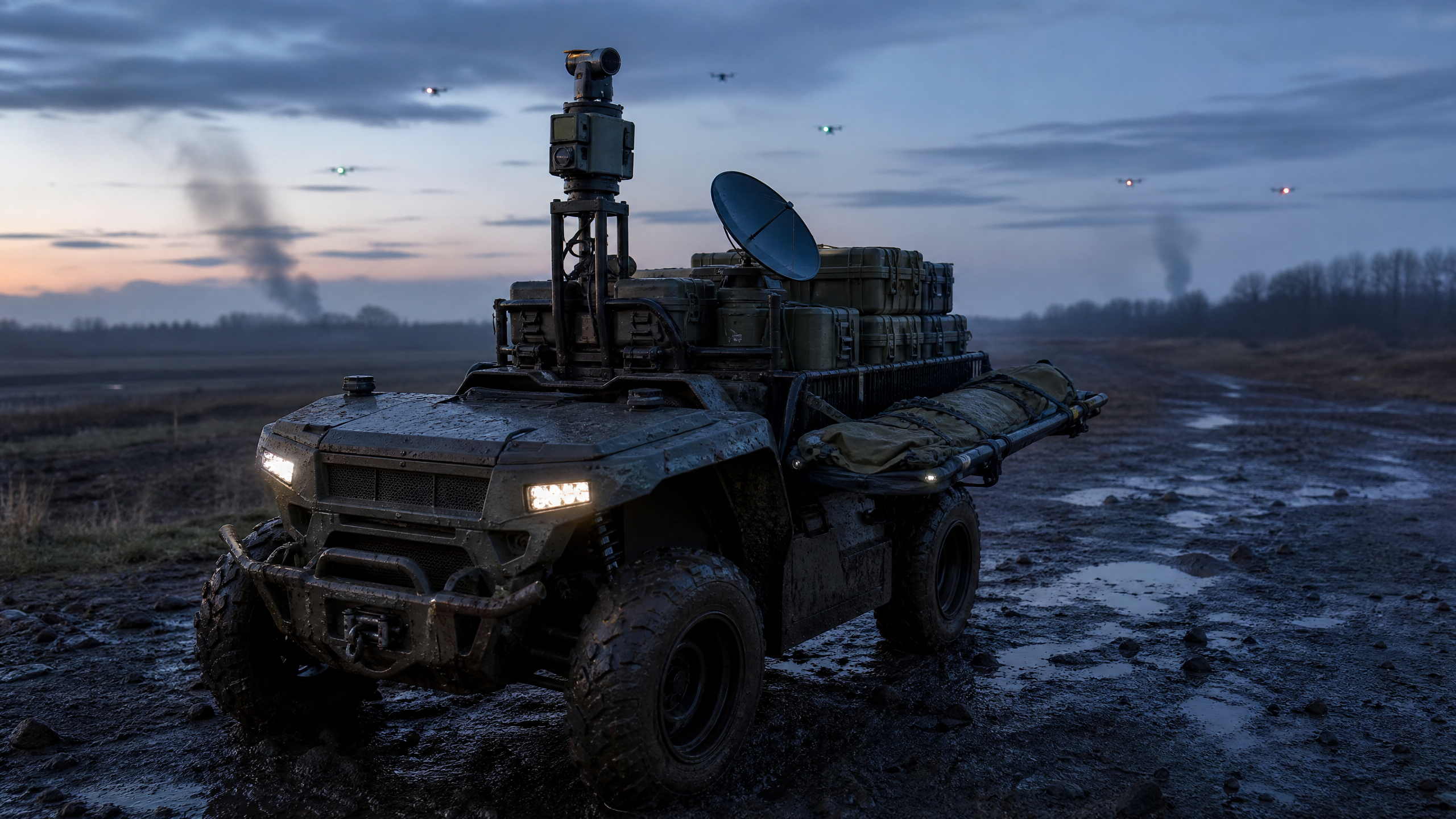
Forterra said on July 7, 2026 that more than one hundred of its Lancer autonomous all-terrain vehicles have been operating with Ukrainian forces for the past nine months, a fielding that began in October 2025. The company reported 1,100 plus missions and more than 2,500 miles of travel, with the vehicles moving an estimated 777,440 pounds of supplies and evacuating 52 casualties. It described the effort as the largest US defense technology autonomous ground vehicle deployment to see combat conditions to date, funded by US defense dollars.
The disclosure gives rare, quantified insight into how unmanned ground logistics are being used at scale in a high-intensity war. It also shows where autonomy still falls short. Forterra executives and US military advisers involved with the program acknowledged that most frontline use has been teleoperated because the machines cannot yet perceive and react to rapidly changing enemy threats with sufficient reliability.
What Forterra revealed, in numbers and timelines
· Deployment size: 100 plus Lancer units, according to Forterra
· Arrival: first vehicles reached Ukraine in October 2025
· Operational window: nine months through early July 2026
· Missions: more than 1,100
· Distance traveled: more than 2,500 miles, about 4,000 kilometers
· Cargo moved: about 777,440 pounds, roughly 352 metric tons
· Medical evacuations: 52 documented casualty movements
Forterra’s Lancer is a Polaris-based, gas powered ATV with a 750 kilogram payload rating, roughly 1,653 pounds. The company integrates a custom sensor and compute suite and adds a Starlink satellite antenna for beyond line-of-sight connectivity when conditions allow. The vehicles are configured for cargo racks, tow kits, stretcher mounts for casualty extraction, and accessory power for radios and sensors.
Scott Sanders, Forterra’s chief growth officer and a former Marine, said the Ukraine missions have focused on moving ammunition, water, batteries, and essential kit along contested routes and across terrain that is often mined, muddy, and exposed to artillery and drones. He emphasized that the point is to take risk off human soldiers where possible. In his account, crews are still in the loop for most missions and maintain positive control when the tactical situation is uncertain or hostile.
Sgt. Maj. Corey Wilkens of the US Army, who advises on unmanned systems integration, described Lancer-style unmanned ground vehicles as a way to lower the human cost of short haul resupply and to create more options for commanders who are trying to sustain units under persistent surveillance and fire. He noted that operators value a system that can survive rough handling, tolerate mud, and keep moving with a heavy load even when the terrain is cut by trenches and shell holes.
A Ukrainian soldier who asked not to be named said the machines have proven durable and useful for night resupply on routes that would be risky for a human driver. He also said more units are needed and they must be cheaper if they are to be used at the levels the front requires. Scott Philips, Forterra’s chief information officer, said the fleet has produced a significant body of operational data that will inform updates to autonomy, reliability, and the human control interface.
The Lancer ATV at a glance
The company’s description paints a picture of an autonomy enabled, remote operated pack mule. The base mobility comes from a commercial Polaris platform, a familiar format for militaries and contractors. From there, Forterra adds the autonomy stack, communications suite, and mission kits. Key elements include:
· Payload: 750 kilograms, with modular cargo rack options and a litter mount for casualty extraction
· Drivetrain: gasoline engine, drawing on widely available fuel and service parts
· Sensors and compute: a custom sensor mast and onboard compute nodes for perception and navigation
· Communications: added Starlink satellite connectivity, with radio integration depending on unit configuration
· Control modes: teleoperation from a tablet or control station, supervised autonomy for route following where safe
The mix reflects a pragmatic approach. The base platform is serviceable with commercial parts. The autonomy is bounded by the reality of a battlefield where adversaries can spoof, jam, or destroy sensors, and where route conditions change minute by minute. The communications suite is eclectic by necessity, with satellite links useful when available and conventional tactical radios used when interference and terrain dictate shorter range control.
Why teleoperation still dominates in combat
Forterra’s account underscores a lesson that has shown up across recent conflicts. Ground autonomy excels in controlled environments and it has improved markedly in unstructured terrain, yet it remains brittle in the presence of an intelligent adversary. Navigation and obstacle avoidance are necessary, but they are not sufficient in areas where a robot must choose between multiple bad options while under threat from artillery, loitering munitions, and snipers.
Company officials said most Lancer missions at the front use teleoperation, with autonomy engaged for segments where risk is lower and terrain is known. The system can follow preset routes, pause for human input when sensors detect ambiguous obstacles, and resume supervised movement. What it cannot reliably do today is interpret hostile intent or respond automatically to an enemy’s deception and sudden threats. That is both a technical limitation and a policy choice, since autonomous lethal action is not part of the Lancer use case and positive human control is seen as essential for safety and accountability.
From a military operator’s perspective, teleoperation is also a way to make the most of an imperfect battlespace network. When satellites are degraded or jammed, operators can shift to short range radio links or position control nodes closer to the vehicle. When conditions improve, the link can extend. In practice, troops blend autonomy and remote control the same way they blend foot movement and vehicle movement, matching the mode to the tactical moment.
A development with national interest on both sides of the Atlantic
For Ukraine, a fielded fleet of over one hundred unmanned ground vehicles gives commanders a tool that does not tire, keeps a predictable pace under heavy load, and does not add to casualty lists when a route goes bad. It turns small resupply tasks into something repeatable and measurable, which matters on a sprawling front where efficiency and attrition both decide outcomes. The documented 52 casualty evacuations add moral and operational weight, since every extraction under fire done by a robot reduces risk for medics and drivers.
For the United States, the deployment is a live validation of a defense innovation pipeline that runs through commercial platforms and venture backed autonomy stacks. Forterra says US defense dollars funded the program. It also says it has raised more than 500 million dollars from investors including XYZ Venture Capital and Moore Strategic Partners, a figure that signals confidence in the category. The result is a pathway from prototyping to combat use that is faster than traditional acquisition, although still dependent on export approvals, training, sustainment, and reliable supply of spares.
The national interest question is not just whether robots work. It is whether they change the way militaries plan logistics and force protection and whether they absorb risk that would otherwise fall on people. The US has an interest in maturing such capabilities with allies who are in contact, then carrying the lessons back into its own doctrine and programs. Ukraine has an interest in turning these deployments into scaled routines that save lives while containing costs.
Strategic consequences for land warfare and supply chains
The strategic consequences unfold on several levels.
First, ground robotics are formalizing a division of labor with soldiers in contested logistics. In the air, small drones already made that shift visible. On the ground, the story has lagged because rough terrain, heavy loads, and adversarial interference are harder for autonomy to manage. A nine month deployment of over a hundred vehicles suggests that the shift is at least practical for last mile resupply, recovery of wounded, and movement of essentials.
Second, communications resilience becomes a central design variable. Forterra added Starlink antennas to Lancer units to enable beyond line of sight control. Satellite connectivity is not a guarantee under fire, which means successful systems will pair satcom with robust radio links, adaptive routing, and human operators who can change tactics when jamming and electronic warfare spike. Nations that control or can deny these links at scale will hold leverage over how quickly ground robotics can spread and how reliably they can be used in combat.
Third, the economics will decide whether this is a niche or a norm. The Ukrainian request for cheaper units is a blunt reminder. If a robot can carry half a ton repeatedly, its value is obvious. If the bill of materials and the sustainment costs limit purchase quantities, that value cannot translate into the persistent presence commanders want. Vendors will face pressure to modularize around commercial parts, to keep repair simple, and to share autonomy stacks that run on commodity compute where possible. Buyers will look for competition, performance guarantees, and contracts that shift some reliability risk back to vendors.
Fourth, the supply chain for fielded ground robots extends far beyond one brand name. A Polaris base, commercial sensors, and a satellite terminal create multiple dependencies that can be disrupted by export controls, sanctions, or manufacturing bottlenecks. Governments will weigh how much of that stack needs to be produced domestically or by trusted partners. That calculation will look different in Europe, North America, and Asia, and it will influence which vendors win programs that move beyond urgent operational needs into multi-year budgets.
Competitive landscape: Forterra and its peers in defense and logistics UGVs
Forterra’s disclosure places it among a short list of companies competing to deliver unmanned ground logistics at scale. Scout AI, Field AI, and Overland AI are all pursuing off-road autonomy and ground logistics, with Scout AI having announced a 100 million dollar raise. Milrem Robotics, based in Europe, is an established supplier whose tracked THeMIS platform has been seen with multiple NATO militaries and in Ukraine.
Below is a snapshot comparison of key players and platforms as they are positioned for defense and logistics use cases. Many program specific details remain undisclosed or vary by buyer, so the table focuses on publicly discussed characteristics and the claims in today’s announcement.
 Signals for policymakers and planners
· Doctrine and training. Units that treat UGVs as routine assets, not experiments, appear to generate the tempo that justifies scale. The mission count in Forterra’s disclosure points to daily employment. That implies dedicated operators, maintenance crews, and standing procedures for route staging, loading, and casualty extraction.
· Communications policy. Allied forces will want to harden satellite links and diversify control pathways. The more unmanned logistics rides on a single commercial constellation, the more adversaries will try to disrupt it. Contracting can push vendors to build for degraded networks by default.
· Industrial base. If the goal is thousands of ground robots in service, governments will need to support qualified suppliers of drivetrains, sensors, compute, and ruggedized enclosures. Export controls should balance the need to protect sensitive autonomy with the strategic value of equipping partners at speed.
· Cost and sustainment. The Ukrainian request for cheaper units should travel straight into design-to-cost targets. Fielded robots that accept commercial parts, simplify training, and reduce time to repair will beat technically elegant but fragile machines.
What to watch next
· Cost curves and new variants. Whether Forterra and peers can deliver a lower cost Lancer-class vehicle without losing payload or ruggedness will determine near-term scale. Watch for simplified sensor stacks and compute that can run on lower power modules.
· Autonomy resilience in adversarial conditions. Expect more attention on perception under electronic warfare, deceptive decoys, dust, smoke, and nighttime conditions. Vendors that can prove supervised autonomy is robust under those conditions will unlock more semi-autonomous routing.
· Communications diversity. New control kits that blend Starlink with emerging satcom options and resilient radios will be a priority. In wartime, no single network remains dominant for long.
· Interoperability with NATO standards. The more these UGVs speak common control and status protocols, the easier it will be to mix fleets on coalition battlefields and to rotate vehicles through different units without retraining.
· Procurement models. Programs that buy service outcomes, for example tonnage moved per month with uptime guarantees, may spread risk and accelerate adoption compared to buying hardware alone.
The bottom line
Forterra’s disclosure gives the strongest quantitative signal yet that unmanned ground logistics has crossed from demonstration to daily use in a major war. The hard numbers matter. More than a hundred vehicles operating for nine months, over a thousand missions, hundreds of tons moved, and dozens of lives evacuated speak to utility, not just novelty. The limits matter too. Teleoperation remains the default in contact, and communications are a constant constraint and target.
For the United States and allies, the strategic value lies in converting today’s field lessons into tomorrow’s doctrine and industrial base. For Ukraine, it lies in making the machines numerous and affordable enough to change the rhythm of resupply and casualty care. On both counts, the next year will test whether vendors can translate combat experience into cheaper, tougher, and more autonomous systems that survive the realities of modern war.
Sources
· TechCrunch exclusive reporting on Forterra’s Lancer deployment in Ukraine












