
AeroVironment Lands First International LOCUST Order
AeroVironment secured its first international purchase order for the LOCUST directed-energy counter-drone system, worth more than US$50 million, six days after a record US$464.8 million US Army production contract for the same laser system.

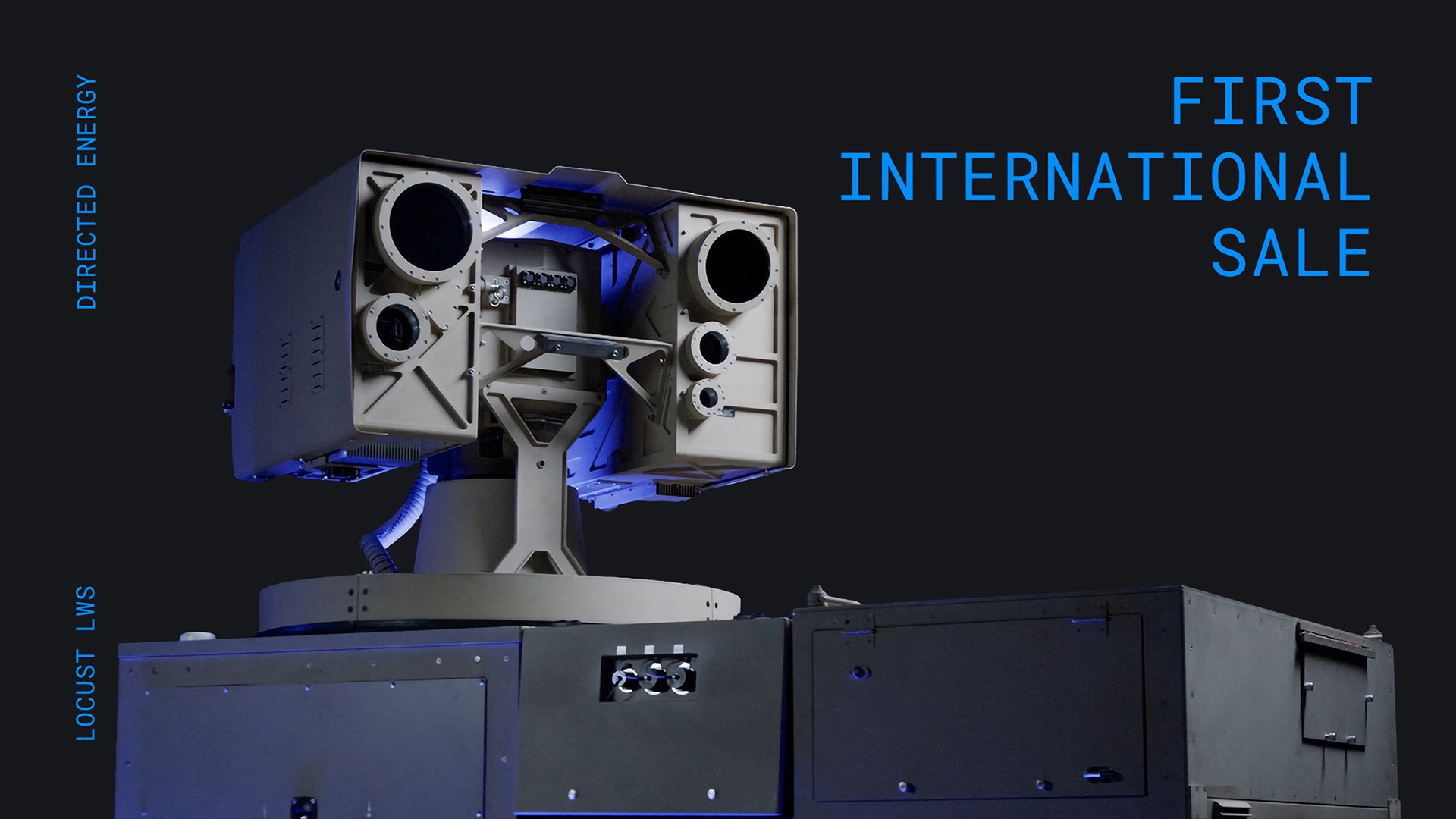
A US Army production contract proves a weapon system works well enough for the Pentagon to buy it at scale. It does not prove a foreign government will spend its own money on the same system once Washington's backing is no longer the deciding factor. AeroVironment closed that gap Tuesday, announcing its first international purchase order for the LOCUST directed-energy counter-drone system, a direct commercial sale worth more than US$50 million that the company describes as the first-ever foreign sale of a mission-proven high-energy laser weapon system. AeroVironment did not name the buyer in its announcement, describing the transaction only as its first international customer for the platform.
The order lands six days after AeroVironment's much larger domestic win: a US$464.8 million US Army contract, announced September 2, covering LOCUST X3 laser systems under the Enduring-High Energy Laser program, which the Army has called the first-ever production contract for a high-energy laser weapon system in American military history. Together, the two announcements mark the moment LOCUST moves from a program the US government funds and tests to one a paying foreign customer has chosen to buy on the open export market, which is a materially different commercial validation than a domestic production award, however large that award is.
Why a Production Contract Is Not an Export Sale
Domestic defense contracts and international arms sales answer different questions for a weapons maker, even when they involve the identical hardware. A US Army production contract confirms that a system met the Pentagon's technical requirements and that Congress appropriated the funds to buy it, a process shaped as much by policy priorities and budget cycles as by a foreign buyer's independent judgment of the system's value. An international direct commercial sale, by contrast, requires a foreign government to clear its own procurement and export-control hurdles, commit its own defense budget rather than benefiting from US taxpayer-funded development, and conclude independently that LOCUST outperforms whatever alternative counter-drone systems it could buy instead, whether from Israeli, European, or domestic suppliers. That a customer went through that entire process and signed a contract worth more than US$50 million before AV had shipped a single unit abroad is a stronger signal of the technology's standalone commercial appeal than the Army's much larger check, because the Army's purchase was never really in doubt once the E-HEL program selected LOCUST, while a foreign government's purchase was optional in a way the Army's was not.
The Counter-Drone Market's Real Growth Driver
Counter-drone demand has shifted decisively over the past three years from a niche military requirement to a mainstream procurement category, driven by the proliferation of cheap, weaponized commercial drones documented extensively in conflicts from Ukraine to the Middle East and the Red Sea shipping lanes. That shift has created urgent demand among militaries and, increasingly, critical-infrastructure operators for systems that can defeat drone swarms at a cost per engagement far below the traditional missile-based approach, where a single interceptor can cost more than the drone it destroys many times over. Directed-energy weapons like LOCUST offer a fundamentally different cost structure: once a laser system is deployed, each engagement costs roughly the price of the electricity consumed, rather than the price of a expendable munition, which is the economic argument that has pulled high-energy laser programs from experimental status into production budgets across multiple governments simultaneously over the past 18 months.
That economic logic is almost certainly what closed this particular sale. A government buying LOCUST is not primarily purchasing a counter-drone capability it lacks entirely, most militaries facing serious drone threats have already fielded some combination of kinetic interceptors, electronic jamming, and gun-based systems, but rather buying a lower marginal cost per engagement against the kind of sustained, high-volume drone attacks that expendable interceptors cannot economically sustain over an extended engagement. Buyers evaluating counter-drone procurement should treat that operating-cost calculus, not the headline unit price, as the more decisive factor in any comparison between directed-energy and traditional interceptor systems, since a laser system's total cost advantage compounds with every drone it engages over its service life.
What LOCUST's Halo_Shield Role Tells Foreign Buyers
LOCUST is not a standalone product in AeroVironment's portfolio; it functions as the directed-energy engagement layer within Halo_Shield, the company's broader modular, layered air-defense architecture that also handles detection, tracking, and surveillance functions ahead of an intercept decision. A foreign government buying LOCUST in isolation, without the surrounding detection and tracking infrastructure Halo_Shield is designed to integrate with, would be purchasing a weapon without the sensor architecture that makes it effective against the fast-moving, low-signature drone threats it is meant to counter. AeroVironment has not disclosed whether this international order includes the broader Halo_Shield sensor suite or LOCUST hardware alone for integration into a buyer's existing air-defense network, and that distinction materially changes both the total contract value implied by the deal and how quickly the buyer can bring the system to operational readiness. A buyer integrating LOCUST into an already-mature layered air-defense network faces a shorter path to deployment than one starting from a standalone laser purchase with no existing detection architecture to plug it into.
AeroVironment's Widening Bet Beyond a Single Program
This international order is the third distinct AeroVironment contract disclosed in the span of a week, following the Army's E-HEL production award and a separate US$51 million Army order for the company's Switchblade 600 loitering munition. Taken together, the run shows a company whose counter-drone and precision-strike portfolio is being validated across multiple product lines and multiple customer types simultaneously, rather than depending on a single program's success. That diversification matters for how investors and defense planners alike should weigh AeroVironment's near-term revenue visibility: a company whose backlog spans laser weapons, loitering munitions, and now a foreign directed-energy sale in the same week is less exposed to the risk that any single program's budget cycle or political headwind derails its growth trajectory than a competitor concentrated in one product category. It also reflects a broader industry pattern in which the same handful of Western defense contractors, having built credible directed-energy and loitering-munition track records domestically, are now positioned to capture the first wave of allied nations' matching investments as drone warfare reshapes procurement priorities across NATO and Gulf state militaries alike.
AeroVironment's recent move to establish a production venture in Greece adds a further layer to that international expansion story: a European manufacturing footprint gives the company a faster, more politically palatable path to fulfill orders from NATO members and nearby partner states than shipping every unit from US production lines, particularly for buyers whose own procurement rules favor a degree of regional industrial participation. Whether this specific LOCUST order will eventually route through that European production capacity, or ship directly from AeroVironment's US facilities, is not disclosed, but the timing of the two initiatives suggests a company deliberately building the infrastructure to convert a single reference sale into a repeatable export business rather than treating this contract as an isolated win.
The Export Precedent Other Governments Are Watching
Whoever the undisclosed customer is, this sale functions as a reference deal for every other government currently evaluating directed-energy counter-drone procurement, in the same way a first commercial airline order for a new aircraft type shapes subsequent orders from other carriers regardless of the launch customer's own reasoning. Defense export sales rarely happen in isolation: allied and partner nations facing similar drone threats routinely track which systems their peers have already committed budget to, both as a technical due-diligence shortcut and as a hedge against being the sole operator of an unproven export system. AeroVironment's ability to point to both a record US Army production contract and a paying foreign customer within the same week gives the company a considerably stronger position heading into the next round of international counter-drone procurement competitions than either announcement would have provided alone, particularly against European and Israeli directed-energy competitors who can point to extensive operational deployment history but, in several cases, less recent large-scale production commitments of their own.
For governments still evaluating counter-drone options, the immediate takeaway is less about LOCUST specifically than about the category: directed-energy weapons have now cleared the threshold from demonstrated technology to twice-purchased production system within the same fiscal quarter, once by the country that funded its development and once by a customer that had no obligation to buy it. The next contract AeroVironment discloses publicly, whether it names a second international customer or reflects an expanded domestic Army order, will show whether that early momentum compounds into a genuine, repeatable export franchise or instead remains a single, well-timed reference sale that other governments continue to cite in briefings without yet actually following it with orders of their own.
Hero image credit: AeroVironment, Inc.
This analysis draws on AeroVironment's own public contract disclosures alongside independent defense-industry trade press coverage. It is for general information purposes only and does not constitute investment, financial, or legal advice.











