NVIDIA Board Reinstates Jensen Huang as CEO, Ending an 11-Day Leadership Gap
NVIDIA's board voted unanimously to reinstate Jensen Huang as president and CEO after an 11-day gap tied to a national security inquiry, while standing up a permanent export-control oversight committee that robotics buyers should watch more closely than the leadership vote itself.

NVIDIA Board Reinstates Jensen Huang as CEO, Ending an 11-Day Leadership Gap
NVIDIA's board of directors voted unanimously on November 23, 2026, to reinstate Jensen Huang as president, chief executive and board director, effective immediately. The vote ends an 11-day stretch in which chief financial officer Colette Kress ran the company as interim CEO, following reports that Huang had become the target of a foreign intelligence effort. The board also disclosed a new compliance structure that will outlast the leadership question it was built to answer.
Harvey C. Jones, NVIDIA's board chair, delivered the reversal in a single sentence that buyers and partners have been waiting eleven days to hear: the board "believes Jensen is the right person to lead NVIDIA." Jones said directors reached that conclusion after a series of meetings and discussions, and that the board was satisfied with Huang's candor and his capacity to keep running the company through an active investigation.
A Reversal Written in One Boardroom Statement
The mechanics of the reinstatement are narrow but unambiguous. Huang returns to all three roles he held before the gap: president, CEO and board director. Kress, who absorbed the chief executive's responsibilities on top of her existing finance mandate, returns to CFO alone. The board thanked her directly for the interim stretch, a signal that NVIDIA wants the market to read this as a clean handoff back rather than a quiet admission that the interim arrangement had become unworkable.
What the board did not do is explain, in its own words, why Huang left the chief executive seat in the first place. The release frames the gap only in terms of what comes next: an independent committee, formed after reports that Huang had been targeted by a foreign intelligence effort, will continue its investigation to a conclusion rather than stopping now that Huang is back in the building. Huang has said he supports that process continuing. For a company whose products sit inside national export-control regimes on three continents, finishing the inquiry matters more to long-term credibility than resolving it quickly.
Eleven days is a short enough gap that NVIDIA avoided the slower, more damaging version of this story: a prolonged succession fight at a company whose market value and robotics roadmap are both tied directly to one founder-operator's credibility with chip customers, cloud partners and Washington simultaneously. A sitting chief executive stepping back over a national security inquiry is not a routine event at any company NVIDIA's size, and the speed of the board's reversal, unanimous rather than contested, is itself a data point. Boards that are genuinely split on a CEO's fitness to continue do not resolve the question in eleven days with a unanimous vote; they commission longer reviews, bring in outside counsel for months, or install a permanent successor. NVIDIA chose none of those paths, which tells buyers more about the board's actual confidence level than the press release's careful language does on its own.
Export Compliance Was Already Tightening Before This
The new National Security and Export Control Committee does not appear out of nowhere. NVIDIA has spent the past two years operating under successive rounds of U.S. export restrictions on its most advanced AI accelerators, including the China-specific licensing fights over cut-down chips designed to stay just inside the rules. Each round pushed compliance decisions that used to sit with product and sales teams further up into the corporate governance structure. Standing up a board committee made entirely of independent directors, with its own mandate over trade compliance and national security risk, is the logical endpoint of that drift: it moves the riskiest allocation calls out of reach of any single executive, Huang included, and into a body that reports to the board rather than to management.
The National Security Committee Nobody Asked For
The detail procurement teams should not skip past is governance, not personnel. NVIDIA is standing up a National Security and Export Control Committee staffed entirely by independent directors, with a mandate covering trade compliance and national security risk specifically. The company is separately recruiting a new chief compliance officer who will report to the Nominating and Corporate Governance Committee rather than into the CEO's office. Both moves insert a permanent layer of board-level oversight between Huang's judgment and decisions that touch export licensing, chip allocation and government relationships.
NVIDIA's board said it consulted senior levels of the U.S. government before reinstating Huang and came away confident the move carries no national security risk. That is a reassurance aimed at Washington as much as at shareholders. It also tells robotics buyers something concrete: NVIDIA expects its compute allocation decisions, especially for customers in jurisdictions already subject to export scrutiny, to run through a documented compliance process from here forward, not through executive discretion alone.
Jetson Thor's Supply Chain Was Never Actually Paused
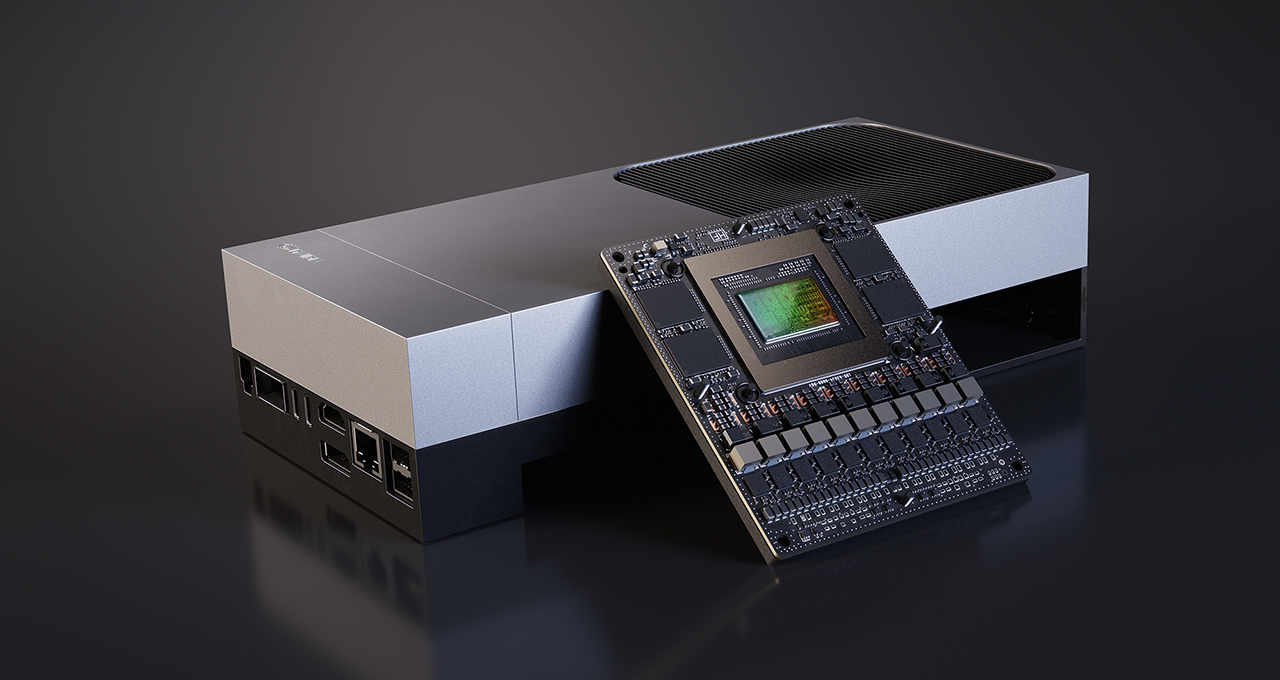
None of this interrupted NVIDIA's robotics roadmap, which is the part of the business procurement and integration teams actually have exposure to. Jetson Thor, the Blackwell-based compute module NVIDIA ships as the reference brain for humanoid and mobile robots, kept moving through its general-availability rollout during the eleven-day gap. Isaac GR00T, the foundation-model stack NVIDIA positions as the software layer that turns Jetson Thor hardware into a trainable robot, had no announced disruption either.
That continuity is the real headline for buyers, more than the leadership drama. Companies building on NVIDIA's physical-AI stack, including Shanghai-based humanoid maker AGIBOT, surgical-robotics developer LEM Surgical, and manipulation-software firm Franka Robotics, have all shipped Jetson Thor or GR00T-based integrations in the months before this governance episode, and none of that engineering depends on who holds NVIDIA's CEO title week to week. Caterpillar's work pairing NVIDIA's platform with autonomous heavy equipment followed the same pattern. The compute roadmap is set by engineering and partner commitments made quarters in advance, not by a single executive's calendar.
Buyers who were already hedging against NVIDIA concentration risk have options, and this episode will likely accelerate interest in them rather than create it from scratch. Qualcomm has pushed its Robotics RB-series compute modules as a lower-cost alternative for mobile and service robots that do not need Jetson Thor's full foundation-model throughput. AMD's embedded accelerators compete at the edge-inference tier. For China-based humanoid makers specifically, where U.S. export licensing already adds friction to any Jetson Thor order, domestic alternatives built around Huawei's Ascend line or homegrown edge-AI silicon from firms like Horizon Robotics have been gaining design wins precisely because they sit outside the committee NVIDIA just created. None of those alternatives match Jetson Thor's software ecosystem today, but the compliance overhead NVIDIA is now formalizing narrows the gap in a way pure performance comparisons do not capture.
What Buyers Should Actually Watch Now
The practical question for a procurement manager evaluating NVIDIA-based robotics hardware is not whether Huang is in the building. It is whether the new National Security and Export Control Committee changes how fast chip allocations clear for international orders, particularly for integrators sourcing components into China, the Gulf or other markets where U.S. export rules already add lead time. A board-level compliance committee with its own independent reporting line is, in practice, a slower and more conservative approval path than one executive's sign-off. Buyers with orders already in NVIDIA's pipeline should expect documentation requests to tighten before they expect delivery dates to move.
The second thing worth tracking is the chief compliance officer search itself. Whoever NVIDIA hires into that role, reporting to the board rather than to Huang, will effectively set the internal rules for which robotics customers get prioritized compute and under what conditions. That hire, not the reinstatement vote, is the appointment that will shape allocation decisions for the next product cycle.
NVIDIA's reinstatement of Jensen Huang removes a leadership question that had sat over every GR00T and Jetson Thor customer conversation for eleven days. It does not remove the national-security question that created the gap in the first place, and the company has now built permanent board machinery to keep answering that question long after this news cycle ends. For robotics buyers, the operational continuity was never in doubt. The compliance apparatus now sitting above it is the part of this story that will still matter at the next chip allocation cycle.
Colette Kress's return to a CFO-only mandate is worth a beat of its own. She ran NVIDIA's finance function and its chief executive's office simultaneously for eleven days without a visible disruption to guidance, supply commitments or partner communications, during one of the more unusual governance episodes a company of NVIDIA's scale has faced in years. That is the kind of operational steadiness procurement teams should actually price into their risk models when they weigh NVIDIA against newer compute suppliers that have never had to prove they can run without their founder: NVIDIA just did, briefly, and nothing in its robotics shipment schedule moved as a result.
This account draws on NVIDIA's own board statement and corporate disclosures surrounding the reinstatement, alongside publicly reported partner activity on NVIDIA's robotics compute platform. This article is for general information purposes only and does not constitute investment, financial, or professional advice.