Kawasaki Launches Certified F Series Safety Controller
Kawasaki's new F Series S-type controller bundles TÜV-assessed safety and IEC 62443 cybersecurity more than a year ahead of EU compliance deadlines, with a field upgrade path for existing robots.


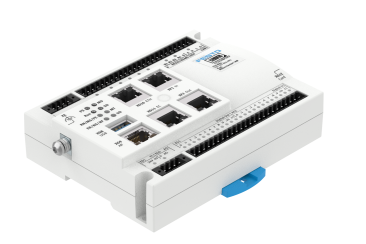
Kawasaki Robotics has launched the F Series Controller S-type, a new industrial robot controller that bundles safety software and cybersecurity features onto the company's existing F Series hardware, timed to arrive more than a year ahead of two overlapping European Union compliance deadlines that will otherwise force machine builders into expensive redesigns. The S-type controller became available this month, running the same hardware and operating environment as Kawasaki's current F Series robots, so existing programming skills and the company's neoROSET offline simulation software carry over without retraining. Existing F Series B-type controllers can be field-upgraded to the S-type without replacing the robot's hardware, which matters more than it sounds for anyone who has already budgeted for a robot cell and does not want to re-budget for a second one.
The timing is the real story here, not the controller itself. The European Union's Machinery Regulation becomes applicable on January 20, 2027, and the core product requirements of the EU Cyber Resilience Act follow on December 11, 2027. Both rules push new compliance burdens onto machine builders and integrators selling into Europe, and Kawasaki is shipping the controller that addresses both more than a year before either deadline bites, rather than scrambling to retrofit a compliant product once the regulation is already in force and customers are asking why their existing robot cells cannot be certified.
What the Controller Actually Does
The S-type ships with CoreCubic-S Lite as its standard safety software, which monitors one robot tool and one workspace out of the box, with more safety capability available as a hardware and software upgrade for cells that need to monitor multiple tools or zones. On the cybersecurity side, the controller adds user authentication, access management, secure communications, and startup integrity checks, the kind of basics that industrial controllers have historically lacked because they were designed for isolated factory networks rather than the increasingly connected plants running today. TÜV SÜD, the German technical inspection body, assessed CoreCubic-S Lite against ISO 10218-1:2025, the current industrial robot safety standard, and Kawasaki's own secure product development process carries IEC 62443-4-1:2018 certification, the standard that governs how a vendor builds security into a product's development lifecycle rather than bolting it on afterward.
Kawasaki also says the S-type's optional energy recovery feature can cut a robot's energy consumption by up to 30 percent, depending on the application, a figure that will matter differently to different buyers: a high-cycle automotive welding cell running three shifts has a much larger energy bill to shrink than a low-utilization pick-and-place station, so that 30 percent ceiling is a best case, not an average result anyone should plug directly into a payback calculation without first checking how it holds up against their specific duty cycle.
The Compliance Trap This Is Built to Avoid
Shuhei Kuraoka, president of Kawasaki Robotics EMEA, described the logic in terms that read as understated given what is actually at stake: regulatory requirements are evolving, he said, but customers need solutions that deliver value well beyond simple compliance. The understatement matters because the alternative to planning ahead of a regulatory deadline is almost always worse than the deadline itself. Machine builders who wait until the Machinery Regulation is actually in force to start the certification process for a robot cell typically discover that the certification body's queue is backed up with everyone else who waited too, that the documentation burden is larger than expected, and that a cell already sold to a customer under the old rules may need retrofitting to stay sellable under the new ones. Kawasaki shipping a pre-certified controller more than a year before the deadline gives its integrator customers a full product cycle to design, certify, and sell machines around it before the regulation actually bites, rather than a scramble in the final quarter of 2026 and first quarter of 2027.
That said, Kawasaki's own announcement carries an important qualifier that buyers should not skip past: the company states plainly that responsibility for full machine conformity still rests with the manufacturer or integrator, not with Kawasaki. A TÜV SÜD-assessed safety module and an IEC 62443-certified development process are necessary components of a compliant machine, not a substitute for the integrator's own conformity assessment of the complete cell, including whatever end-effector, fencing, and application-specific safety measures sit around the robot itself. An integrator who treats "built on a certified controller" as equivalent to "my machine is certified" is making an expensive assumption that a notified body will not accept at face value.
Why the Upgrade Path Matters More Than the New Features
The ability to upgrade an existing F Series B-type controller to the S-type without swapping hardware is, commercially, more significant than any individual safety or cybersecurity feature on the spec sheet, because it changes who Kawasaki's actual customer base is for this product. A brand-new controller aimed only at new robot sales would compete for the relatively small number of cells a plant is adding this year. A field-upgradeable controller competes instead for the much larger installed base of F Series robots already running on factory floors across Europe, every one of which will eventually need some path to compliance with the incoming Machinery Regulation if its operator wants to keep running it, modify it, or resell it after January 2027. Kawasaki has effectively turned a regulatory deadline that could have been a threat to its installed base, customers switching to a competitor's compliant hardware rather than paying for an upgrade, into a retention mechanism, giving existing F Series customers a reason to stay on Kawasaki hardware rather than shop around once the deadline forces a decision.
What This Means Outside Europe
Buyers outside the European Union should not assume this announcement is irrelevant to them simply because the Machinery Regulation and Cyber Resilience Act are EU rules. Industrial cybersecurity standards adopted in Europe have a consistent history of becoming de facto global baselines within a few years, as multinational manufacturers standardize their robot cell specifications across every plant they operate rather than maintaining separate compliance tiers for European and non-European facilities. A US or Asian manufacturer buying Kawasaki F Series robots today for a plant with no current EU exposure should still weigh whether the S-type's certified safety and cybersecurity baseline becomes the specification its own global procurement team adopts as standard within the next product cycle, in which case paying for the upgrade now is cheaper than retrofitting a fleet of B-type controllers later once that internal standard changes.
The Bar This Sets for Competitors
Kawasaki's move also raises the floor for every other industrial robot controller vendor selling into Europe. Once one major supplier ships a TÜV-assessed, IEC 62443-certified controller with a field upgrade path more than a year ahead of the compliance deadline, a competitor shipping a controller without equivalent certification is asking its own integrator customers to either accept uncertified risk or wait for a compliant version while Kawasaki's customers are already selling certified machines. That pressure will likely force the rest of the industrial controller market to accelerate its own certification timelines over the next twelve months, which is good news for integrators generally, since it means more certified options rather than a single-vendor bottleneck, but it also means buyers evaluating controllers today should ask every vendor, not just Kawasaki, exactly which certifications their current and upcoming controllers actually carry, rather than assuming the whole category is keeping pace with the same regulatory calendar.
Reading the Fine Print on "Up to 30 Percent"
The energy recovery figure deserves one more layer of scrutiny before it ends up in anyone's capital-expenditure justification. Energy recovery on an industrial robot typically works by capturing and reusing the braking energy generated when a heavy arm decelerates, which means the savings scale with how often the robot is stopping and starting a significant mass, not with how long it runs. A robot performing continuous, smooth motion, like a dispensing or inspection task, will see far less benefit than one doing repetitive pick-and-place work with frequent full stops, because there is simply less braking energy to recover in the first place. Kawasaki's own framing, that the 30 percent figure depends on the application, is the honest version of this; the version that will actually circulate in sales conversations and trade coverage over the next few months is the headline number without the caveat, and a buyer who commits to a purchase order based on the headline rather than a duty-cycle-specific estimate from Kawasaki's own applications engineers is likely to end up disappointed at the first utility bill.
This is also where the harder commercial truth about the whole announcement sits. A compliance-driven controller upgrade is, by its nature, a defensive purchase rather than an exciting one: nobody buys a safety and cybersecurity upgrade because it makes their robot faster or their product better, they buy it because the alternative, non-compliance, eventually becomes illegal or uninsurable in their target market. That is a real and sufficient reason to buy, but it is a different sales pitch than the energy-savings and productivity language Kawasaki is leading with, and buyers should separate the two when deciding how urgently to act: the compliance clock is fixed and approaching, the energy savings are speculative and application-dependent, and conflating the two risks either over-paying for a feature that will not deliver as advertised or under-prioritizing a deadline that genuinely cannot be negotiated once it arrives.
This analysis synthesizes company statements and public market activity surrounding the launch.
This article is for general information purposes only and does not constitute investment, financial, legal, or professional advice. Readers should conduct their own due diligence before making business or purchasing decisions based on the information presented.