Kawasaki's CP110L Palletizer Makes Its North American Debut
Kawasaki Robotics will bring its CP110L palletizer, already selling in Japan and Europe, to North America at PACK EXPO International, targeting older, low-ceiling facilities that disqualify larger palletizing robots before cost ever enters the comparison.

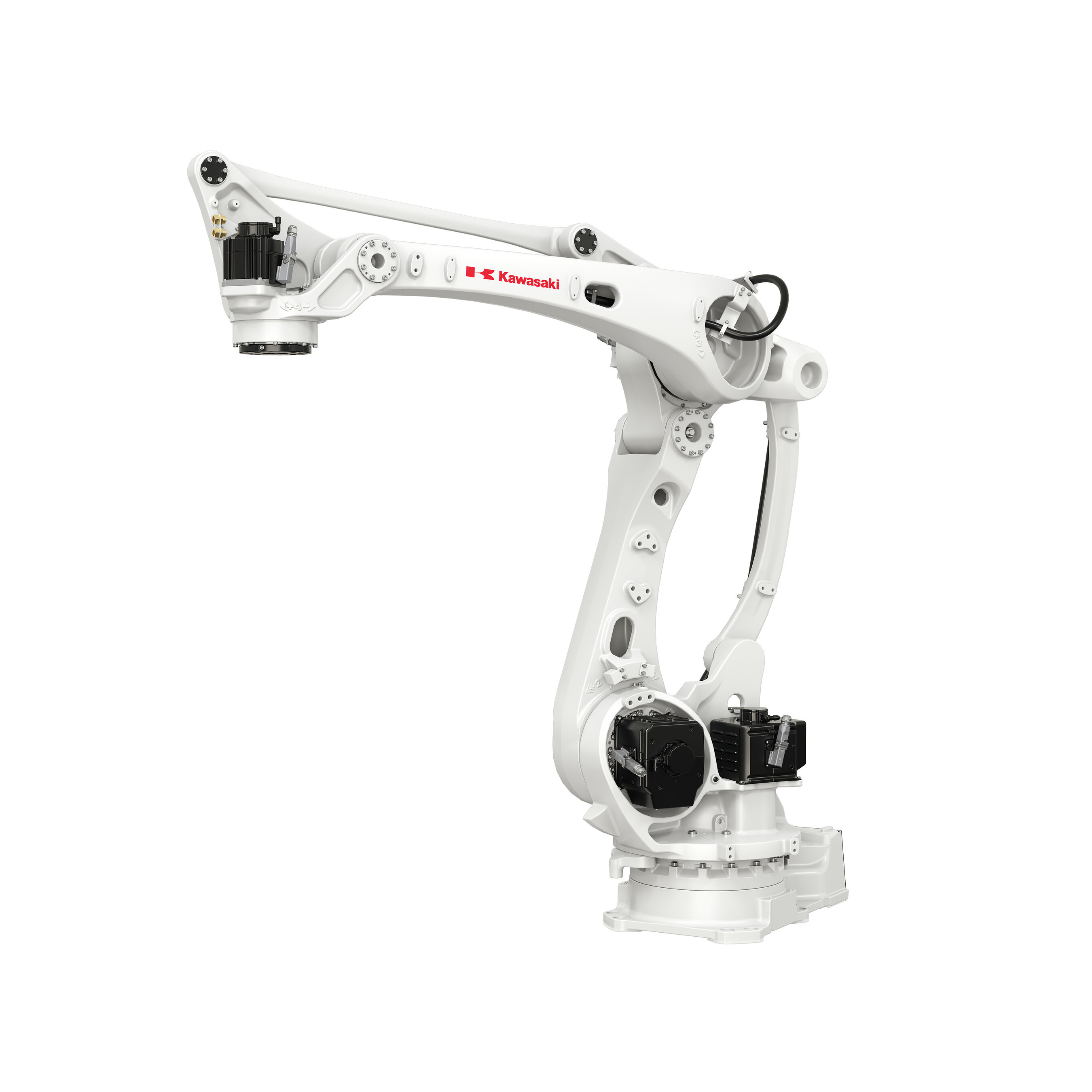
Kawasaki Robotics (USA), Inc., a subsidiary of Kawasaki Heavy Industries based in Wixom, Michigan, announced on October 8, 2026, that its CP110L high-speed palletizing robot will make its North American debut at PACK EXPO International 2026, the packaging-industry trade show running October 18 through 21 at McCormick Place in Chicago. The company will show the 110-kilogram-payload machine at Booth N-5933, several months after introducing the same platform in Japan and giving it a European premiere at Interpack in Dusseldorf in May.
Nothing about the robot itself is new. What changed on October 8 is market access: North American packaging operators, consumer packaged goods manufacturers, and the systems integrators who build cells for them now have a confirmed date and booth number for a machine Kawasaki has already been selling and servicing elsewhere for most of 2026. That sequencing matters more than the show-floor theatrics, because it tells a buyer how long the CP110L has actually been in commercial use, rather than how new it looks under trade-show lighting.
The Ceiling-Height Arithmetic That Actually Sells This Robot
Kawasaki's own spec sheet frames the CP110L around two numbers most palletizer marketing ignores: a required ceiling clearance of just 2,242 millimeters and a revolute-axis interference radius of 453 millimeters, alongside a maximum reach of 2,505 millimeters and a quoted throughput of up to 2,200 cases per hour under specified operating conditions. The robot carries four controlled axes, repeatability of plus or minus 0.05 millimeters, and a mass of 820 kilograms, with a hollow wrist that routes cables and hoses internally and a standard power-regeneration function that recovers energy during the robot's frequent vertical deceleration cycles.
None of those figures is remarkable on its own among industrial palletizers. What is notable is that Kawasaki built the product brief around a building survey rather than a speed sheet. A packaging plant or third-party logistics facility built decades ago, with low clear heights and tight column spacing, routinely disqualifies the largest palletizing robots before procurement ever compares cycle times, simply because the ceiling will not clear the arm's vertical swing. The CP110L is positioned to pass that first filter, extending Kawasaki's CP Series lineup, previously spanning 180 to 700 kilograms of payload, down to 110 kilograms specifically to compete for sites that a bigger, faster robot would never reach.
Why a Dog-Food Demo Is the Real Pitch, Not the Spec Sheet
The booth demonstration Kawasaki is using to introduce the robot is deliberately mundane: a single custom end-of-arm tool from material-handling specialist Piab palletizing both boxed dog food and bagged cat food, back to back, without a tooling change or a footprint change. That choice says more about the buyer Kawasaki is courting than the raw case-per-hour figure does. Pet food, like much of grocery and consumer packaged goods, increasingly ships in mixed formats on the same line as private-label SKU counts climb and e-commerce fulfillment fragments order sizes, and the operational cost that erodes a plant's margin is rarely top-line speed. It is changeover time, the minutes a line sits idle while a technician swaps grippers or reprograms a cell for the next format.
A robot that handles a box and a bag with the same end-of-arm tool removes a manual intervention that would otherwise fall to a line operator, which is where the labor argument for this class of automation actually lives. Packaging and logistics operators have spent much of 2026 citing warehouse and production-line staffing as a binding constraint well before capital cost, and palletizing automation has become one of the clearest illustrations of the task displacement pattern already visible in logistics, where the job being automated is not the whole role but the single repetitive motion inside it. Kawasaki is selling the CP110L against that motion specifically, not against a competitor's robot.
A Lineup Move, Not a Standalone Launch
The two dates in play here deserve to be kept straight, because trade-show coverage routinely blurs them. Kawasaki launched the CP110L commercially earlier in 2026 and gave it a European show debut at Interpack in May. The October 8 announcement and the October 18 to 21 appearance at PACK EXPO International do not introduce a new robot; they introduce an existing robot to a new regional sales channel, backed by Kawasaki's established North American distributor and systems-integrator network rather than a freshly built one. That is a meaningfully lower-risk claim than a ground-up launch, and buyers evaluating lead times and support should read it that way: the CP110L arrives in the United States and Canada with a service history elsewhere, not as an unproven first-run product.
Kawasaki is pairing the CP110L debut with two other end-of-line demonstrations at the same booth, an R Series case-packing cell built around its RS013N robot and integrated by Design For Making, and an IRIS RPZ-U palletizing system pairing its RS025N robot with IRIS Factory Automation's modular platform. The RS013N carries a 13-kilogram payload and 1,460-millimeter reach; the RS025N offers 25 kilograms and 1,885 millimeters of reach. Read together, the three demonstrations describe a deliberate payload ladder, from light case-packing through mid-weight palletizing to the CP110L's heavier, space-constrained end-of-line role, rather than a single product pitch. Kawasaki is effectively asking integrators to build a system around whichever rung of that ladder matches a specific facility, instead of forcing every customer toward one robot.
What the PMMI Number Is Actually Doing in This Release
Kawasaki's release leans on one external data point: PMMI, the Association for Packaging and Processing Technologies, reported in its 2026 Robotics in Packaging & Processing study that 61 percent of surveyed end users expect to increase their robotics investment over the next 12 months. That figure is doing a specific job in the announcement. It is evidence that demand for packaging-line automation has not stalled even as broader industrial capital spending has turned more selective through 2026, and it gives Kawasaki's North American sales team a market-level argument to pair with a facility-level one when a plant manager asks whether now is the right time to commit budget to a new palletizing cell.
That is a useful number for a sales conversation, and it is also a reminder that a trade-show specification sheet and an operating production line are not the same evidence. The gap between demo performance and deployment reality is where most palletizing projects actually succeed or stall, since a booth demonstration runs a controlled cycle with ideal box weights and perfect timing, while a live distribution center runs variable case weights, inconsistent pallet loading, and maintenance windows the showroom never has to account for. The 2,200-cases-per-hour figure Kawasaki quotes is explicitly qualified as holding "under specified operating conditions," language that procurement teams should treat as an instruction to request the underlying test parameters, not as a guaranteed line rate for their own facility.
What a Buyer Should Confirm Before Booth N-5933
For a procurement or automation team actually evaluating the CP110L this month, three questions matter more than anything Kawasaki will say from the stage. First, does the 2,242-millimeter ceiling figure and 453-millimeter interference radius actually clear the specific building in question, including conveyor infeed, safety fencing, and any overhead utilities a generic spec sheet cannot account for; that is a site-survey question, not a brochure question. Second, what do delivery lead time and local parts and service support look like through Kawasaki's existing North American distributor network, given that the robot's commercial history to date has been built primarily on Japanese and European installations. Third, whether the quoted throughput holds at the buyer's actual case weight, dimensions, and pallet pattern, since palletizing cycle times are notoriously sensitive to all three and a single headline figure rarely survives contact with a real product mix.
None of that diminishes what Kawasaki has built. A palletizer engineered specifically around the building constraints that eliminate larger competitors before a cost comparison even starts is a genuinely useful addition to a crowded mid-tier automation market, and the CP110L's position below Kawasaki's own 180-kilogram CP180L gives the company a lower rung on its own ladder that it did not previously have in North America.
The Test That Actually Matters Comes After the Show Floor
PACK EXPO International will generate plenty of booth traffic for Kawasaki between October 18 and 21, but the number worth tracking is not anything that happens at McCormick Place. It is whether Kawasaki's North American distributor network can convert the PMMI-backed demand signal into installed CP110L units inside the kind of older, low-clearance facilities the robot was built to serve, and whether competing palletizer vendors respond with their own compact, low-ceiling entries rather than conceding that segment. The show floor will tell buyers what the robot can do in ideal conditions; the next several quarters of installed base will tell them what it actually does on someone else's production line.
This analysis synthesizes company statements and public market data as of the stated information cutoff.
This article is provided for general information purposes only and does not constitute investment, procurement, legal, or engineering advice. Figures reflect the sources listed above as of the stated information cut-off and may change without notice.