DESCRIPTION
Genisom L1W EDU est un Research-Robots de Genisom AI (智身科技). Il est conçu pour Education, SLAM and 3D reconstruction research, autonomous navigation development. Chiffres clés : 22 kg, 90 min d'autonomie, 5 kg de charge utile, 12 degrés de liberté.
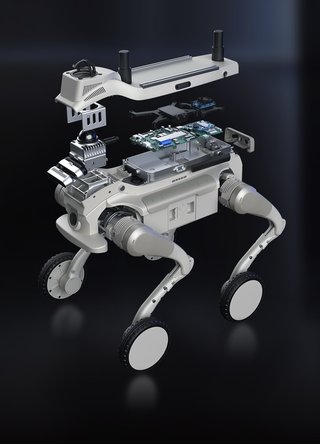
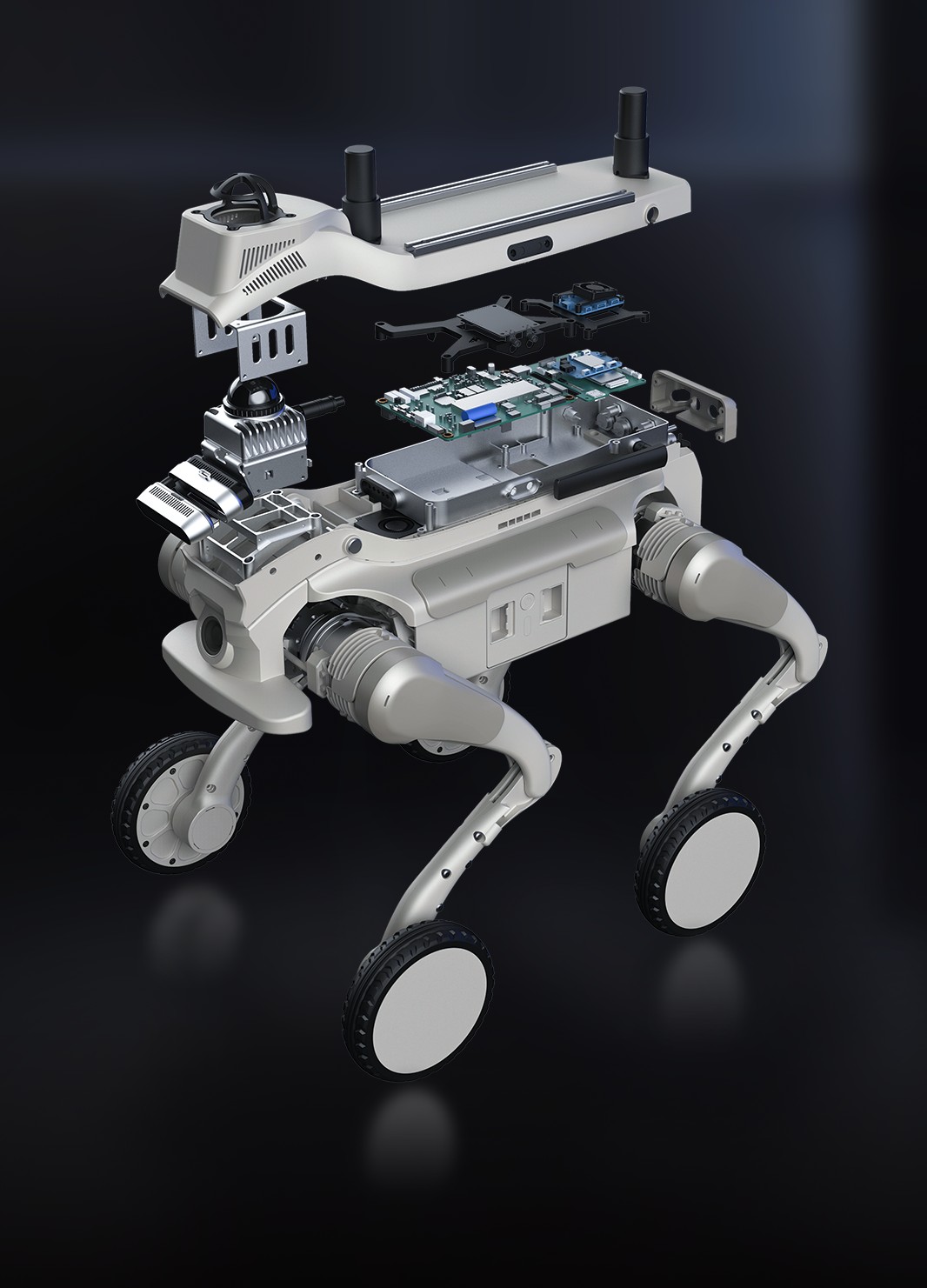
The Genisom L1W EDU is the research and education configuration of the company's wheel-legged L1-W quadruped, shipped with the full autonomy sensor stack pre-integrated: an NVIDIA Jetson Orin NX 16GB module delivering 100 TOPS, a Livox Mid-360 LiDAR, an Intel RealSense depth camera, a GNSS positioning module with RTK antenna and a 5G communication module. That triple-sensing fusion of visible light, depth vision and 3D point clouds targets full-scenario SLAM and 3D reconstruction work, indoors and out. The 22 kg platform carries 5 kg, runs 12 degrees of freedom with 48 Nm peak joint torque, tops 3.7 m/s, ranges 4.5 km per charge and climbs 30° slopes behind IP54 protection. An aviation-grade expansion port exposes dual gigabit Ethernet, SBUS+RS485, two USB 3.0 Type-C channels, 24 V DC output and a SIM slot, and the ROAMER X Lite software stack is published on GitHub for secondary development.
FONCTIONNALITÉS
- Pre-integrated research stack: Jetson Orin NX 16GB (100 TOPS), Livox Mid-360 LiDAR, Intel RealSense depth camera, GNSS + RTK antenna, 5G module
- aviation-grade expansion port (2x gigabit Ethernet, SBUS+RS485, 2x USB 3.0 Type-C, 24 V DC out, SIM slot)
- IP54 all-weather body
- open-source ROAMER X Lite packages on GitHub for secondary development.
CARACTÉRISTIQUES TECHNIQUES
| Physique | |
| Poids | 22 kg |
|---|---|
| Dimensions | L 630 mm × W 360 mm × H 565 mm |
| Charge utile | 5 kg |
| Mobilité | |
| Type de déplacement | Quadruped, Wheeled |
| Degrés de liberté | 12 |
| Vitesse | 13.32 km/h |
| Environnement | Indoor and outdoor; 30° standard climbing angle; 4.5 km max range, IP54 |
| Alimentation | |
| Autonomie de la batterie | 0.5-1.5 h |
| Perception et calcul | |
| Capteurs | Livox Mid-360 LiDAR, Intel RealSense depth camera, GNSS positioning module with RTK antenna |
| Connectivité | 5G module, GNSS + RTK, 2x gigabit Ethernet, SBUS+RS485, 2x USB 3.0 Type-C, SIM slot |
| Logiciel / IA | ROAMER X Lite open packages (github.com/zsibot/zsibot_roamerx_lite); secondary development supported |
FORUMS DU ROBOT
Chargement des forums...
CARACTÉRISTIQUES TECHNIQUES
| Physique | |
| Poids | 22 kg |
|---|---|
| Dimensions | L 630 mm × W 360 mm × H 565 mm |
| Charge utile | 5 kg |
| Mobilité | |
| Type de déplacement | Quadruped, Wheeled |
| Degrés de liberté | 12 |
| Vitesse | 13.32 km/h |
| Environnement | Indoor and outdoor; 30° standard climbing angle; 4.5 km max range, IP54 |
| Alimentation | |
| Autonomie de la batterie | 0.5-1.5 h |
| Perception et calcul | |
| Capteurs | Livox Mid-360 LiDAR, Intel RealSense depth camera, GNSS positioning module with RTK antenna |
| Connectivité | 5G module, GNSS + RTK, 2x gigabit Ethernet, SBUS+RS485, 2x USB 3.0 Type-C, SIM slot |
| Logiciel / IA | ROAMER X Lite open packages (github.com/zsibot/zsibot_roamerx_lite); secondary development supported |
Images
 martti

Contributions d'images
Vidéos
FORUMS DU ROBOT
Chargement des forums...
NOTES
QUESTIONS FRÉQUENTES
What is the Genisom L1W EDU?
The Genisom L1W EDU is the research and education configuration of the company's wheel-legged L1-W quadruped, shipped with the full autonomy sensor stack pre-integrated: an NVIDIA Jetson Orin NX 16GB module delivering 100 TOPS, a Livox Mid-360 LiDAR, an Intel RealSense depth camera, a GNSS positioning module with RTK a…
Who makes the Genisom L1W EDU?
The Genisom L1W EDU is made by Genisom AI (智身科技), a robotics company based in China.
How much does the Genisom L1W EDU cost?
Genisom AI (智身科技) has not publicly announced pricing for the Genisom L1W EDU. You can enquire through RobotAIGeek for current pricing.
What is the Genisom L1W EDU used for?
The Genisom L1W EDU is designed for education, slam and 3d reconstruction research, autonomous navigation development, and robotics education. It is used in research and education settings.
What is the payload capacity of the Genisom L1W EDU?
The Genisom L1W EDU has a payload capacity of 5 kg.
How much does the Genisom L1W EDU weigh?
The Genisom L1W EDU weighs 22 kg.
How fast is the Genisom L1W EDU?
The Genisom L1W EDU can move at speeds of up to 13.32 km/h.
What is the battery life of the Genisom L1W EDU?
The Genisom L1W EDU runs for 0.5-1.5 h on a charge.
COMPARER AVEC DES ROBOTS SIMILAIRES
Voyez comment ce robot se positionne face à ses alternatives les plus proches
- Genisom L1W EDU vs MagicDog
- Genisom L1W EDU vs MagicDog-W
- Genisom L1W EDU vs AGIBOT D1 Ultra
- Genisom L1W EDU vs DHAV
- Genisom L1W EDU vs SVAN M2