



BESCHREIBUNG
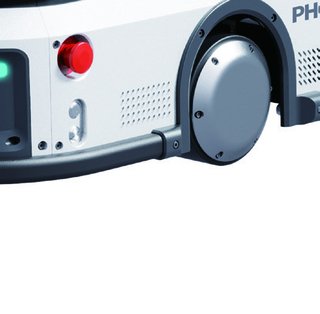
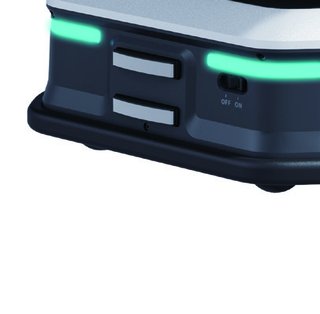
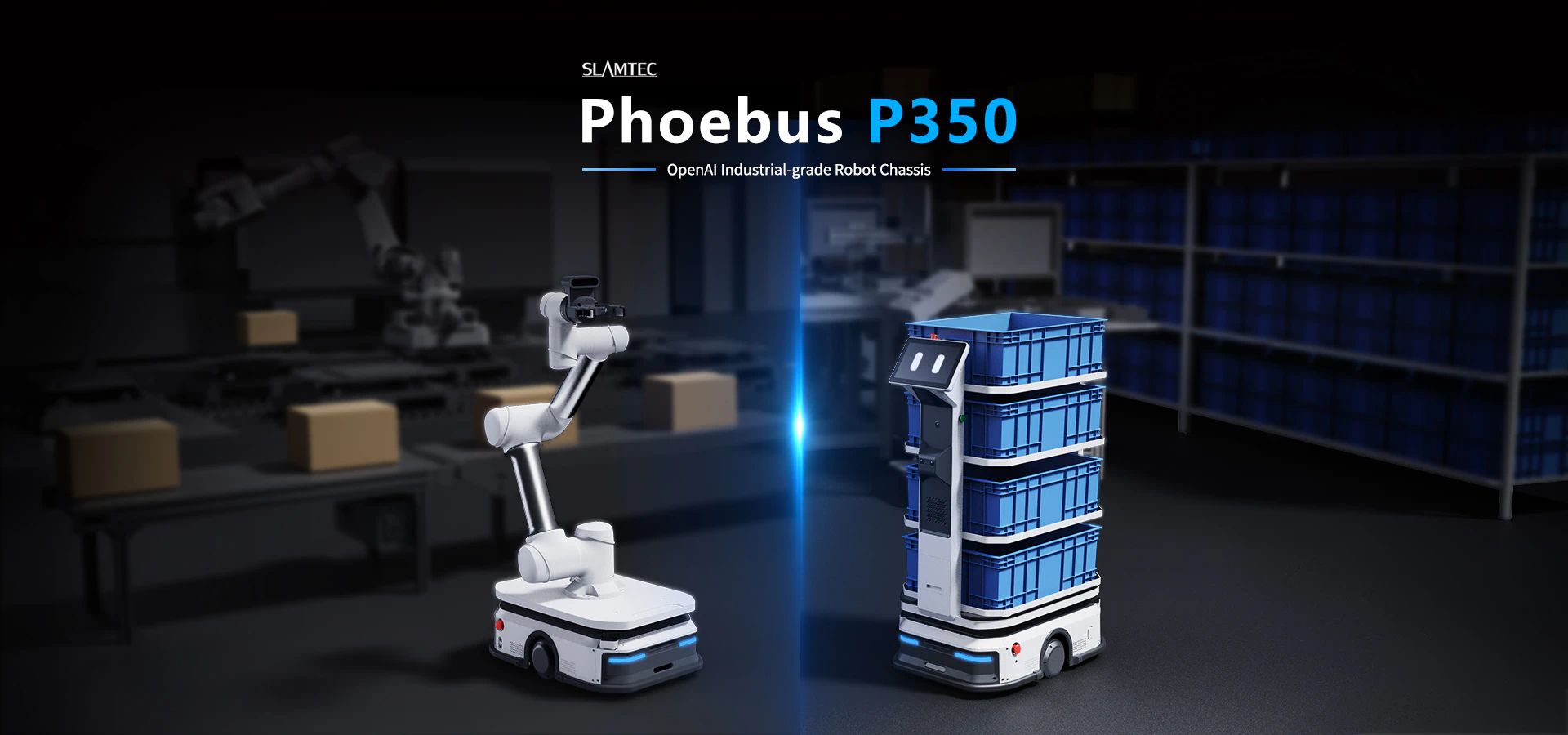
Phoebus P350 is Slamtec's industrial chassis, aimed at small and medium factories that want material moving between stations without committing to a full AGV installation. The point Slamtec keeps making about it is deployment: it navigates by laser and vision together, so there are no magnets to sink into the floor, no reflectors to mount and no QR codes to stick down, and mapping is done by pushing the robot around the site by hand. A 60 cm corridor is enough for it to pass without shelving. It carries up to 300 kg on a 780 x 506 x 270 mm footprint and comes in two builds: the P4M11, which adds a 60 mm lifting deck that raises in four seconds for moving shelves and bins, and the lighter P4M21 without it. Accuracy is quoted as better than 40 mm and 2 degrees navigating to a point, tightening to 10 mm and 1 degree at the final position. Perception is two diagonally placed RPLIDAR S3E scanners covering 40 m, a depth camera, a dedicated low-obstacle and cliff LiDAR and two industrial touch edges, which is what gets it to the 360-degree coverage industrial safety standards expect. It runs 12 hours unloaded or about 4.5 in typical duty, fast-charges from 30 to 80 percent in two hours, and talks over 4G, Wi-Fi, LoRa or Bluetooth, including to lifts and turnstiles.
FUNKTIONEN
- Maximum load 300 kg
- Body dimensions 780 x 506 x 270 mm
- P4M11 configuration: self-weight up to 105 kg, 60 mm lifting deck, 4 s minimum lift time
- P4M21 configuration: self-weight up to 90 kg, no lifting deck
- Maximum speed at full load 1.2 m/s
- Navigation-to-point accuracy better than +/-40 mm and 2 degrees
- End positioning accuracy better than +/-10 mm and 1 degree
- Passes a 60 cm corridor without shelving
- Obstacle crossing 20 mm vertical, 40 mm horizontal
- Two RPLIDAR S3E scanners, 0-40 m range at 90% reflectivity, +/-3 cm accuracy, diagonally placed
- One depth camera (a second optional), FOV H75 x V51 degrees, 0.3-3.5 m
- Optional front RGB camera and VSLAM module
- One low-height and cliff detection LiDAR
- two industrial touch edges
- Dual-wheel differential drive
- Laser SLAM navigation with optional visual SLAM
- Map resolution 5 cm default, configurable to 1.5 cm
- Maximum mapping area 500 x 500 m at 5 cm, 300 x 300 m at 1.5 cm
- 24 V 30 Ah lithium iron phosphate battery, 80% capacity retained after 2000 cycles
- Operating time 12 hours no-load, about 4.5 hours typical
- Fast charging 30 to 80 percent in 2 hours
- manual or automatic charging
- 4G, Wi-Fi, LoRa and Bluetooth communication
- IoT connectivity to lifts, turnstiles and callers
- Standard, lifting and bin expansion modes
- traction mode announced
- CE and FCC certified
TECHNISCHE DATEN
Verifiziert| Physisch | |
| Gewicht | 105 kg |
|---|---|
| Abmessungen | L 780 mm × W 506 mm × H 270 mm |
| Traglast | 300 kg |
| Mobilität | |
| Bewegungsart | Radbasiert |
| Geschwindigkeit | 4.32 km/h |
| Einsatzumgebung | Small and medium factory floors, production lines and warehouses |
| Aktoren | Dual-wheel differential drive with an optional 60 mm lifting deck on the P4M11 build |
| Energie | |
| Akkulaufzeit | 12 hours no-load; about 4.5 hours typical |
| Ladezeit | 2 hours from 30 to 80 percent |
| Sensorik & Rechenleistung | |
| Sensoren | RPLIDAR S3E LiDAR x2, depth camera, low-height and cliff detection LiDAR, industrial touch edge x2, optional front RGB camera, optional VSLAM module |
| Software / KI | Laser SLAM navigation with a deep-learning navigation system, optional visual SLAM, built-in push-to-map tool and a full API for business-logic development |
TECHNISCHE DATEN
Verifiziert| Physisch | |
| Gewicht | 105 kg |
|---|---|
| Abmessungen | L 780 mm × W 506 mm × H 270 mm |
| Traglast | 300 kg |
| Mobilität | |
| Bewegungsart | Radbasiert |
| Geschwindigkeit | 4.32 km/h |
| Einsatzumgebung | Small and medium factory floors, production lines and warehouses |
| Aktoren | Dual-wheel differential drive with an optional 60 mm lifting deck on the P4M11 build |
| Energie | |
| Akkulaufzeit | 12 hours no-load; about 4.5 hours typical |
| Ladezeit | 2 hours from 30 to 80 percent |
| Sensorik & Rechenleistung | |
| Sensoren | RPLIDAR S3E LiDAR x2, depth camera, low-height and cliff detection LiDAR, industrial touch edge x2, optional front RGB camera, optional VSLAM module |
| Software / KI | Laser SLAM navigation with a deep-learning navigation system, optional visual SLAM, built-in push-to-map tool and a full API for business-logic development |
Bilder
 martti
 martti
 martti
 martti
Bildbeiträge
Videos
ROBOTER-FOREN
Foren werden geladen...
BEWERTUNGEN
HÄUFIG GESTELLTE FRAGEN
What is the Slamtec Phoebus P350?
Phoebus P350 is Slamtec's industrial chassis, aimed at small and medium factories that want material moving between stations without committing to a full AGV installation.
Who makes the Slamtec Phoebus P350?
The Slamtec Phoebus P350 is made by Slamtec, a robotics company based in China.
How much does the Slamtec Phoebus P350 cost?
Slamtec has not publicly announced pricing for the Slamtec Phoebus P350. You can enquire through RobotAIGeek for current pricing.
What is the Slamtec Phoebus P350 used for?
The Slamtec Phoebus P350 is designed for intralogistik, materialhandhabung, lieferung, and transport. It is used in lager & logistik and fertigung settings.
What is the payload capacity of the Slamtec Phoebus P350?
The Slamtec Phoebus P350 has a payload capacity of 300 kg.
How much does the Slamtec Phoebus P350 weigh?
The Slamtec Phoebus P350 weighs 105 kg.
How fast is the Slamtec Phoebus P350?
The Slamtec Phoebus P350 can move at speeds of up to 4.32 km/h.
What is the battery life of the Slamtec Phoebus P350?
The Slamtec Phoebus P350 runs for 12 hours no-load; about 4.5 hours typical on a charge. It takes 2 hours from 30 to 80 percent to charge.
MIT ÄHNLICHEN ROBOTERN VERGLEICHEN
Sehen Sie, wie sich dieser Roboter gegenüber seinen nächsten Alternativen schlägt
- Slamtec Phoebus P350 vs P500
- Slamtec Phoebus P350 vs M-Series (MP1000)
- Slamtec Phoebus P350 vs Geek+ P40
- Slamtec Phoebus P350 vs Geek+ RS8-DA
- Slamtec Phoebus P350 vs MF1000PT