Nippybot Raises Angel Funding to Scale UK Campus Delivery Robots
Middlesbrough startup Nippybot has closed an undisclosed angel round to expand its controlled-site delivery robot beyond its Teesside University test deployment, though it has not named investors or disclosed terms.

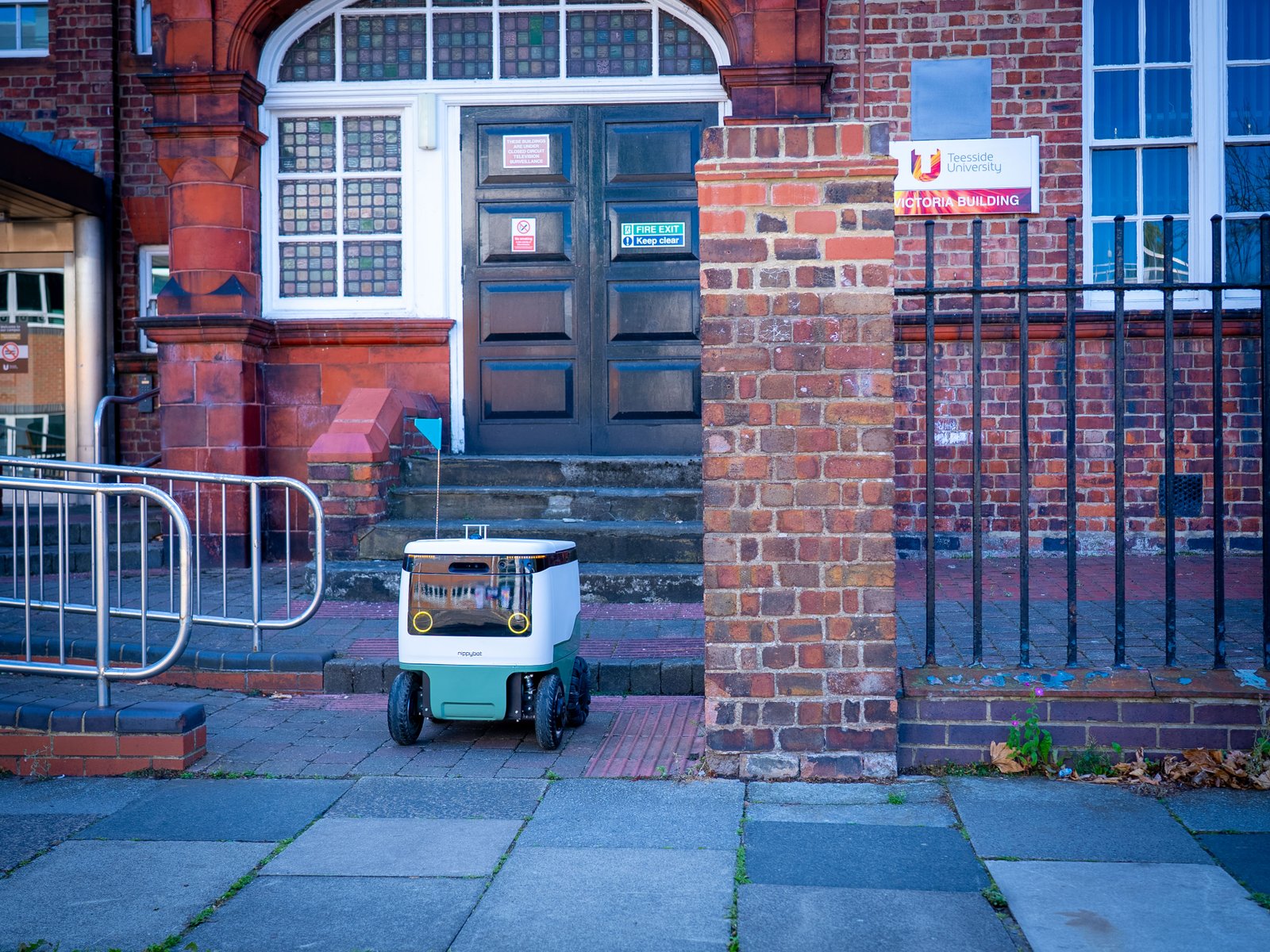
A sidewalk-width delivery robot has been quietly mapping the walkways around Teesside University for weeks, logging routes between the Victoria Building and the pedestrian paths that run through campus. The company behind it, Middlesbrough-based Nippybot, said Thursday it has closed an angel funding round to accelerate deployment of that robot across the United Kingdom, though it has not disclosed the amount raised or named its investors.
Nippybot is a small Teesside startup building compact, battery-powered delivery robots for short, repeated trips through pedestrian areas and controlled sites rather than open public streets. Founder and chief executive Samson Adewole said the company exists to solve a specific operational problem rather than chase a broad delivery-robot vision: "We started Nippybot because we saw an opportunity to build autonomous delivery robots around real operational problems." The company's own site lists its current robot, built roughly 40 centimeters square, with a top speed of 15 kilometers per hour, an eight-hour runtime on a self-charging system, and a payload capacity of up to 100 kilograms, designed to run indoors and outdoors in UK weather.
A Funding Round That Tells You Less Than It Seems To
An undisclosed angel round with no named investors is not, on its own, a strong signal either way. Angel rounds at this stage typically run from a few hundred thousand pounds to the low millions, funded by individuals rather than institutional venture funds, and founders frequently keep both figures private at this point for competitive or negotiating reasons. What the round does confirm is that Nippybot has reached a stage where it is actively raising to fund a specific next phase: building more robots, continuing technology development, and expanding commercial partnerships and real-world deployments, according to the company's own account of its plans.
That is a narrower and more useful signal than the headline figure would have been anyway. A buyer evaluating a seed-stage robotics vendor should weight the stated use of funds more heavily than the round size: a company spending fresh capital on building physical units and signing pilot sites is behaving differently than one spending it on marketing or headcount. Nippybot's stated priorities point toward the former, which is the pattern that logistics, healthcare, and campus operators should want to see before committing to a pilot with any unproven vendor.
Why Controlled Sites, Not Open Streets
Nippybot has deliberately scoped its robot toward the same category of environment that has let a handful of other delivery-robot companies survive where many have not: fixed, semi-private, repeatedly traveled routes rather than unconstrained public sidewalks. The company's target list includes logistics operations, hospitals, universities, and business parks, and it says it is already in discussions with organizations across several of those categories. Robots operating inside hospital corridors, warehouse yards, or a single campus face a dramatically smaller set of edge cases than a robot navigating an entire town center: fewer unpredictable pedestrians, no mixed traffic at junctions, and an operator who controls the physical environment the robot moves through.
That scoping decision carries a commercial logic that procurement teams evaluating any short-haul delivery robot should recognize. The failure mode for sidewalk and campus robots has rarely been the robot's basic navigation; it has been the long tail of situations a closed environment eliminates by design. Nippybot's own technology description leans into this constraint rather than away from it, combining autonomous navigation with what the company calls remote operational capability, meaning a human can intervene when needed while the robot completes most deliveries unassisted. That hybrid model, pairing autonomy with a remote fallback, has become close to standard practice across the sector precisely because fully unsupervised operation in anything but a controlled site remains commercially risky.
The company has used its home region, the Tees Valley in Northeast England, as both its development base and its first test environment, a pattern that gives it a geographic concentration advantage: shorter feedback loops between engineering and the physical robot, and a visible local presence that has already produced some regional recognition, including a Tech Startup of the Year award from the Black Business and Tech Awards covering the Tees Valley, and a meeting with Middlesbrough's mayor to discuss partnerships. None of that substitutes for commercial traction, but it does suggest a company building relationships with the institutions, universities, hospitals, and local authorities, it would need as reference customers before it can credibly pitch outside its home region.
The Pattern Other Campus Robots Have Already Set
Nippybot is entering a category that already has a track record, which is useful context for judging how realistic its ambitions are. Sidewalk and campus delivery robots from established operators have been running on university grounds and business campuses in the United States and Europe for several years, and the lesson from that history is consistent: the robots that survived did so by staying inside geofenced, operator-controlled sites rather than expanding into open public streets on anyone's original timetable. Expansion into unconstrained environments has tended to come years after a company proved reliability on campus, not as a first move. Nippybot's stated focus on hospitals, universities, and business parks tracks that same sequencing, which is the sensible path rather than a shortcut, but it also means the company is years, not months, away from the kind of open-street deployment that would make it a household name outside logistics and facilities circles.
That slower, narrower path also shapes the commercial model a buyer should expect to negotiate. Robot-as-a-service pricing, where a site operator pays a recurring fee rather than buying hardware outright, has become the default structure across this category because it shifts maintenance and software-update risk onto the vendor, who is usually better positioned to absorb it at this stage than a hospital estates team or a university facilities department would be. Any site considering Nippybot should expect, and should ask for, that structure rather than a capital purchase, and should push for contract terms that tie payment to measured uptime rather than to installation alone.
The Liability and Insurance Questions a Funding Announcement Does Not Answer
A funding round says nothing about how a robot is insured, who is liable if it collides with a patient, a student, or stock on a warehouse floor, and how quickly a vendor can respond when a unit breaks down mid-shift at a site with no spare robot. These are the operational questions that determine whether a pilot turns into a multi-site contract, and they fall disproportionately on vendors still building out their support infrastructure. A single-site, pre-scale company such as Nippybot should be expected to answer them directly and specifically rather than in general terms, and a buyer should treat a vague or deflected answer on liability or spare-parts turnaround as a bigger red flag than an undisclosed funding figure.
UK sites also sit inside a regulatory environment for pavement and campus robots that remains a patchwork of local authority permissions and site-specific risk assessments rather than a single national framework built around robots of this kind. That makes a vendor's own experience navigating approvals, insurance, and local authority sign-off at its existing test site a meaningful piece of due diligence in its own right, separate from the robot's technical performance. A company that has already done this work once, as Nippybot appears to be doing at Teesside University, has a repeatable template to offer a second site; a company that has not will be learning that process on the buyer's timeline.
What Buyers Should Actually Ask Before a Pilot
For a procurement or operations team considering any seed-stage delivery robot, Nippybot's current disclosures leave real gaps that matter more than the funding figure. The company has not stated how many robots are currently operating, how many hours of real-world runtime its fleet has logged, or what its fleet-wide reliability and intervention rate looks like outside of controlled testing. It has also not disclosed a founding date, so there is no way from public information to judge how long the current hardware and software stack have been in development versus how recently the company pivoted or iterated toward its present design.
Those are the right questions to ask directly rather than infer from a funding announcement, and they apply to nearly every early-stage delivery-robot vendor, not just this one. A buyer should ask for documented uptime across whatever pilot sites already exist, the actual intervention rate when the remote-operation fallback kicks in, and a clear service-level commitment for parts and support given that a single-site vendor at this stage typically has thin bench strength for field maintenance. Nippybot's listed technology partnerships, which include participation in NVIDIA's Inception program for AI startups and relationships with robotics and logistics firms such as Secnora, Ampoxe, Grishin Robotics, and Beelivery, plus a testbed collaboration with Teesside University, are a reasonable proxy for technical credibility while direct deployment data remains unpublished. They are not, however, a substitute for asking to see that data before signing a pilot agreement.
The broader UK market for short-haul delivery robotics has already shown both how quickly a credible controlled-site deployment can scale and how often funding announcements outrun actual commercial deployment. Operators who have been burned by vendors that raised loudly and delivered slowly have reason to discount headline funding news and instead ask any vendor, Nippybot included, for a reference site they can call directly. A company still in the testing phase on its own campus, as Nippybot currently is, has not yet crossed that threshold, and the honest read of this week's announcement is that it marks the start of a scale-up attempt rather than proof that the scale-up has already worked.
What happens over the next two or three pilot cycles, not this funding round, will be the real test of whether Nippybot's controlled-site strategy converts into paying customers beyond its home region. Buyers evaluating it, or any similarly early vendor, should treat this announcement as a reason to ask for a site visit, not as a reason to sign one.
This article is for general information purposes only and does not constitute investment advice. This analysis synthesizes company statements and public market activity.